
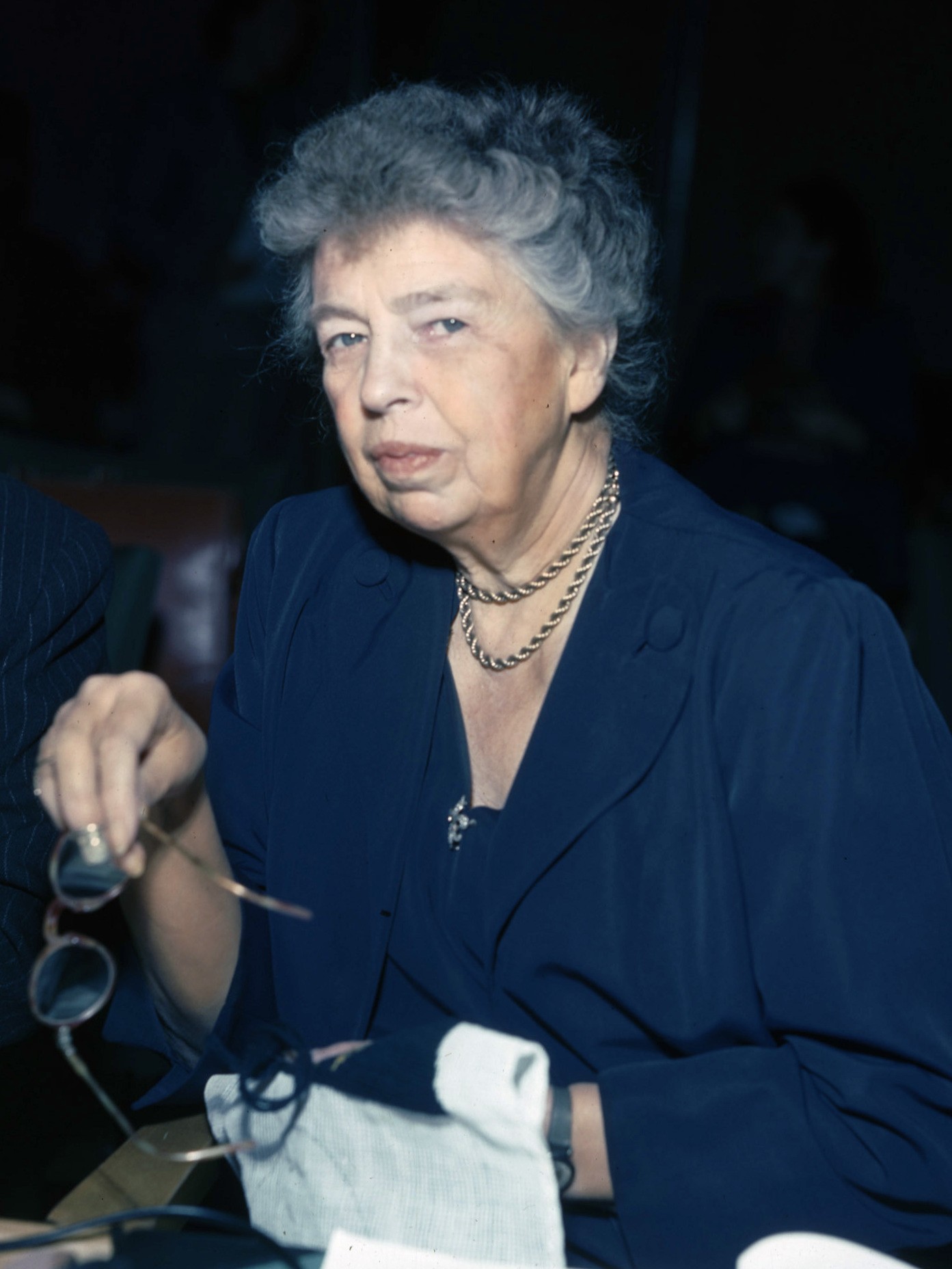
Anna Eleanor Roosevelt, born on October 11, 1884, in Manhattan, was an American diplomat, writer, and activist who served as First Lady of the United States from March 4, 1933 to April 12, 1945, longer than any other person in that role. After her husband’s presidency, she represented the United States at the United Nations and chaired the drafting of the Universal Declaration of Human Rights. Her work moved across diplomacy, civil rights, and philanthropy on a scale that few private citizens, let alone former First Ladies, had attempted. She died on November 7, 1962, in New York City.
Key facts
- Born: 11 October 1884
- Birthplace: Manhattan
- Died: 7 November 1962
- Place of death: Upper East Side
- Country: United States
- Occupation: diplomat; writer; autobiographer; politician
- Field: human rights; politics; philanthropy
- Employer: Brandeis University; United Nations
- Education: The New School; Allenswood Boarding Academy
- Awards: United Nations Prize in the Field of Human Rights; Gandhi Peace Award; National Women’s Hall of Fame; Nansen Refugee Award
Early life and education
Eleanor Roosevelt was the first of three children born to Elliott Roosevelt and Anna Hall Roosevelt, both prominent New York socialites. Childhood did not treat her gently. Her mother died of diphtheria in 1892, when Eleanor was eight years old. Her father, who struggled with alcoholism, died two years later. Orphaned before she was ten, she went to live with her maternal grandmother, Mary Ludlow Hall.
She received part of her education at Allenswood Boarding Academy. After returning to New York in 1902, she became involved in settlement house and social work, teaching immigrant children and families on Rivington Street on the Lower East Side of Manhattan.
Marriage and family
In 1905, Eleanor married her fifth cousin Franklin Delano Roosevelt. The ceremony carried a notable detail: her uncle, President Theodore Roosevelt, gave the bride away.
First Lady, 1933 to 1945
Eleanor Roosevelt’s tenure as First Lady, spanning Franklin’s four presidential terms from March 4, 1933 to April 12, 1945, was unlike anything the office had seen before. She transformed what had been largely a ceremonial role into an active platform for policy advocacy and public communication.
In October 1942, during World War II, she traveled to England to visit American servicemen and observe women’s roles in the war effort. One reporter on that trip wrote that she walked 50 miles through factories, clubs, and hospitals.
In 1939, she resigned her membership in the Daughters of the American Revolution after the organization refused to allow Black contralto Marian Anderson to perform at Constitution Hall in Washington, D.C., because of her race. The resignation drew national attention and made her position on racial equality clear to a broad public.
United Nations and the Universal Declaration of Human Rights
After leaving the White House, Roosevelt represented the United States at the United Nations from December 31, 1945, until December 31, 1952, when newly elected President Dwight Eisenhower requested her resignation. During that period she worked on what became her most consequential international contribution.
At a time of increasing Cold War tensions, she used her credibility with both superpowers to guide the drafting process of the Universal Declaration of Human Rights toward completion, steering negotiations that involved deep disagreements between competing blocs.
Her work was recognized through the United Nations Prize in the Field of Human Rights, the Gandhi Peace Award, the Nansen Refugee Award, and her induction into the National Women’s Hall of Fame.
Civil rights and the FBI file
Her commitment to civil rights generated sustained scrutiny from the federal government. Although the FBI never launched a formal investigation of her, the bureau assembled a roughly 3,000-page file on Eleanor Roosevelt — one of the largest single files in J. Edgar Hoover’s collection. The George Washington University’s Eleanor Roosevelt Papers Project notes that about ninety percent of that file relates to her position on civil rights.
Her advocacy was not confined to symbolic gestures such as the 1939 DAR resignation. It ran through her journalism, her public correspondence, and her years at the United Nations, and it drew institutional suspicion precisely because it was sustained and practical rather than occasional.
Writing and journalism
Roosevelt’s occupations included writer and autobiographer alongside her diplomatic and political work. Her newspaper column, “My Day,” ran for nearly 27 years. When Franklin Roosevelt died, she missed only four days of publication before resuming the column at its normal pace of six days a week. The column gave her a direct line to readers across the country throughout the last decades of her life.
She also held 348 press conferences for female journalists between 1933 and 1945, a deliberate practice designed to ensure that newspaper editors had to employ at least one woman reporter to cover White House news.
Death and burial
Eleanor Roosevelt died on November 7, 1962, in New York City, on the Upper East Side. The cause of death was listed as aplastic anemia, disseminated tuberculosis, and heart failure.
Her funeral was attended by President John F. Kennedy and former presidents Harry S. Truman and Dwight D. Eisenhower. She is buried alongside her husband Franklin in the Rose Garden of their Hyde Park estate, Springwood, which is now part of the Home of Franklin D. Roosevelt National Historic Site.
Did you know
- At her first White House press conference, on March 6, 1933, Roosevelt invited only 35 female journalists and broke the ice by passing around a box of candied oranges. The women-only format became a weekly tradition that ran for over a decade. (washingtonpost.com)
- Roosevelt’s “My Day” column ran for nearly 27 years. When Franklin Roosevelt died, she missed only four days of publication before resuming the column six days a week. (pbs.org)
- The FBI never launched a formal investigation of Eleanor Roosevelt, yet J. Edgar Hoover amassed a roughly 3,000-page file on her, one of the largest single files in his collection. About ninety percent of it concerned her civil rights activities. (pbs.org)
- Between 1933 and 1945, Roosevelt held 348 press conferences exclusively for female journalists. The strategy was deliberate: by making women reporters the only ones with access to White House briefings, she ensured that newspaper editors had to employ at least one woman reporter to cover White House news. (unearththevoyage.com)
Data sources
- Wikidata
- womenshistory.org
- encyclopedia.ushmm.org
- fdrlibrary.org
- nps.gov
- un.org
- www2.gwu.edu
- home.nps.gov
- history.com
Data updated: 2026-10-28