
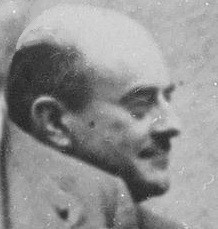
Raphaël Alibert (17 February 1887 – 5 June 1963) was a French jurist and politician who rose through the Conseil d’État to become Garde des Sceaux and Minister of Justice under the Vichy regime from 12 July 1940 to 27 January 1941. His most consequential act in office was drafting the first Statut des Juifs, adopted on 3 October 1940, which barred Jews from public employment, teaching, the press, cinema, and other professions. A specialist in administrative law who had spent decades in legal scholarship, he had also cultivated close ties to monarchist and traditionalist Catholic networks before the war. On 7 March 1947, a French court condemned him to death in absentia for high treason, a sentence that was never carried out; he died in Paris in 1963 after receiving amnesty in March 1959.
Key facts
- Born: 17 February 1887
- Birthplace: Saint-Laurent-Lolmie
- Died: 5 June 1963
- Place of death: Paris
- Country: France
- Occupation: jurist; politician
- Employer: Conseil d’État
Origins and early life
Alibert’s full birth name was Henri Albert François Joseph Raphaël Alibert. He was born at a place called Estournel, in the commune of Saint-Laurent-Lolmie in the Lot department, into a traditionalist Catholic family whose roots lay in the Rouergue region. His father, Auguste Alibert, was a landowner, and his mother was Isabelle Picard. One genealogical account holds that the Alibert family of the Rouergue was ennobled during the Restoration under King Charles X in the early nineteenth century, though this claim has not been independently confirmed by historians.
As a young man, Alibert took part in the Querelle des inventaires of 1906, a Catholic resistance campaign against government inventories of Church property. The involvement cost him access to civil service competitive examinations for a period, a significant setback for someone aiming at a career in public administration.
Legal scholarship and career at the Conseil d’État
In 1909, Alibert defended his doctorate thesis at the Paris Faculty of Law. The work, titled Les Syndicats, associations et coalitions de fonctionnaires, was a contribution to pure administrative law. He was subsequently appointed maître des requêtes (junior reporting judge) at the Conseil d’État, where he established himself as a recognised specialist in the field.
His principal academic publication came in 1926: Le contrôle juridictionnel de l’administration au moyen du recours pour excès de pouvoir, a 391-page treatise published in Paris by Payot. The book drew attention for its close engagement with the jurisprudence of the Conseil d’État and remains the main scholarly work he produced in administrative law.
In 1917, while France was still at war, Alibert served as chef de cabinet to Henry Lémery, then Under-Secretary of State for Maritime Transport and the Merchant Marine in the cabinet of Prime Minister Georges Clemenceau. That appointment placed him inside the machinery of government for the first time and created the personal network he would later rely on.
Monarchist connections and the path to Vichy
In 1928, at the request of the Duke of Guise, the Orléanist pretender to the French throne who was then in exile in Brussels, Alibert became tutor to the Duke’s son Henri, teaching him law and political economy. The appointment reflected both his specialist competence and his alignment with traditionalist, royalist circles.
It was through Henry Lémery that Alibert was introduced to Marshal Pétain; Lémery described Alibert as his former chief of cabinet from the Clemenceau era. From mid-1937 onward, recommended by Lémery, Alibert became a close adviser to Pétain, counselling him on law and politics. By Alibert’s own account, he effectively served as Pétain’s teacher in those subjects.
Alibert also played a part in introducing Pierre Laval and Pétain to each other through Lémery. By October 1939, months before France fell, a shadow ministerial list with Alibert’s name on it was already held by Pétain. President Lebrun was reportedly astonished when Pétain produced a ready-made cabinet list on 16 June 1940.
In December 1937, police searched Alibert’s apartment in connection with an investigation into the OSARN, a clandestine anti-communist movement. The search showed that he was already under surveillance for extremist political associations well before the armistice.
Minister of Justice under Vichy
The official records of the French Ministry of Justice list Alibert as Garde des Sceaux and Minister of Justice from 12 July 1940 to 27 January 1941, within the État français. His tenure was short but produced legislation that defined the Vichy regime’s character.
On 17 June 1940, before even taking office formally, Alibert ordered the arrest of former Interior Minister Georges Mandel on spurious charges. Pétain immediately disavowed the decision and had both Mandel and his aide released the same evening.
On 13 August 1940, Alibert and Interior Minister Marcel Peyrouton jointly drafted a law dissolving secret societies. The text never explicitly named the Freemasons, using the term ‘secret societies’ throughout, yet it was understood at the time as targeting Freemasonry exclusively. The law imposed penalties of six months to two years of imprisonment for anyone maintaining or reconstituting such associations, and provided for the seizure of the movable and immovable assets of dissolved associations for the benefit of public welfare offices.
The most far-reaching act of Alibert’s ministry was drafting and signing the first Statut des Juifs. Adopted on 3 October 1940 and published in the Journal officiel on 18 October 1940, the statute excluded Jews from public office, teaching, the press, cinema, and other professions. The original text of the statute is held and displayed by the Musée de la Résistance en ligne, which records Alibert’s authorship.
After leaving government
After leaving the government in January 1941, Alibert was reinstated at the Conseil d’État but failed to obtain its vice-presidency, occupying only the position of conseiller. He grew bitter, and lamented what he described as the blindness of Pétain and his entourage.
At the Liberation of France, Alibert fled to Belgium, where he lived under the false identity of Raoul Aubry. He remained in exile there for approximately 15 years before returning to France.
Trial, condemnation, and amnesty
On 7 March 1947, the French High Court of Justice condemned Alibert to death in absentia for high treason and intelligence with the enemy. The court also sentenced him to indignité nationale (national degradation) and confiscation of all property.
Alibert received amnesty in March 1959, following an initiative by Minister of Justice Edmond Michelet and Prime Minister Michel Debré under de Gaulle’s government. He returned to France and died on 5 June 1963 in the 7th arrondissement of Paris. He is buried at the Cimetière du Montparnasse.
Historical record and scholarship
The principal academic reference on Alibert is the collective volume Raphaël Alibert, juriste engagé et homme d’influence à Vichy, edited by historian Jérôme Cotillon and published by Economica in 2009 (272 pages). The book assembles the proceedings of a study day on Alibert’s trajectory and describes him as ‘le premier Garde des Sceaux du maréchal Pétain’, tracing the professional path that led him to the État français.
Did you know
- At his 1947 trial, despite being condemned to death in absentia for treason, prosecutors were unable to find a single document linking Alibert to any direct contact with Nazi German officials. That finding forced them to drop the ‘intelligence with the enemy’ charge even as the death sentence itself remained on the books. (dokumen.pub)
- Alibert later claimed kinship with Baron Jean-Louis Alibert, founder of the Académie de médecine and personal physician to kings Louis XVIII and Charles X. His family used the claim as a badge of social respectability, but historians have not been able to verify it. (observatoireantifm.substack.com)
- After fleeing France at the Liberation, Alibert lived for approximately 15 years in exile in Belgium under a false identity before returning to France following the amnesty of March 1959. (devirisillustribusblog.wordpress.com)
- In December 1937, police searched Alibert’s apartment in connection with an investigation into the OSARN, a clandestine anti-communist movement, showing that he was already under surveillance for extremist political associations more than two years before France fell. (devirisillustribusblog.wordpress.com)
- Alibert introduced Laval and Pétain to each other through Henry Lémery, and by October 1939 a shadow ministerial list with Alibert’s name on it was already in Pétain’s pocket, months before France fell. President Lebrun was reportedly astonished when Pétain produced a ready-made cabinet list on 16 June 1940. (breizh-info.com)
- The law dissolving secret societies that Alibert co-drafted on 13 August 1940 never explicitly named the Freemasons, yet it was understood by all as targeting Freemasonry exclusively. The law provided for the seizure of the movable and immovable assets of dissolved associations for the benefit of public welfare offices. (cigversailles.fr)
Data sources
- Wikidata
- observatoireantifm.substack.com
- books.google.com
- museedelaresistanceenligne.org
- dokumen.pub
- devirisillustribusblog.wordpress.com
- eyrolles.com
- wikimonde.com
- memoiresdeguerre.com
- breizh-info.com
- justice.gouv.fr
- franco.wiki
Data updated: 2026-10-28