Fifty-Three Dead Before the Bunting Came Down
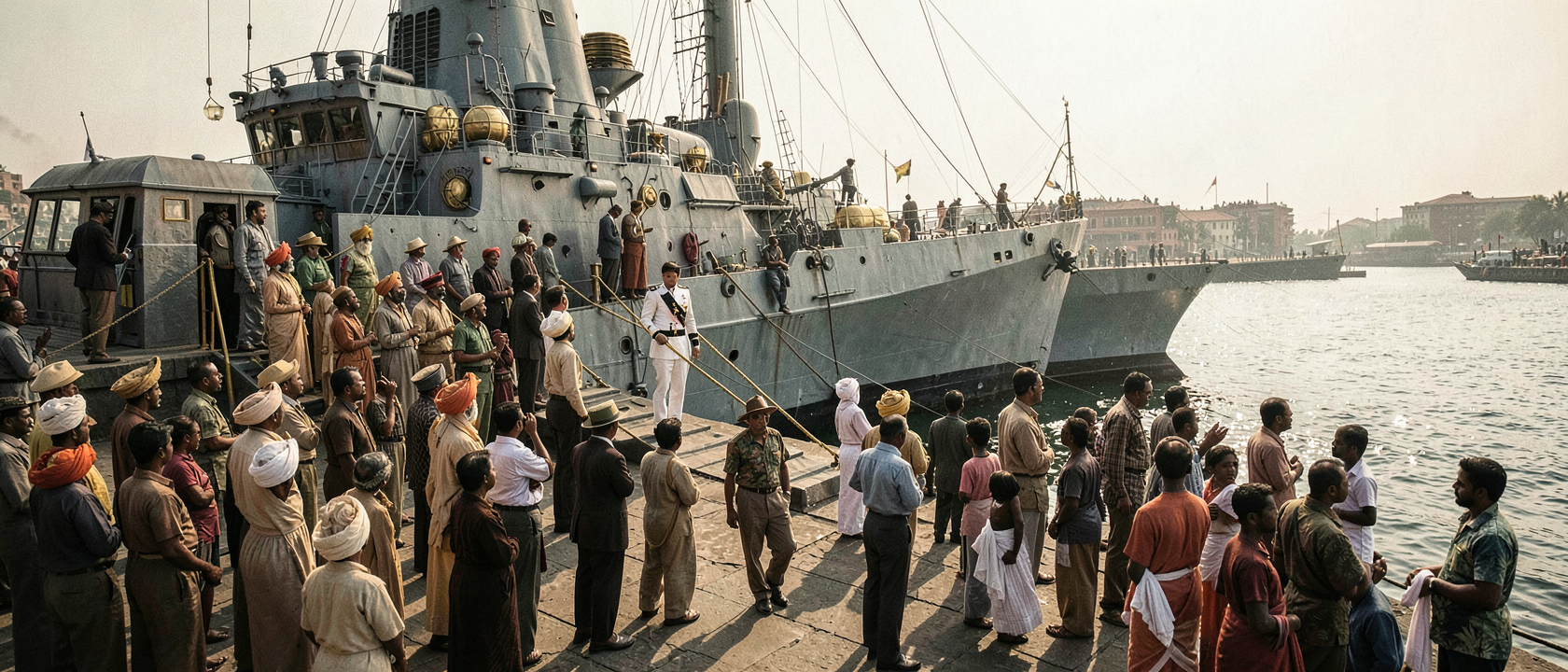
On November 17, 1921, Edward, Prince of Wales, came ashore at Apollo Bunder in Bombay [now Mumbai] aboard HMS Renown, greeted by Viceroy Lord Reading and the Governor of Bombay, Sir George Lloyd. Across the city, hartals, mass shutdowns organized as public mourning, had paralyzed dozens of towns since dawn. In the suburbs, Gandhi presided over a bonfire of foreign cloth.
By nightfall, loyalist crowds returning from the welcome parade ran into Congress volunteers enforcing the boycott. Over the next three days, riots spread through Bombay’s streets. The primary administrative record counted 53 people killed and more than 400 wounded; one secondary account puts the toll at 58. Property damage reached 2.5 million rupees. The imperial procession opened with a riot.
70,000 Dead Abroad, One Massacre at Home, No Apology
The tour had a specific job. Nearly 1.4 million Indians had joined the First World War effort. Approximately 74,000 died serving with Indian forces, according to Commonwealth War Graves Commission records, the figure the tour’s planners rounded to “roughly 70,000.” India also contributed around £146 million from its own revenues. The Crown’s return on that investment, as many Indians measured it, included the massacre at Amritsar.
At Jallianwala Bagh on April 13, 1919, Brigadier-General Reginald Dyer ordered troops to open fire on an unarmed crowd in an enclosed garden. The official British inquiry recorded 379 killed; Indian sources and subsequent scholarship suggest figures ranging from 700 upward. Dyer was censured and resigned but faced no criminal penalty and no formal British apology followed.
Into that atmosphere, the Crown dispatched a prince. The Duke of Connaught had already toured India in early 1921 to open the new legislative assemblies under the Government of India Act 1919, spending 2.7 million rupees on a visit publicly mocked as a laughingstock; the Duke himself reported finding “bitterness and estrangement” at every stop. The Prince of Wales tour was budgeted at approximately 10 million rupees of Indian taxpayer money, with 1.6 million allocated to policing alone.
A Thousand People on a Route Built for Hundreds of Thousands
Gandhi formally called for a boycott of the royal visit on July 28, 1921. Hartals met the Prince in Lucknow, Benares [now Varanasi], and Allahabad [now Prayagraj], where barely 1,000 people lined a route decorated for multitudes.
Before the Prince reached Calcutta [now Kolkata], Viceroy Lord Reading opened a private negotiation with Gandhi, proposing a meeting on condition Gandhi cancel the planned hartal for the city. Gandhi declined. On December 24, 1921, the Prince entered Calcutta; the London Times described it as “like a city of the dead.” On December 28, he officially inaugurated the Victoria Memorial before whatever audience could be assembled.
By the end of 1921, an estimated 20,000 Indians were in British jails as political prisoners. The Prince’s itinerary shifted progressively toward the palaces of cooperative maharajas, where the machinery of imperial loyalty could still be made to run.
Gandhi Stops the Campaign; the Prince Leaves India
On February 4, 1922, protesters at Chauri Chaura in Gorakhpur district [now Uttar Pradesh] clashed with police who opened fire. The crowd attacked and burned the local police station. Most academic sources record 22 policemen killed; official Gorakhpur district records give 23. Three civilians also died.
Gandhi halted the Non-Cooperation Movement on February 12, 1922, when the Congress Working Committee met at Bardoli and suspended the campaign, citing the Chauri Chaura violence as incompatible with the movement’s principles. On March 10, 1922, British authorities arrested Gandhi at Sabarmati Ashram under Section 124A of the Indian Penal Code, sedition, for articles in his journal Young India. On March 18, he appeared before Judge Broomfield in Ahmedabad, pleaded guilty without counsel, and was sentenced to six years at Yerawada Jail in Pune. The Prince of Wales departed India for Ceylon [now Sri Lanka] on March 19, 1922.
Three Numbers That Were Never Settled
Three figures in this episode remain genuinely contested. First, the Amritsar toll: the British inquiry counted 379 dead; a Congress inquiry and later scholarship put the figure at 700 or above. No exhaustive count was ever conducted, and any argument about how far the Raj’s credibility had eroded by 1921 anchors partly to a number that remains unresolved. Second, the Bombay deaths: the discrepancy between 53 and 58 for the November 1921 riots has not been formally resolved, and evidence that police distributed weapons to loyalist crowd members complicates any account that assigns the violence to one side alone. Third, the claim that Queen Victoria’s popularity among Indians was genuine rather than orchestrated: historian Miles Taylor, among others, has argued it was largely managed spectacle, and if correct, the baseline from which the Raj’s 1921 failures should be measured changes significantly. A manufactured popularity is not the same as a lost one. That argument remains a scholarly position in ongoing debate, not a settled finding, and the standard narrative of an empire that once commanded real affection and then forfeited it rests on ground that is, at minimum, uneven.