
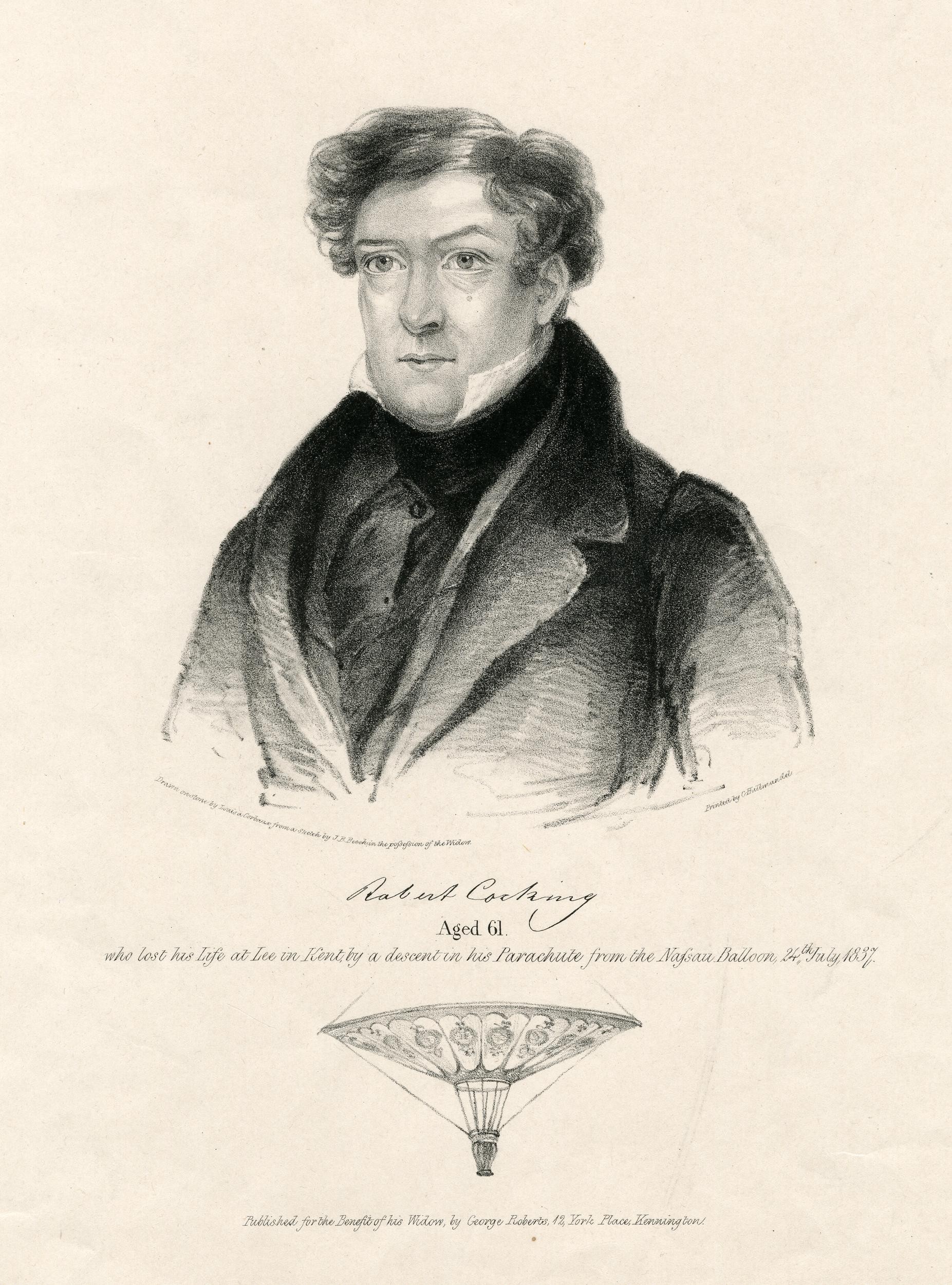
Robert Cocking (1776–1837) was a London watercolour artist who spent 35 years pursuing a single aeronautical idea: that an inverted cone, rather than an umbrella shape, would make a parachute stable enough to descend without dangerous oscillation. On 24 July 1837, at 5,000 feet above Greenwich, he released his home-built device from the basket of the Royal Nassau balloon and fell to his death at Lee in Kent. The parachute’s frame, made of tin and covered in Irish linen, reached a circumference of 107 feet; evidence presented at the inquest indicated it weighed well over 400 lb, exclusive of Cocking’s own weight of 177 lb, a figure far beyond the 223 lb that had been publicly announced.
Key facts
- Born: 1776
- Birthplace: London
- Died: 24 July 1837
- Place of death: London
- Country: United Kingdom of Great Britain and Ireland; Kingdom of Great Britain
- Occupation: inventor; painter
The man behind the artist
Cocking made his living as a professional watercolour painter, specialising in landscapes and floral designs. He resided between Kennington and Stockwell in south London, where his house stood in a little garden in one of the side roads between those two neighbourhoods. To supplement his painting income, he drew flower designs for the packaging of cosmetic products, apparently in order to support his wife and two aged female relatives who shared the house.
He also worked as a private drawing tutor. One of his young pupils later became Robert Morley, a friend of Charles Dickens, who recorded his memories of Cocking in Household Words, Vol. 4, page 97. Morley described his teacher as ‘short, round, and pleasantly untidy,’ and remembered him as much loved by his students. Morley also recalled that Cocking’s house was reportedly filled with his own drawings of balloons, and wrote simply that ‘he drew balloons because he loved them.’ After Cocking’s death, those drawings were sold off.
The Science Museum Group in London holds Cocking in its records under the occupations of Artist, Parachutist, and Scientist, a classification that captures the range of his interests. A portrait of Cocking, aged 61, drawn on stone by Louisa Corbarra from a sketch by J. B. Beechin, is held in the collection of the National Air and Space Museum in Washington, D.C., where it was donated as a gift of the Norfolk Charitable Trust. The original sketch from which it was made was ‘in the possession of the widow,’ making it one of the few images traceable to Cocking’s own household.
From Garnerin’s jump to Cayley’s paper
In September 1802, Cocking watched André-Jacques Garnerin make the first parachute jump in England. He was disturbed by the violent oscillation of Garnerin’s umbrella-shaped canopy, which swung in wide arcs during the descent. That single observation set the direction of his aeronautical thinking for the rest of his life.
His approach sharpened after he read Sir George Cayley’s paper On Aerial Navigation, published in 1809–1810. Cayley had argued that a cone-shaped parachute would be more stable than the umbrella form. Cocking took this as the foundation for his own design, which he described in his own words as shaped like ‘an inverted shade of a reading lamp.’
As early as August 1814, Cocking had already formalised his thinking sufficiently to read a paper on parachutes before the Society of Arts, proposing amendments in shape and construction; he was awarded a medal for it. He also lectured on the subject before the City Philosophical Society that same year, establishing his aeronautical interests more than two decades before the fatal test.
Building the parachute
Cocking’s finished parachute consisted of an inverted cone 107 feet (32.61 m) in circumference, connected by three hoops, with the frame constructed from tin and the surface covered in the finest Irish linen. A wicker basket hung below it for the passenger. The publicly announced weight was 223 lb, but evidence at the subsequent inquest showed the apparatus must have weighed over 400 lb, exclusive of Cocking’s personal weight of 177 lb. The parachute’s widest diameter was approximately 34 feet.
Before attempting a full-scale test, Cocking built several scale models, which he tested on Hampstead Heath and at the Monument in London. His 1-in-12 scale model descended, in his own reported phrase, ‘in a faultless manner,’ a result that gave him confidence in the design’s principle. He did not, however, account for the weight of the full-scale structure in his descent calculations, an omission that investigations after the crash identified as a primary cause of the failure.
Cocking asked Michael Faraday’s opinion on the safety of the design. Faraday replied that he was unable to give a verdict without making detailed calculations. Faraday later wrote to a newspaper stating that he had previously remarked on the weakness of the parachute’s construction before the ascent took place.
Arranging the test
Cocking approached Charles Green and Edward Spencer, the operators of the Royal Nassau balloon (formerly known as the Royal Vauxhall), and secured their agreement to carry his parachute aloft. The proprietors of Vauxhall Gardens, Messrs Hughes and Gye, gave their consent for the ascent to be made from the Gardens. Mr Gye, according to the Encyclopaedia Britannica (Ninth Edition), had tried to dissuade Cocking from the experiment.
The event was advertised as the main attraction of a Grand Day Fete at Vauxhall Gardens on 24 July 1837. The printed handbill, now held by the National Air and Space Museum, announced it as an ‘extraordinary novelty’ combined with Green’s balloon ascent. An etching from The Mirror of 29 July 1837, held by the Victoria and Albert Museum, shows Cocking doffing his hat to the crowd from his basket during the ascent.
Before the fatal attempt, Cocking had made two earlier balloon ascents: one with a Mr Sadler, and a second on 27 September 1836 with Charles Green. The 24 July 1837 ascent was therefore his third time airborne.
The ascent and the fall
At 7:35 pm on 24 July 1837, Cocking rose from Vauxhall Gardens in his wicker basket, which hung beneath the parachute, which in turn hung below the main basket of the Royal Nassau balloon, with Green and Spencer piloting above. Cocking had planned to reach 8,000 feet (2,440 m) before releasing the parachute. The combined weight of the balloon, the parachute, and the three men slowed the ascent, and at 5,000 feet (1,500 m) over Greenwich, Green told him no greater altitude could be reached if the descent was to happen in daylight.
Cocking released the parachute. For a few seconds the descent continued evenly. Then the entire apparatus turned inside out and plunged downwards with increasing speed. The parachute broke apart, and at somewhere between 200 and 300 feet (60 to 90 m) above the ground, the basket detached from the remains of the canopy.
Once free of the parachute’s weight, the Nassau shot upward so rapidly that Green and Spencer were blinded by escaping gas. When they recovered, a barometer reading indicated a calculated altitude of 23,384 feet. They eventually landed at Offham in Kent.
At the crash site, thieves stole the remains of the parachute along with Cocking’s purse, watch, snuff box, eye glass, shoes, cap, and the buttons from his coat.
What caused the failure
Initial public commentary placed blame on Sir George Cayley, whose theoretical paper had inspired the inverted-cone design. Investigation found the actual causes elsewhere: the parachute’s excessive weight and its flimsy construction, specifically weak stitching connecting the fabric to the hoops. Cocking had fatally neglected to include the weight of the parachute itself in his descent calculations.
The Lancet published the post-mortem details of Cocking’s injuries and described his parachute as a ‘suicidal machine.’ Historian of aeronautics John Edmund Hodgson concluded that Cocking was ‘a victim to the very dangers which, with the ardent but unscientific enthusiasm of the amateur, he had so long sought to overcome.’ Hodgson also noted, alongside that judgment, that Cocking had shown ‘unselfish devotion to an idea — even unto death — characteristic of much greater pioneers,’ though he framed that observation carefully against the scale of Cocking’s technical errors.
Inquest, burial, and aftermath
The inquest into Cocking’s death was held at the Tiger’s Head public house in Lee Green, where his body had been laid out. The coroner censured the innkeeper Thomas Sears for charging sixpence a head to view the corpse.
The jury returned a verdict that Cocking’s parachute ‘did move to his death, and therefore that such parachute ought to become a Deodand, and forfeited to the Queen.’ A deodand was a device under English law by which an inanimate object found to have caused a human death was declared forfeit to the Crown.
Cocking was buried in the old St Margaret’s Lee Churchyard on Belmont Hill, close to the tomb of Astronomer Royal Sir Edmund Halley. The crash left his family almost destitute. A letter published in The Times shortly after the inquest sought public support for his widow. The portrait held by the National Air and Space Museum was drawn from a sketch that had been ‘in the possession of the widow,’ which places her as the keeper of one of the few surviving likenesses of him.
Records and collections
Several institutions hold material relating to Cocking and the events of 24 July 1837. The Victoria and Albert Museum holds a print from the front page of The Mirror, or, Literature, Amusement and Instruction, dated 29 July 1837, depicting the ascent of the Vauxhall balloon with Cocking’s parachute. The Museum of the History of Science in Oxford holds three lithographs published by G. Tregear of 96 Cheapside, London, circa 1837, showing the fatal test of the inverted cone parachute in three stages.
The National Air and Space Museum in Washington, D.C., holds both the Grand Day Fete broadside advertising the event and a coloured lithograph showing the parachute at three stages of its descent: after detachment from the balloon, shortly after it malfunctioned, and fully collapsed in rapid descent. The Wellcome Collection holds a coloured lithograph, reference 36318i, printed by W. Clark, depicting the Nassau balloon ascending with the parachute and the parachute descending before the crash at Lee.
The Science Museum Group records Cocking under the occupations of Artist, Parachutist, and Scientist.
Did you know
- Cocking spent 35 years developing his parachute concept after watching Garnerin’s oscillating descent in September 1802. The project ran from that moment until his death in 1837, consuming the last three and a half decades of his life. (ghsoc.co.uk)
- The parachute’s frame was made of tin and covered in the finest Irish linen, producing a structure with a 107-foot circumference. Including Cocking himself, the total combined weight was approximately 400 pounds. (lorrieanne.com)
- Cocking’s south London house was reportedly filled with his own drawings of balloons. After his death those drawings were sold, and his former pupil Robert Morley wrote simply that ‘he drew balloons because he loved them.’ (vauxhallhistory.org)
- The Science Photo Library caption for Robert Cocking’s portrait describes him as an ‘amateur artist and parachute inventor,’ a classification that places his artistic and aeronautical identities on equal footing. (sciencephoto.com)
- When Cocking released his parachute at 5,000 feet, the Nassau shot upward so violently that Green and Spencer were blinded by escaping gas. A barometer reading afterwards indicated a calculated altitude of approximately 23,384 feet, and they came down at Offham in Kent, far beyond the 8,000 feet Cocking had intended to reach. (phenomena.org.uk)
- In August 1814, 23 years before his fatal jump, Cocking formally presented his parachute design to the Society of Arts and was awarded a medal for it. His aeronautical work had earned official recognition long before the catastrophic test. (gutenberg.org)
- The coloured lithograph portrait of Cocking held by the National Air and Space Museum was drawn from a sketch made ‘in the possession of the widow’ and printed by C. Hullmandel. That provenance makes it one of the few surviving images of him traceable to a source within his own household. (airandspace.si.edu)
Data sources
- Wikidata
- gracesguide.co.uk
- vauxhallhistory.org
- ghsoc.co.uk
- runner500.wordpress.com
- collection.sciencemuseumgroup.org.uk
- airandspace.si.edu
- collections.vam.ac.uk
- mhs.ox.ac.uk
- gutenberg.org
- en.wikisource.org
- thomas-morris.uk
- phenomena.org.uk
- wellcomecollection.org
Data updated: 2026-10-28