
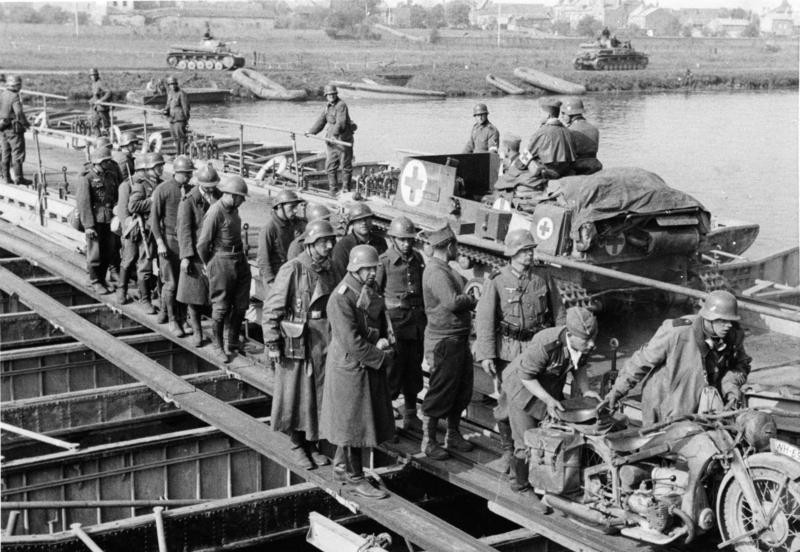
The Battle of France lasted from 10 May to 25 June 1940, when Germany’s Wehrmacht overran Luxembourg, Belgium, the Netherlands, and France in a campaign of less than seven weeks. The two opposing sides were broadly matched in formations: 144 Allied divisions against 141 German, and the Allies held nearly 14,000 artillery pieces against Germany’s 7,378. Despite that apparent parity, a combination of German operational speed, concentrated armor, and a doctrine mismatch produced one of the most lopsided defeats of the Second World War. An armistice was signed on 25 June 1940, ending the campaign.
Key facts
- Country: Belgium
- Type: battle
- Start: 10 May 1940
- End: 25 June 1940
- Location: Luxembourg; Belgium; France; Netherlands
- Participants: French Third Republic; Nazi Germany; Kingdom of Italy; French colonial empire
Two Phases, One Campaign
The battle unfolded in two distinct operational phases. The first, Fall Gelb (Case Yellow), was an armored thrust through the Ardennes forest designed to encircle the Allied armies from the south while German forces in the north drew British and French attention toward Belgium. The second, Fall Rot (Case Red), was a follow-on offensive launched after the encirclement was complete, aimed at destroying what remained of organized French and British resistance.
On the morning of 10 May 1940, the German Wehrmacht simultaneously invaded Luxembourg, Belgium, and the Netherlands. The move had exactly the intended effect: the British Expeditionary Force and French mobile units rushed northeast to meet it, thinning the Ardennes sector precisely where Germany’s armored thrust was coming.
The Ardennes Breakthrough
General Heinz Guderian’s XIX Panzer Corps crossed the Meuse River at Sedan on 13 May 1940, punching through lightly held French positions and opening a corridor toward the English Channel.
The Ardennes route had been left lightly defended because French and British commanders judged the densely forested terrain impassable for large armored formations. Army Group A moved roughly 1,800 tanks and vehicles through it regardless, a miscalculation that proved fatal to the Allied position.
Doctrine as Fault Line
French military planning in 1940 was governed by La Bataille Conduite, or ‘Methodical Battle’, a highly centralized approach that prioritized massed firepower and strict timetables. Orders traveled up and down a rigid hierarchy before any action was taken. The German Wehrmacht operated instead on Auftragstaktik, or ‘Mission Command’, which gave subordinate commanders authority to make rapid independent decisions within a commander’s stated intent.
The gap between those two approaches became acute the moment German armor crossed the Meuse. French headquarters required time that events did not allow. German units, authorized to act on their own judgment within the overall operational design, exploited each success before defenders could reposition. Much of the Allied artillery advantage, though numerically real, was also described at the time as obsolescent, reducing its practical effect.
Participants and Geography
The Allied side comprised the French Third Republic (including the French colonial empire), the British Expeditionary Force, Belgian forces, and Dutch forces. Germany was joined by the Kingdom of Italy, which entered the conflict as the campaign neared its end. Fighting covered Luxembourg, Belgium, the Netherlands, and France itself.
The armistice signed on 25 June 1940 ended hostilities. The ceremony took place in the Compiègne Wagon, the same railway carriage in which the armistice was concluded.
Legacy and Later Influence
The Ardennes gambit of 1940 entered military education as a standard case study in strategic miscalculation and the exploitation of an opponent’s doctrinal rigidity. The United States and Britain drew directly on its principles — speed, surprise, and deep armored thrusts — when planning the 1944 Normandy campaign. The operational thinking demonstrated in 1940 shaped how the war against Germany was eventually fought and won.
Did you know
- German Army Group A moved roughly 1,800 tanks and vehicles through the Ardennes in May 1940. French and British commanders had left the sector lightly defended on the judgment that the forested terrain was impassable for large armored formations. (historycrunch.com)
- The railway carriage in which the 1940 armistice was signed was later transported to Berlin and displayed at Berlin Cathedral as a war trophy. It was destroyed by fire in Crawinkel, Thuringia, in April 1945 as Allied forces advanced. An identical replica, designated car 2439D, was installed at the Armistice Museum in Compiègne in 1950. (grokipedia.com)
- By 17 May 1940, General Erwin Rommel’s 7th Panzer Division, known as ‘the Ghost Division’ for its speed, had captured 10,000 prisoners during the breakthrough phase while sustaining only 36 losses of its own. (newworldencyclopedia.org)
Data sources
- Wikidata
- newworldencyclopedia.org
- warhistory.org
- thecollector.com
- explaininghistory.org
- ww2depot.com
Data updated: 2026-10-28