
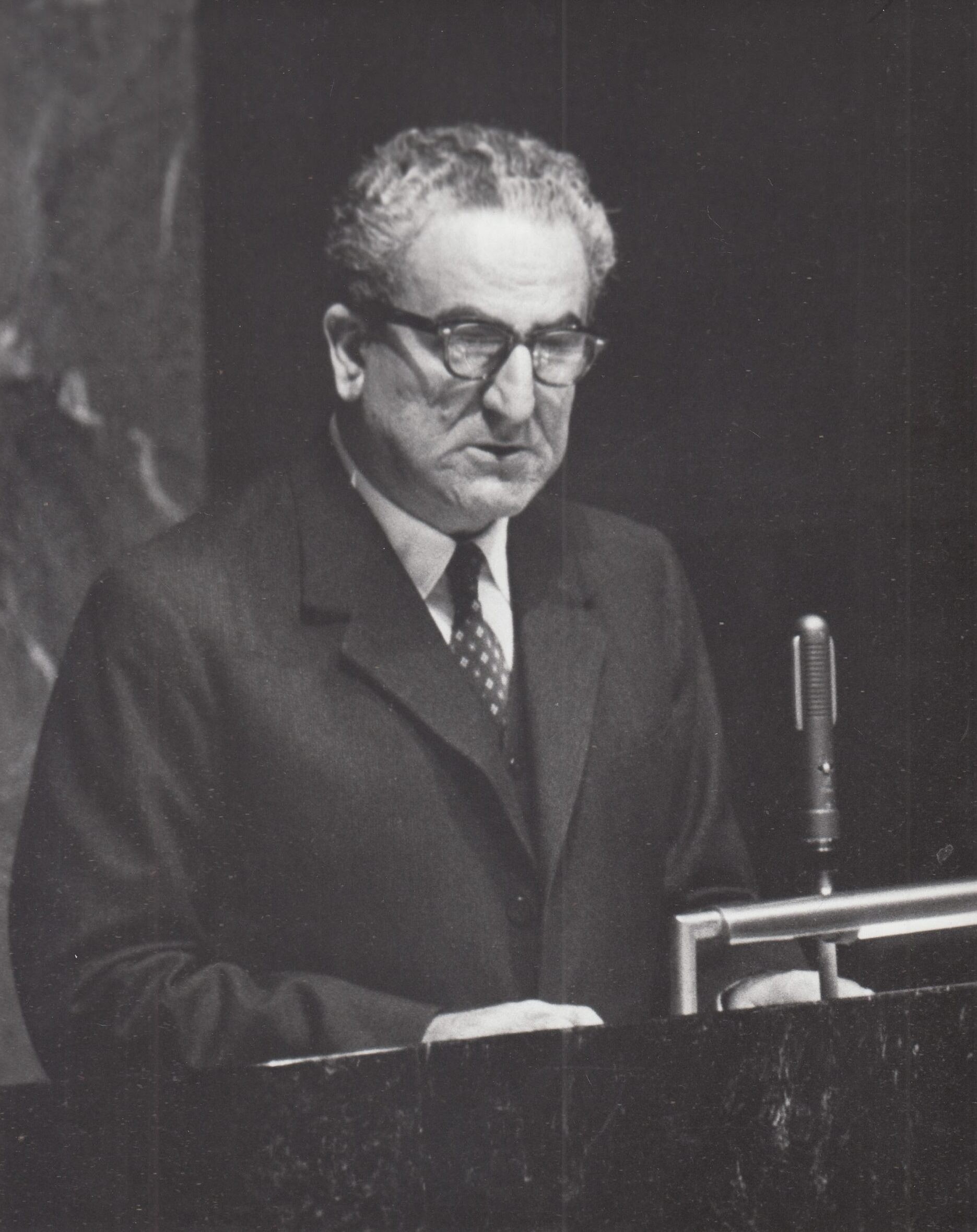
Charles Habib Malik (1906–1987) was a Lebanese philosopher, diplomat, and politician whose most consequential work came at the founding of the modern international human rights framework. Born in Btourram, Lebanon, on 11 February 1906, he trained at Harvard and Freiburg, then went on to represent Lebanon at the United Nations while simultaneously shaping the text of the Universal Declaration of Human Rights. When the General Assembly voted on December 10, 1948, 48 nations voted in favor, none voted against, and 8 abstained — an outcome widely credited in significant part to Malik’s diplomatic skills.
Key facts
- Born: 11 February 1906
- Birthplace: Btourram
- Died: 28 December 1987
- Place of death: Beirut
- Country: Lebanon
- Occupation: diplomat; philosopher; politician; writer
- Employer: Harvard University; The Catholic University of America; University of Notre Dame; American University
- Education: Harvard University; University of Freiburg; American University of Beirut; Tripoli Evangelical School
Early Life and Education
Malik was born the second of six children — two girls and four boys — to Dr. Habib Malik, a medical doctor, and Zarifa Karam, in the village of Btourram. He attended the Tripoli Evangelical School before moving on to the American University of Beirut, where he developed his philosophical interests.
From Beirut he went to Harvard University, where he distinguished himself sufficiently in the philosophy department to win its highest award. The prize allowed him to study with a philosopher of his choice, and he chose Martin Heidegger, travelling to Freiburg, Germany. After fourteen months there, he cut short the stay because he found the political atmosphere, then dominated by the Nazis, unfavorable, and returned to Harvard to finish his doctorate.
In 1937, Harvard awarded him a Ph.D. in philosophy. His dissertation examined the metaphysics of time in the philosophies of Alfred North Whitehead and Martin Heidegger.
Drafting the Universal Declaration of Human Rights
In February 1947, the core drafting group of the International Bill of Human Rights came together: Eleanor Roosevelt, Peng-Chun Chang, and Charles Malik. Malik served as rapporteur of the Commission on Human Rights throughout the drafting period.
His influence on the final document is traceable in specific provisions. The wording of the Preamble bears marks of his intervention, as does Article 18, which concerns religious freedom — Malik pressed for an expansion of its scope — and Article 16, which addresses the family. These were not incidental clauses; religious freedom and the status of the family were among the most contested points in the negotiations.
The General Assembly adopted the Declaration on December 10, 1948, with 48 nations in favor, 8 abstaining, and none against. The absence of any opposing vote, across a deeply divided postwar world, was widely credited to Malik’s diplomatic skills.
Academic Career
Malik held positions at several universities over his career, including Harvard University, the American University, and the University of Notre Dame. His final academic appointment was as Jacques Maritain Distinguished Professor of Moral and Political Philosophy at the Catholic University of America in Washington, D.C., a post he held from 1981 to 1983.
Over his lifetime he received close to fifty honorary doctoral degrees from institutions including Harvard, Princeton, Yale, and Columbia.
Christian and Ecumenical Engagement
Malik’s commitments extended beyond state diplomacy and the academy into Christian institutional life. He served as President of the World Council on Christian Education from 1967 to 1971, and as Vice-President of the United Bible Societies from 1966 to 1972. Both organizations operated on a transnational scale, and his involvement in each during the same period reflects how thoroughly his religious and philosophical convictions were integrated with his public work.
The Lebanese Civil War and Political Activity
After the outbreak of the Lebanese Civil War in 1975, Malik helped found the Front for Freedom and Man in Lebanon, an organization that later became the Lebanese Front. Among the senior leadership of that body, he was the only non-Maronite, a fact that set him apart from most of the coalition’s other founding figures.
Malik died of cancer in Beirut on 28 December 1987.
Legacy and the Charles Malik Institute
In 2022, the Charles Malik Institute, an initiative of the Philos Project, was inaugurated with the stated aims of expanding awareness of Malik’s legacy and training young leaders in his approaches to statesmanship. The institute’s founding reflects continuing interest, particularly among Christian intellectual and policy circles, in his body of work.
Did you know
- Malik had only one child, a son named Habib, born in 1954 while Malik was serving as Lebanon’s ambassador to Washington. Habib went on to earn a Harvard Ph.D. of his own, giving the family a father-and-son pair of Harvard doctorates — Malik’s in philosophy, his son’s in history. (charlesmalikinstitute.org)
- Malik’s 1937 Harvard doctoral dissertation on Heidegger’s “Sein und Zeit” remained unpublished in print for decades after his death. It eventually appeared as a volume edited and annotated by Prof. Nader El-Bizri in the Orient-Institute’s “Beirut Texts and Studies” series, giving it the distinction of being a pioneering Anglophone engagement with Heidegger — one that had waited a long time to reach readers in book form. (orient-institut.org)
Data sources
- Wikidata
- charlesmalikinstitute.org
- un.org
- researchers.westernsydney.edu.au
- weeklyword.eu
- gulfnews.com
- wlcui.com
- lebanonculture.wordpress.com
- influencewatch.org
Data updated: 2026-10-28