
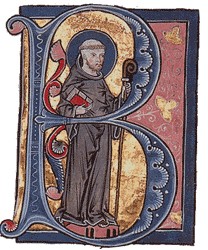
Bernard of Clairvaux was a Burgundian monk, theologian, and ecclesiastical statesman who shaped twelfth-century Catholic Europe more visibly than almost any figure outside the papacy itself. Born in 1091 at Fontaine-lès-Dijon to a family of the highest Burgundian nobility, he entered religious life in 1113 and spent the next forty years at the centre of monastic reform, doctrinal controversy, and crusading politics. As abbot of Clairvaux he personally oversaw the founding of sixty-five Cistercian monasteries, and his written works fill four volumes in their modern critical edition. He died on 20 August 1153, was canonized in 1174, and was declared a Doctor of the Church in 1830.
Key facts
- Born: 1091
- Birthplace: Fontaine-lès-Dijon
- Died: 20 August 1153
- Place of death: Clairvaux Abbey
- Country: Kingdom of France
- Occupation: theologian; writer; philosopher; hymnwriter
- Field: philosophy; theology; monastic life
Origins and education
Bernard was the third of seven children born to Tescelin, lord of Fontaines, and Aleth of Montbard. Both parents belonged to the uppermost rank of Burgundian nobility, a social position that would later open doors across France and Rome with unusual ease.
Around the age of nine he was sent to a school at Châtillon-sur-Seine maintained by the Secular Canons of Saint-Vorles. There he developed a lasting attachment to literature and poetry, and his studies covered the full trivium as well as a working familiarity with the quadrivium.
Entry into monastic life
After his mother Aleth died, Bernard turned away from a secular vocation and resolved on the cloister. In 1113 he arrived at the Cistercian monastery of Cîteaux under Abbot Stephen Harding, bringing with him approximately thirty young noblemen of Burgundy, many of them relatives. The arrival of so large a group gave the struggling new community a decisive boost.
His formation at Cîteaux lasted only three years. In 1115, before reaching the age of twenty-five, Bernard was dispatched by Stephen Harding to found a new house near the Aube river. He named it Claire Vallée, Valley of Light, a name that contracted in common use to Clairvaux. The abbey was officially established on 25 June 1115 in a valley formerly called Vallée d’Absinthe, within the Diocese of Langres; William of Champeaux, Bishop of Châlons-sur-Marne, installed Bernard as its first abbot.
The abbacy of Clairvaux
Bernard served as abbot of Clairvaux for thirty-eight years. During that period the Cistercian order expanded dramatically: approximately three hundred monasteries were founded, and Bernard personally oversaw sixty-five of them. His role was organizational as much as spiritual, requiring sustained correspondence and repeated travel across the Latin West.
He also became an adviser to five popes over the course of his abbacy, a reach that made him arguably the most politically powerful non-papal figure in the twelfth-century Catholic Church. The last years of his abbacy were clouded by the failure of the Second Crusade, for which he had traveled through Flanders and the Rhine provinces recruiting participants. Bernard also moved against the Cathar and Waldensian movements in southern France, bringing his personal reputation and his notably austere appearance to bear in disputes he framed as defences of Catholic orthodoxy.
Writings
Bernard’s complete body of works appears in four volumes of the modern critical edition Sancti Bernardi Opera, published between 1957 and 1977. The collection includes the Sermons on the Song of Songs, On Loving God, On the Steps of Humility, On Grace and Free Choice, and On Consideration, along with a substantial correspondence.
On Loving God (De Diligendo Deo, composed around 1126) is among his most systematic pieces. It lays out four stages of love, beginning with love of self for the sake of self and ascending, through love of God for the benefits God provides and then love of God for God’s own sake, to the fourth and highest stage: perfect love of God for God’s sake alone, in which even self-love is subsumed into love of God.
The Council of Sens and Peter Abelard
In 1140 Bernard arranged for the theologian Peter Abelard to be summoned before a council at Sens. The council condemned Abelard’s teaching. Abelard appealed to Rome, but Pope Innocent II confirmed the sentence, and Abelard retired to the monastery of Cluny.
Historians of philosophy have read the episode as a confrontation between conservative monastic learning and the more open intellectual culture that was taking shape in the rising cathedral schools. Bernard’s action at Sens illustrates both the scope of his influence and the limits of what that influence was used to protect.
Death, canonization, and legacy
Bernard died on 20 August 1153 at Clairvaux, in the sixty-third year of his age. His death came shortly after that of Pope Eugenius III, whom he counted among his closest associates. He had spent forty years in the cloister from the time of his entry at Cîteaux.
Pope Alexander III canonized him on 18 January 1174 in Rome; Bernard was the first Cistercian monk placed on the calendar of saints. In 1830, Pope Pius VIII declared him a Doctor of the Church. His relics remain at Clairvaux, and his skull is kept in the cathedral of Troyes, which functions as his principal shrine.
Did you know
- When Bernard entered the Cistercian monastery of Cîteaux in 1113, he arrived with approximately thirty companions, many of them relatives. The influx was large enough to give the struggling young community fresh momentum at a critical point in its existence. (ebsco.com)
- Bernard’s formation at Cîteaux under Stephen Harding lasted just three years before he was sent out to found a daughter house. He became abbot of Clairvaux before reaching the age of twenty-five. (ccel.org)
- Over the course of his abbacy, Bernard served as adviser to five popes, a record of sustained influence that made him arguably the most politically powerful non-papal figure in the twelfth-century Catholic Church. (christianitytoday.com)
Data sources
- Wikidata
- newadvent.org
- catholic.com
- ebsco.com
- ccel.org
- philosophyprofessor.com
- christianhistoryinstitute.org
- newworldencyclopedia.org
- ewtn.com
Data updated: 2026-10-29