
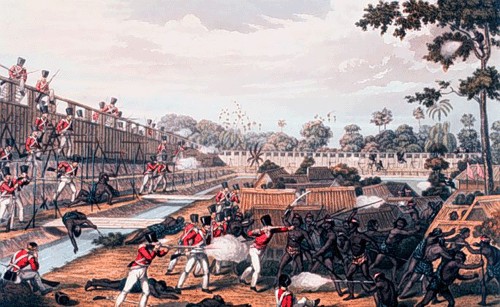
The First Anglo-Burmese War, fought from 5 March 1824 to 24 February 1826, was the opening conflict in a sequence of three wars between the British Empire and the Konbaung dynasty that governed Burma. The fighting ranged across Myanmar and was triggered by the expansion of the Konbaung dynasty into territories bordering British India. At least 15,000 British and Indian soldiers died, three-quarters of them from disease rather than enemy action, making it one of the costliest military campaigns of the early nineteenth century in human terms. The war ended with the Treaty of Yandabo, which transferred large territories to British control and imposed a war indemnity of one million pounds sterling on Burma.
Key facts
- Country: British India
- Type: war
- Start: 5 March 1824
- End: 24 February 1826
- Location: Myanmar
- Participants: British Empire; Rattanakosin Kingdom; Konbaung dynasty
Background
Through the reigns of kings Bodawpaya and Bagyidaw, the Konbaung dynasty had pushed its frontiers outward aggressively, absorbing Arakan, Manipur, and Assam. That expansion brought Burmese forces into direct contact with the northeastern frontier of British India, creating a disputed border that neither side was willing to leave unsettled.
On the Burmese side, the commander-in-chief Maha Bandula was the principal advocate of a forward policy toward the British. An English resident at the Burmese court described him as ‘the Wellington of the army.’ Bandula assembled a force of 30,000 men for an offensive intended to retake Rangoon from British-held positions, but the attack was repulsed.
Outbreak and conduct of the war
Governor-General Lord William Amherst formally declared war on the Kingdom of Ava on 5 March 1824. British forces were financed by the East India Company and placed under the command of Major General Sir Archibald Campbell. The Rattanakosin Kingdom also participated on the British side, while the Konbaung dynasty bore the main burden of resistance.
Initial peace negotiations opened in September 1825 at Ngagyaungbinzeik, roughly 20 miles north of Pyay (Prome). The talks collapsed because the Burmese refused to accept British terms, and the fighting continued until February 1826.
Treaty of Yandabo
The war concluded on 24 February 1826 with the signing of the Treaty of Yandabo, a document containing 11 articles. Burma was required to cede Arakan and Tenasserim to the British and to renounce all claims in Assam and Manipur, both of which became British protectorates. The indemnity set at one million pounds sterling was to be paid in four instalments.
Beyond the territorial and financial clauses, the treaty required Burma to accept a British Resident at the Court of Ava and to post a Burmese ambassador in Calcutta. A bilateral commercial treaty was concluded at the same time, opening Burmese ports to British merchant shipping.
Human cost
Of the at least 15,000 British and Indian soldiers who died, approximately three-quarters were killed by malaria, dysentery, dengue fever, or the effects of heatstroke rather than by Burmese arms. The campaign illustrated how poorly adapted European and Indian armies were to fighting in tropical lowland terrain for extended periods.
The toll extended to senior officers. Brigadier-General Morrison, one of the leading British commanders, contracted what was recorded as a ‘malignant jungle fever’ while serving in Arakan and died on his return voyage to Britain, after the fighting had already ended.
Consequences
The financial burden of the war contributed directly to an economic crisis in India. That crisis accelerated the decline of the East India Company and prompted greater British government intervention in Company affairs during the 1830s.
In the territories transferred by the treaty, British colonial administration took hold, Christian missionary activity expanded, and ethnic and religious arrangements shifted, particularly in Arakan. The victory of 1824 to 1826 marked the beginning of British colonial rule in Burma, a period that lasted until Burmese independence in 1948.
Did you know
- Of the estimated 40,000 British and Indian troops deployed throughout the war, one source reports that 45 percent never returned. Of all the deaths recorded, 96 percent were caused not by battle wounds but by tropical disease. (factsanddetails.com)
- Brigadier-General Morrison, one of the senior British commanders, died of a ‘malignant jungle fever’ contracted in Arakan on his way back to Britain after the war, showing that disease claimed officers as readily as rank-and-file troops. (nam.ac.uk)
Data sources
- Wikidata
- britishonlinearchives.com
- gktoday.in
- itihaas.ai
- spmiasacademy.com
- upsclogy.com
- nam.ac.uk
- ebsco.com
Data updated: 2026-10-30