
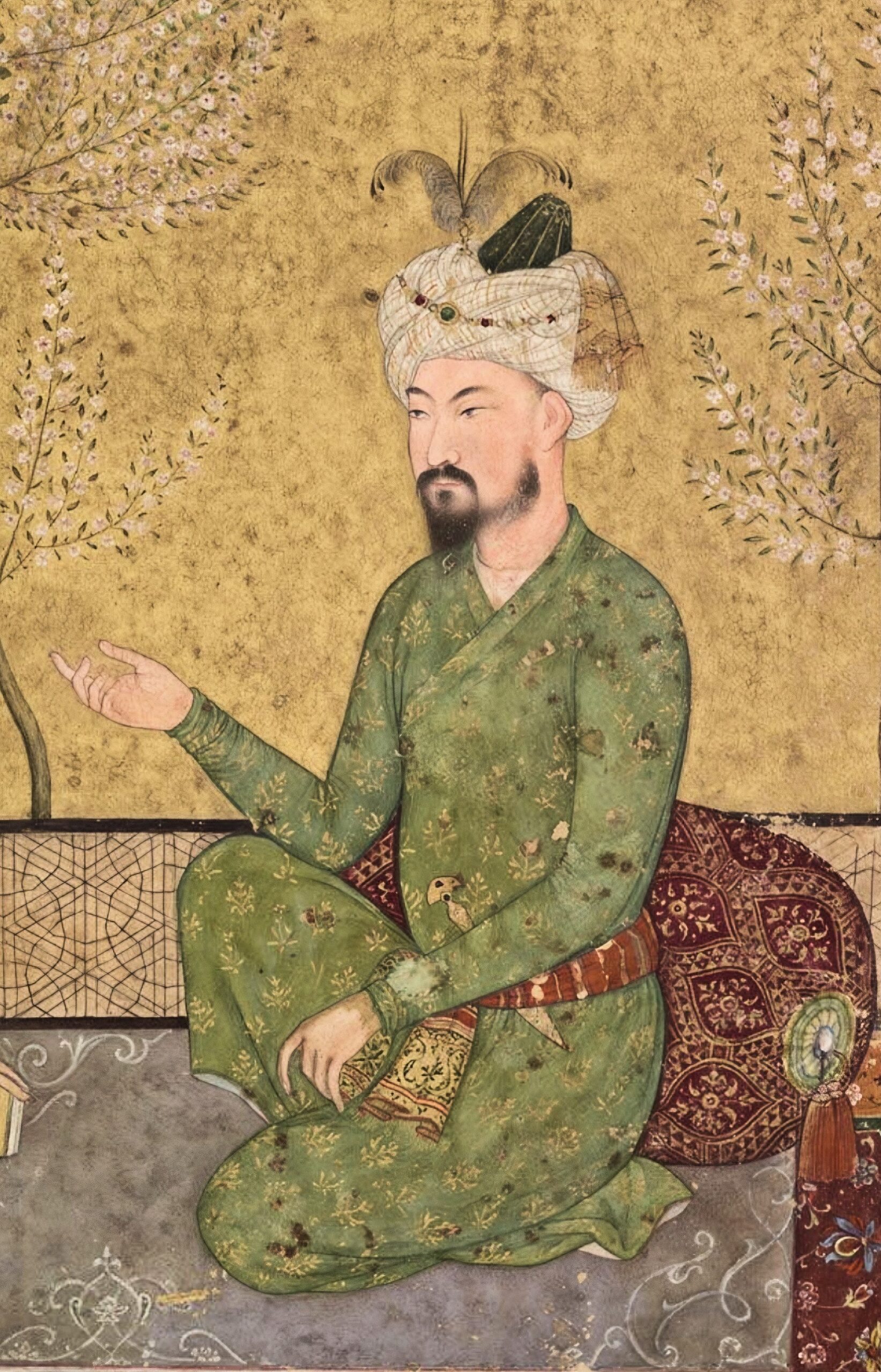
Babur, born Zahir-ud-Din Muhammad on 14 February 1483 in Andijan, conquered northern India and established the Mughal Empire in 1526. At the First Battle of Panipat on 21 April 1526, his force of approximately 12,000 men defeated an army of roughly 100,000 soldiers and approximately 1,000 war elephants, ending the Delhi Sultanate. He died on 26 December 1530 in Agra, leaving behind an empire, a garden, and one of the most arresting personal memoirs any pre-modern ruler ever composed.
Key facts
- Born: 14 February 1483
- Birthplace: Andijan
- Died: 26 December 1530
- Place of death: Agra
- Occupation: poet; autobiographer; monarch; writer
Name and origins
His formal name, Zahir-ud-Din Muhammad, was rarely used. The nickname Babur, meaning lion, tiger, or panther, became the name by which he was universally known, possibly because his given name was difficult for his Central Asian Turco-Mongol army to pronounce. Born in Andijan in the Fergana Valley, he was heir to a small Timurid principality at a moment when the power of that dynasty was fragmenting under the pressure of Uzbek expansion from the north.
Early campaigns and the loss of Samarkand
In 1497, at fourteen years of age, Babur captured Samarkand after a siege of seven months. Samarkand had been the imperial capital of his ancestor Timur, and taking it carried enormous symbolic weight for any Timurid prince. He held the city for only about 100 days. A rebellion in Fergana forced him to march home, and in the time it took him to respond, he lost both cities simultaneously, ending up without either.
His father, Umar Shaikh Mirza II, had died in 1494. Babur spent the following years fighting to recover some foothold in Central Asia, without lasting success. By 1504 he shifted his ambitions southward and captured Kabul, which became his base of operations for the next two decades.
Kabul and the Gardens of Babur
After taking Kabul in 1504, Babur began developing the site now known as Bagh-e Babur, an avenue garden laid out in the chaharbagh (four-part) style on the southwestern foothills of Sher Darwaza mountain. Its 13 stepped terraces made it one of the most formally ambitious garden projects of its era in the region. Babur asked to be buried there, under the open sky with no roof over his grave, and his tomb at the top terrace is surrounded by a simple marble screen.
The garden fell into severe disrepair over subsequent centuries. Between 2002 and 2006, the Aga Khan Trust for Culture undertook a restoration, replanting 4,000 saplings of species mentioned in the Baburnama, including pomegranate, apricot, and cherry trees, and restoring Shah Jahan’s mosque and Babur’s tomb.
Conquest of India
On 21 April 1526, at the First Battle of Panipat, Babur defeated and killed Ibrahim Lodi, the last Sultan of Delhi, founding the Mughal Empire. His army of approximately 12,000 troops faced a force of roughly 100,000 men and approximately 1,000 war elephants, a disparity he overcame through the use of field artillery and flanking tactics that Lodi’s commanders had not previously encountered.
The following year, on 16 March 1527, Babur faced the Rajput confederacy at the Battle of Khanwa, fought approximately 60 kilometers west of Agra. His opponent was Rana Sanga of Mewar, who led a coalition of Rajput chiefs. Before the battle, Babur declared the campaign a jihad, renounced wine, and broke his wine cups publicly. After his victory he took the title Ghazi, warrior of the faith.
Death and succession
Babur’s son Humayun fell critically ill, and according to an account by Babur’s daughter Gulbadan Begum, Babur performed a ritual called tasaqquf, circumambulating his son’s sick-bed three times while praying that the illness be transferred to himself. Humayun recovered. Babur’s health then deteriorated, and he died in Agra on 26 December 1530, having ruled the Mughal Empire for only four years since its founding.
The Baburnama
Babur wrote his autobiography, the Baburnama, in Chagatai Turkic rather than the more prestigious literary Persian. Scholar Wheeler Thackston, whose English translation was published in 1996, described the work as written in an open, frank, and occasionally quite intimate style, and noted that the choice of Chagatai over Persian was itself distinctive among rulers of his background.
The memoir runs to 382 folio pages in the original Chagatai Turkish manuscript. It contains detailed naturalist observations on the flora and fauna of India, including descriptions of rhinoceroses, birds, and fruits, which scholars regard as some of the earliest systematic accounts of Indian natural history written by a ruler.
During the reign of Babur’s grandson Emperor Akbar, the courtier Abdul Rahim Khan-i-Khanan translated the Baburnama from Chagatai Turkic into Persian in 1589–90 CE. At least seven illustrated copies of this Persian version survive, datable to between 1589 and the end of Akbar’s reign in 1605. The translation was commissioned partly because by that point few courtiers at the Mughal court could read Turkish.
Poetry and literary invention
Beyond the Baburnama, Babur authored a Diwan, a collected body of poems, in Chagatai Turkic. He also invented a poetic form called Mubayyan. His poems continued to be recited among the peoples of Central Asia well after his death, giving him a literary presence in the region that outlasted the political one he had sought and failed to secure there.
Did you know
- Babur’s father, Umar Shaikh Mirza II, died in a bizarre accident at Akhsi fortress in 1494 when a dovecote he had built at the edge of the cliff wall collapsed, sending him tumbling into the ravine below. Babur later recorded this scene in the Baburnama with the poetic phrase “flew with his pigeons and became a falcon.” (unpackedhistory.com)
- The Baburnama runs to 382 folio pages in the original Chagatai Turkish manuscript, making it one of the most substantial personal memoirs produced by any ruler of the pre-modern world. (cse.iitk.ac.in)
- By the late 16th century, Babur’s Chagatai Turkic language had become so unfamiliar at the Mughal court that Akbar commissioned a Persian translation of the Baburnama, with few courtiers by that point able to read Turkish. The translation was completed in 1589. (collections.vam.ac.uk)
- Babur and Jahangir are the only two emperors in the history of the Mughal Empire who wrote their own autobiographies. (testbook.com)
- The Baburnama contains detailed naturalist observations on the flora and fauna of India, including descriptions of rhinoceroses, birds, and fruits, which scholars regard as some of the earliest systematic accounts of Indian natural history written by a ruler. (unacademy.com)
Data sources
- Wikidata
- ebsco.com
- historyofwar.org
- ancient-history-sites.com
- anantamias.com
- medievalists.net
- collections.vam.ac.uk
- baike.baidu.com
- gatesofhistory.com
- translatormag.co
- lonelyplanet.com
Data updated: 2026-10-30