
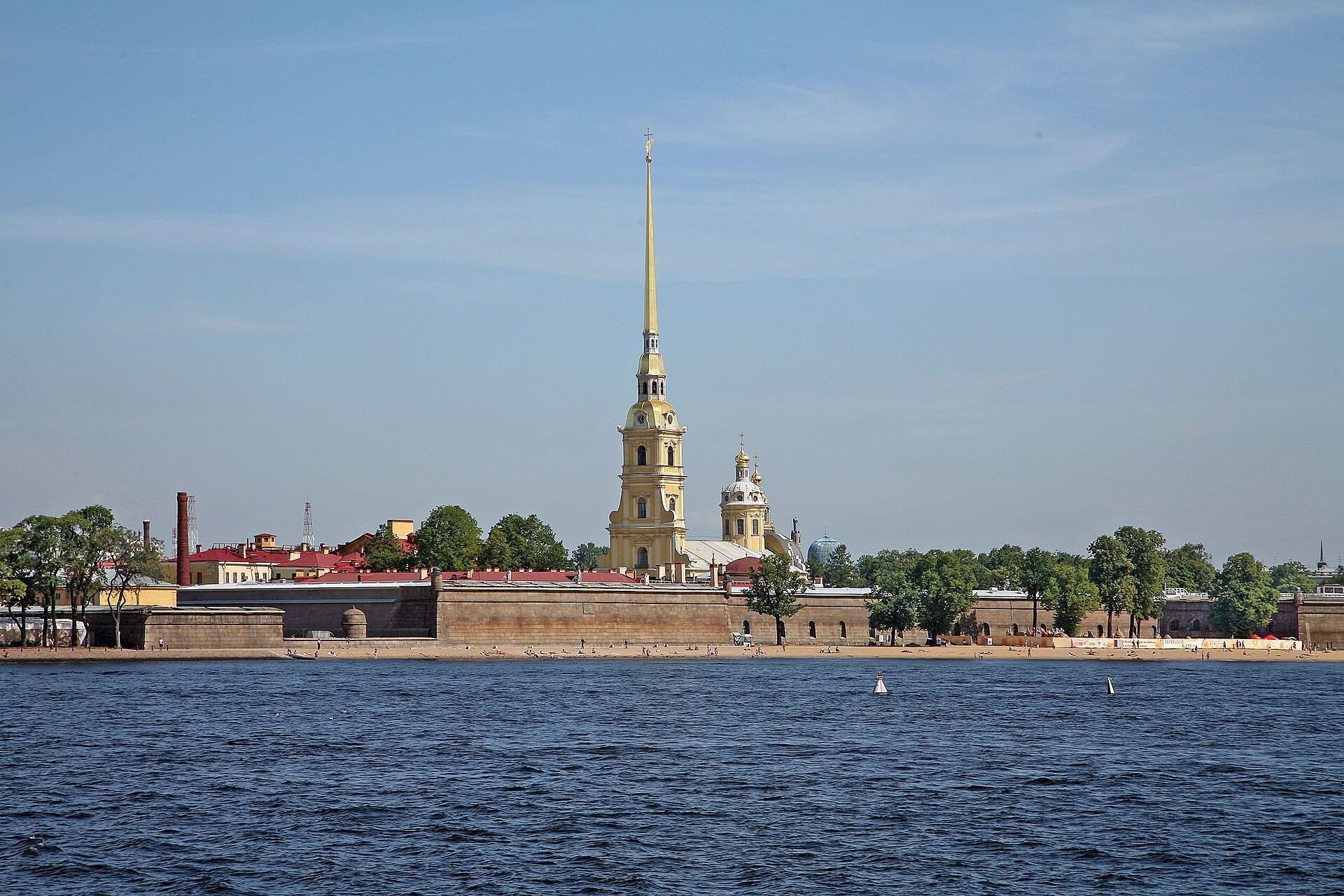
The Peter and Paul Fortress is the original citadel of St. Petersburg, occupying Zayachy (Hare) Island in the broadest stretch of the Neva River delta. Construction began on 16 May 1703 under Peter the Great and the French-born military engineer Joseph Gaspar Lambert de Guerin, making it the founding structure of the city. The island covers about 28 hectares and measures approximately 0.9 kilometres from end to end. For more than three centuries the fortress has accumulated roles that its builders never anticipated: imperial mausoleum, state prison, and, as of 2025, the headquarters of the State Museum of the History of Saint Petersburg.
Key facts
- Country: Russia
- Type: military museum; citadel; architectural landmark; fortress
- Located in: Petrogradsky District
- Coordinates: 59.9500, 30.3167
- Founded: 16 May 1703
The Island and Its Setting
Before 1703, the island carried two names: Finnish speakers called it Yanissaari, meaning Hare Island, while seventeenth-century Swedish records referred to it as Lust-Eiland, or Merry Island. At that time it was a wild, waterlogged place, subject to regular flooding from the Neva. Those floods did not stop after fortification; the vaults beneath the Peter and Paul Cathedral, where the Romanov burial chambers are located, sit below the river’s water table and were historically flooded with some regularity.
The island’s shape dictated the fortress plan. Engineers laid out the fortifications as a stretched hexagon following the contour of Zayachy Island, with six massive bastions connected by curtain walls standing 32 to 39 feet high and 65 feet thick. Between 1779 and 1786, the bastions and curtain walls on the Neva River side were faced with granite, giving the embankment the appearance it retains today.
Construction and Engineering
The fortress Peter the Great ordered in May 1703 was first raised in earth and wood, a form quick to build but vulnerable to siege artillery. In 1706, work began to replace the earthen walls with masonry, and the stone reconstruction ran until 1740. The result was the only surviving permanent fortified structure in Russia planned and executed strictly according to the bastion system developed by the French military engineer Sebastien de Vauban.
The Vauban system arranged bastions so that each one could be defended by fire from its neighbours, eliminating the blind spots that plagued older fortress designs. At the Peter and Paul Fortress, six bastions were positioned around the perimeter of the island, each connected by the heavy curtain walls described above. The system was state-of-the-art for early eighteenth-century European military engineering, even if the fortress itself was never put to the test it was designed for.
In 1725, the reconstruction of the fortress’s crownwork — the outwork beyond the main walls — was entrusted to Abram Gannibal, a military engineer who had served under Peter the Great. Gannibal is also remembered as the great-grandfather of the poet Alexander Pushkin.
The Peter and Paul Cathedral
The centrepiece of the fortress complex is the Peter and Paul Cathedral, designed by the architect Domenico Trezzini and built between 1712 and 1733. Its gilded bell tower carries a spire that reaches 122.5 metres, topped by an angel holding a cross. Gilding that spire required more than 8 kilograms of pure gold, and the angel weathervane at the summit stands 3.2 metres tall.
The cathedral’s interior departs from Orthodox convention in one conspicuous way: its iconostasis is shaped as a triumphal arch rather than the solid wall traditional in Russian church architecture. The design was deliberate, intended to celebrate Russia’s military victories, particularly those of the Great Northern War against Sweden.
The cathedral served as the burial church of the Romanov dynasty for two hundred years. From Peter I to Nicholas II, all Russian rulers — with the exceptions of Peter II and Ivan VI — and members of their families were interred there, their graves marked by sarcophagi of white Carrara marble.
A Fortress That Never Fought
The Peter and Paul Fortress was raised specifically to counter Swedish advances during the Great Northern War. Its guns, however, were never turned against an enemy. The fortress never fired a shot in battle. Instead, the cannon became instruments of civic life: they were discharged to announce military victories, signal flood warnings, and mark holidays. A noon gun fired to mark the time has been a feature of daily life in St. Petersburg for generations.
The defensive works were completed at a moment when the military situation in the region was already shifting, and the fortress’s location deep within the growing city made it impractical as a battlefield position. What it remained, for most of its existence, was a symbol of imperial authority rather than an active military installation.
Prison and Political Prisoners
From an early date the fortress served as a place of detention for political prisoners. Among those held within its walls were the writer Fyodor Dostoevsky, the novelist Maxim Gorky, the anarchist philosopher Mikhail Bakunin, the revolutionary Leon Trotsky, and Alexander Ulyanov, the elder brother of Vladimir Lenin. Josip Broz Tito, who later led Yugoslavia, spent three weeks in the fortress in 1917.
The list spans ideological lines and decades, reflecting the fortress’s function as a holding place for individuals the tsarist government considered dangerous, regardless of whether their politics pointed left or right.
The Boathouse and Peter’s Dinghy
One of the smaller structures within the complex is the Boathouse pavilion, built by architect Alexander Vist between 1762 and 1765. Its specific purpose was to shelter the small sailing dinghy associated with Peter the Great, a vessel referred to by his admirers as the ‘Grandfather of the Russian Navy.’ The dinghy was kept in the Boathouse from 1767 to 1931, after which it was moved; a scale replica now occupies the space.
The Fortress as Museum Complex
As of 2025, the Peter and Paul Fortress operates as the State Museum of the History of Saint Petersburg, open daily from 10:00 AM to 6:00 PM, with hours extended to 8:00 PM on Thursdays; the cathedral closes on Wednesdays. The complex encompasses several distinct institutions alongside the main museum: the Museum of Cosmonautics and Rocket Technology, the Museum of the History of Money, and the Military-Historical Museum of Artillery, Engineer and Signal Troops, housed in the Crownwork beyond the main walls.
Did you know
- Although the Peter and Paul Fortress was constructed specifically to repel Swedish attacks during the Great Northern War, it never fired a shot in battle. Its cannons were used instead to announce flood warnings, holidays, and military victories. (saint-petersburg.com)
- The Peter and Paul Cathedral’s iconostasis is shaped as a triumphal arch rather than a traditional solid wall. The design was a deliberate choice to celebrate Russia’s military victories, notably those of the Great Northern War against Sweden. (spbmuseum.ru)
- The vaults beneath the Peter and Paul Cathedral, where the Romanov sarcophagi stand, are located below the water table of the Neva River and were historically frequently flooded. (alexanderpalace.org)
- In 1725, the reconstruction of the fortress’s crownwork was led by Abram Gannibal, who served as a military engineer under Peter the Great. Gannibal was the great-grandfather of the poet Alexander Pushkin. (eng.petersway.org)
- More than 8 kilograms of pure gold were used to gild the cathedral’s 122-metre spire. The angel weathervane at the summit stands 3.2 metres tall. (advantour.com)
Data sources
- Wikidata
- ancient-history-sites.com
- saint-petersburg.com
- spbmuseum.ru
- russiable.com
- eng.petersway.org
- ermakvagus.com
Data updated: 2026-10-30