
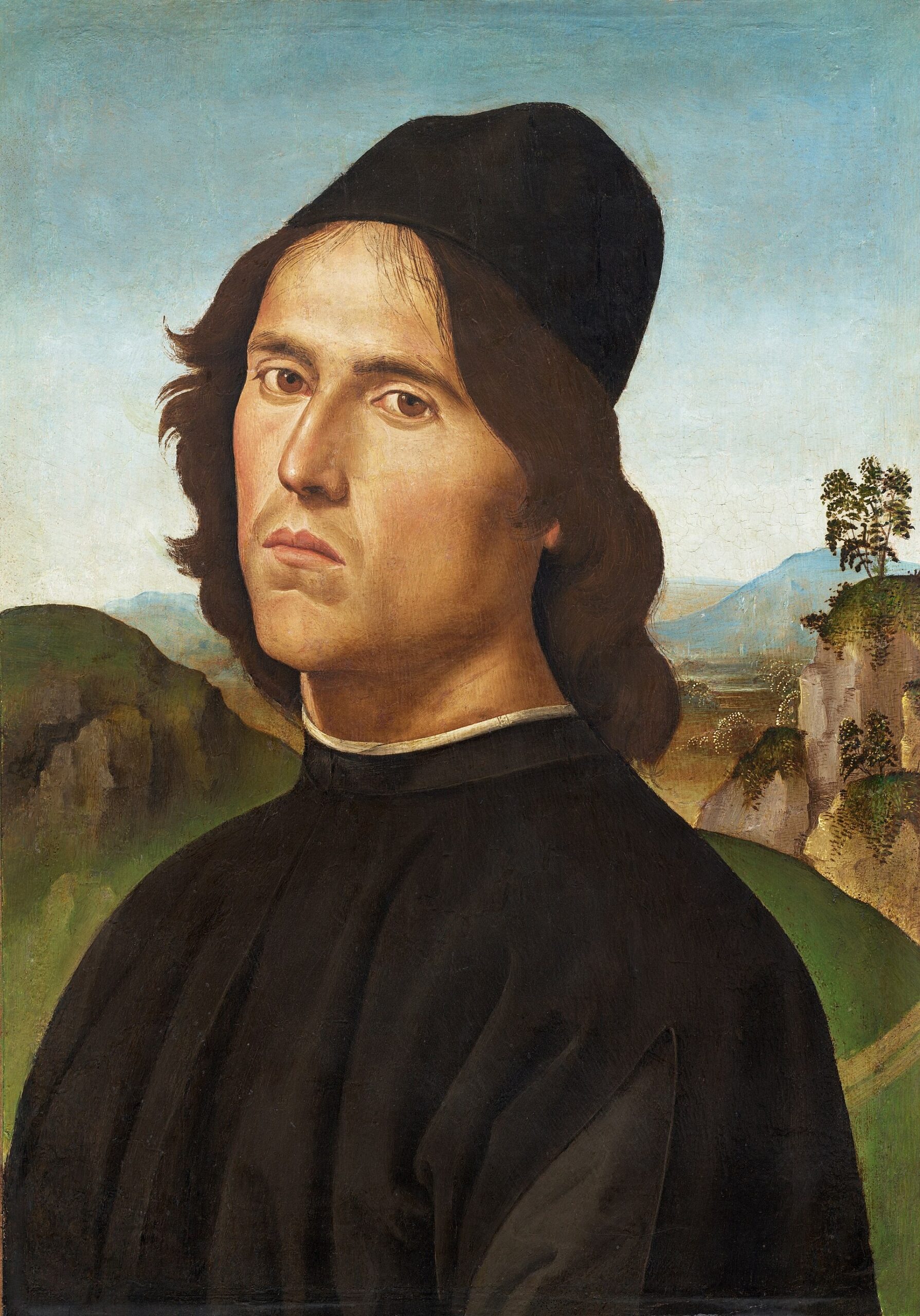
Lorenzo di Credi was a Florentine painter, sculptor, and draftsperson born in 1459 and trained in the workshop of Andrea del Verrocchio. His full birth name was Lorenzo d’Andrea d’Oderigo, though he took the surname “di Credi” from an early goldsmith master named Credi. On Verrocchio’s death in 1488, Lorenzo was named sole executor of his will and inherited the entire workshop, becoming the principal keeper of that studio’s methods and style for decades. His career spanned religious commissions, portraiture, and restoration work, and it ended with a will that left his estate to the lay confraternity of the Buonomini di San Martino, who assisted Florence’s poor.
Key facts
- Born: 1459
- Birthplace: Florence
- Died: 12 January 1537
- Place of death: Florence
- Country: Republic of Florence; Duchy of Florence
- Occupation: painter; sculptor; draftsperson
Origins and Training
Lorenzo was born in Florence to Andrea d’Oderigo, a goldsmith, which explains the occupational path that shaped his earliest training. Before entering Verrocchio’s workshop, he apprenticed under a goldsmith named Credi, and the surname he carried for the rest of his life came from that first master. Critics and contemporaries alike noticed the mark of that background in his mature paintings: the drapery folds in his religious pictures were described as having the appearance of metalwork, a characteristic rooted in his early familiarity with hammered and chased surfaces.
Giorgio Vasari, in his Lives of the Artists, gave Lorenzo a full biography and described him as ‘a young man of beautiful intellect and excellent character’ who was ‘beloved by his master.’ That standing within the workshop translated into real responsibility: when Verrocchio died in 1488, Lorenzo received not just the workshop but all of Verrocchio’s tools, furnishings, bronze, tin, and personal goods held in both Florence and Venice.
The Verrocchio Workshop and Its Continuation
One of Lorenzo’s most important early commissions as Verrocchio’s successor was the Madonna di Piazza altarpiece for Pistoia Cathedral. Verrocchio had originally accepted the commission in 1475, but it was Lorenzo who executed the work, between 1485 and 1491, completing it on his master’s behalf.
Later scholarly assessment has placed Lorenzo in the role of a highly skilled but comparatively conservative craftsman who preserved and extended Verrocchio’s style well into the sixteenth century, by which point his approach had grown old-fashioned relative to the innovations around him. That conservatism did not reduce demand: his religious pictures were sought for churches and convents across Florence and its surrounding territory throughout his active decades.
The workshop Lorenzo inherited became one of the largest in Florence for several decades after Verrocchio’s death. Among the pupils he trained were Tommaso di Stefano Lunetti and Antonio del Ceraiolo. He also worked in collaboration with Giovanni di Benedetto Cianfanini and with the anonymous artist recorded as ‘Tommaso di Credi.’
Portraits and Artistic Influences
Lorenzo’s most celebrated portrait is of Caterina Sforza, known as La dama dei gelsomini (Lady of the Jasmines), painted around 1490 and now held at the Pinacoteca Civica in Forlì. The picture attracted scholarly attention because the sitter’s features bear a notable resemblance to those of the subject of Leonardo da Vinci’s Mona Lisa.
His art showed affinities reaching beyond his immediate Florentine milieu. Connections were observed with Flemish and German masters as well as with his Florentine contemporaries, and his mature works were further shaped by Fra Bartolomeo, Perugino, and the young Raphael.
The Bonfire of the Vanities
Lorenzo became a devout follower of Girolamo Savonarola. On February 7, 1497, he burned some of his own paintings in the Bonfire of the Vanities in the Piazza della Signoria in Florence, an act consistent with Savonarola’s call on Florentines to destroy objects considered morally corrupting.
Restoration Work
Beyond original production, Lorenzo also restored significant Renaissance paintings, including works by Fra Angelico, as recorded by the J. Paul Getty Museum. One such intervention, carried out in 1501, involved Fra Angelico’s Fiesole Altarpiece: Lorenzo applied lapis lazuli over Fra Angelico’s original painted throne. A 21st-century restoration of that altarpiece employed infrared reflectography, which uncovered the hidden design beneath di Credi’s overpaint.
Legacy and Final Years
Lorenzo di Credi died on 12 January 1537 in Florence, the city where he had been born and had spent his entire career. In his last will and testament he named the lay confraternity of the Buonomini di San Martino, known in Florence as the Procurators of the Ashamed Poor, as his universal heirs.
Vasari’s account noted that Lorenzo was a slow painter who ‘took immense pains’ and personally ground and prepared all his own colors. That deliberateness was apparently inseparable from his broader method, which kept Verrocchio’s standards alive in a city that was moving toward the High Renaissance. What remained when he died was a body of religious work in Florence’s churches and convents, a workshop tradition passed on through several pupils, and an estate directed entirely to charity.
Did you know
- A portrait believed to depict Lorenzo di Credi was painted in 1488 by his fellow Verrocchio pupil Pietro Perugino and is now held at the National Gallery of Art in Washington. A later inscription on the work reads: ‘Lorenzo di Credi, most excellent painter, 1488, age 32 years, 8 months.’ (histflorence.blogspot.com)
- When Lorenzo modified Fra Angelico’s Fiesole Altarpiece in 1501, he applied lapis lazuli directly over Fra Angelico’s original painted throne. Infrared reflectography carried out during a 21st-century restoration uncovered the hidden design beneath di Credi’s overpaint. (theartnewspaper.com)
- Vasari wrote that Lorenzo was a slow painter who ‘took immense pains’ and personally ground and prepared all his own colors. Despite that method, his workshop was still considered one of the largest in Florence for several decades after Verrocchio’s death. (en.wikisource.org)
Data sources
- Wikidata
- italianartsociety.org
- newadvent.org
- rogallery.com
- artvee.com
- foliamagazine.it
- getty.edu
- masterworks.com
Data updated: 2026-10-30