
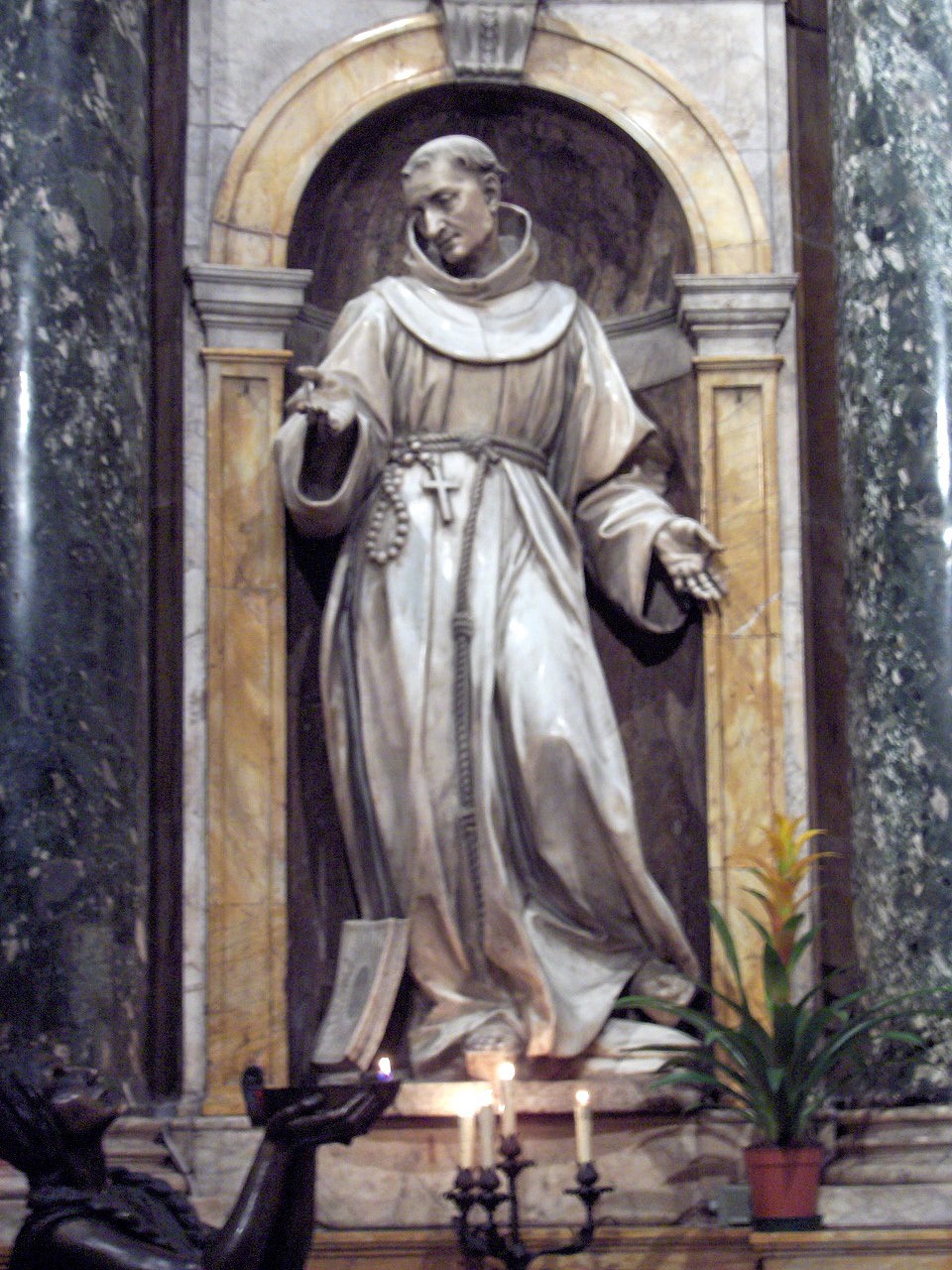
Bernardino of Siena (1380–1444) was an Italian Franciscan friar, theologian, and one of the most widely heard preachers of the fifteenth century. Born Bernardino degli Albizzeschi into a noble Sienese family, he spent more than 30 years walking the length of Italy delivering sermons that drew crowds reportedly reaching 30,000 people, despite a raspy voice that contemporaries noted as a handicap. He is best remembered for popularising the IHS monogram as a devotional symbol, for an economic treatise that offered the most thorough defence of the entrepreneur written in his time, and for a body of collected writings that ultimately filled twenty large volumes. The Roman Catholic Church observes his feast on 20 May.
Key facts
- Born: 8 September 1380
- Birthplace: Massa Marittima
- Died: 20 May 1444
- Place of death: L’Aquila
- Country: Siena
- Occupation: theologian; regular priest; preacher; confessor
- Education: University of Siena
Origins and early life
Bernardino was born on 8 September 1380 in Massa Marittima, where his father served as governor. The family name, degli Albizzeschi, placed him among the Sienese nobility, though neither social position nor parental care defined his childhood for long. Both parents died before he turned six, and two devout aunts took charge of him. They arranged an education in the liberal arts and law, and in time he studied at the University of Siena.
Having given away his personal patrimony in charity, he received the Franciscan habit at San Francesco in Siena on 8 September 1402, then withdrew to the Observantine convent of Columbaio outside the city. He was professed on 8 September 1403 and ordained to the priesthood on 8 September 1404. The following year he was commissioned as a preacher.
Preaching across Italy
For more than 30 years Bernardino covered the Italian peninsula on foot. He sometimes preached in more than one city on the same day, and his sermons could last three or four hours. Where many contemporary preachers read from prepared texts, Bernardino drew his themes from the ordinary lives of his audiences and spoke directly to them in the open air. Scholar Cynthia Polecritti described his surviving sermon texts as acknowledged masterpieces of colloquial Italian.
His targets from the pulpit were specific: gambling, usury, witchcraft, infanticide, and the factional violence that fractured Italian civic life. His preaching also generated documented hostility toward Jewish moneylenders, leaving a legacy of resentment among Jewish communities. In several Italian cities the moral reforms he inspired were formally written into local statutes under the title Riformazioni di frate Bernardino.
At the close of his sermons Bernardino displayed a wooden tablet bearing the IHS symbol he had devised: the first three letters of Jesus’s name in Greek, rendered in Gothic script on a blazing sun. The symbol became so associated with him that it eventually required a formal ecclesiastical ruling to settle questions about its use.
The IHS monogram and the 1427 trial
In 1427 Bernardino was summoned to Rome to answer charges of heresy arising from his promotion of the Holy Name of Jesus devotion. The trial took place at Saint Peter’s Basilica, presided over by Pope Martin V, with John of Capistrano acting as Bernardino’s defence. Bernardino was found innocent, and Pope Martin V was sufficiently impressed that he invited Bernardino to preach in Rome as well.
The controversy did not end with the acquittal. Pope Martin V subsequently required that a large crucifix be added to the IHS monogram disk as a condition of approving its liturgical use, and that modification resolved the theological objection. Bernardino’s close friend and fellow theology student John of Capistrano, and his disciple James of the Marches, continued working with him as co-missionaries across the peninsula in the years that followed.
Economic writing and imperial connections
Between 1431 and 1433 Bernardino composed On Contracts and Usury, a treatise that addressed the justification of private property, the ethics of trade, the determination of value and price, and the problem of usury. Historians have described it as the fullest discussion and defence of the entrepreneur produced at that time.
During the same period he maintained a relationship with Holy Roman Emperor Sigismund, who sought Bernardino’s counsel and intercession. Bernardino accompanied Sigismund to Rome in 1433 for his imperial coronation.
Death and commemoration
Bernardino died on 20 May 1444 at L’Aquila. The magistrates of L’Aquila refused to allow his body to be transferred to Siena, and after a funeral described as being of unprecedented splendour, he was interred in the church of the Conventuals in the city.
Within the year two hagiographies had been written by his friends: one in 1444 by Barnaba of Siena, and another by the humanist Maffeo Vegio. By 1480, historian Franco Mormando noted, there were already more than a dozen written accounts of his life. The Franciscan order promoted an iconographic programme centred on images of Bernardino that was surpassed in scope, within the order, only by that devoted to Saint Francis himself.
An early painted portrait, made around 1444 by Pietro di Giovanni d’Ambrogio, is considered an indisputably authentic likeness. Many subsequent depictions of the saint are thought to derive from it and from the death mask preserved at L’Aquila. Bernardino’s collected writings were first published at Lyon in 1501 and eventually ran to twenty large volumes, encompassing his sermons, the economic treatise, texts on the Blessed Virgin and Saint Joseph used in the Breviary, and a commentary on the Apocalypse.
His feast day in the Roman Catholic Church falls on 20 May, the date of his death. He is venerated as patron saint of advertisers, advertising, gambling addicts, public relations personnel, Italy, Aquila, and the Diocese of San Bernardino in California.
Did you know
- Bernardino was born on 8 September 1380, professed as a friar on 8 September 1403, and ordained to the priesthood on 8 September 1404. Three of the defining moments of his life fell on the same calendar date, the feast of the Nativity of the Virgin Mary. (newadvent.org)
- At the conclusion of his sermons, Bernardino would persuade a playing card maker in Bologna, whose business had been ruined by Bernardino’s preaching against gambling, to produce holy cards depicting the IHS monogram instead of his usual fare. (catholicculture.org)
- Pope Martin V required that a large crucifix be added to Bernardino’s IHS monogram disk as a condition of approving its liturgical use. That addition resolved the heresy controversy over the symbol. (catholicculture.org)
- Bernardino is believed to be the first saint in Church history for whom an indisputably authentic portrait in art survives. His lifetime coincided with the period in which realistic portraiture emerged as a distinct genre. (santosepulcro.co.il)
- In several Italian cities, civic law reforms inspired by Bernardino’s moral preaching were formally codified and recorded in local statutes under the name Riformazioni di frate Bernardino. (catholic.com)
- According to local tradition at L’Aquila, Bernardino’s grave continued to leak blood until two rival factions of the city achieved reconciliation. (santosepulcro.co.il)
- Despite his raspy voice, which contemporaries noted as a physical weakness for a preacher, Bernardino drew crowds reportedly reaching 30,000 people to hear his open-air sermons. (marypages.com)
Data sources
- Wikidata
- franciscantradition.org
- newadvent.org
- mariedenazareth.com
- santosepulcro.co.il
- franciscanmedia.org
- sacredheartfla.org
- saints-alive.siministries.org
Data updated: 2026-10-30