
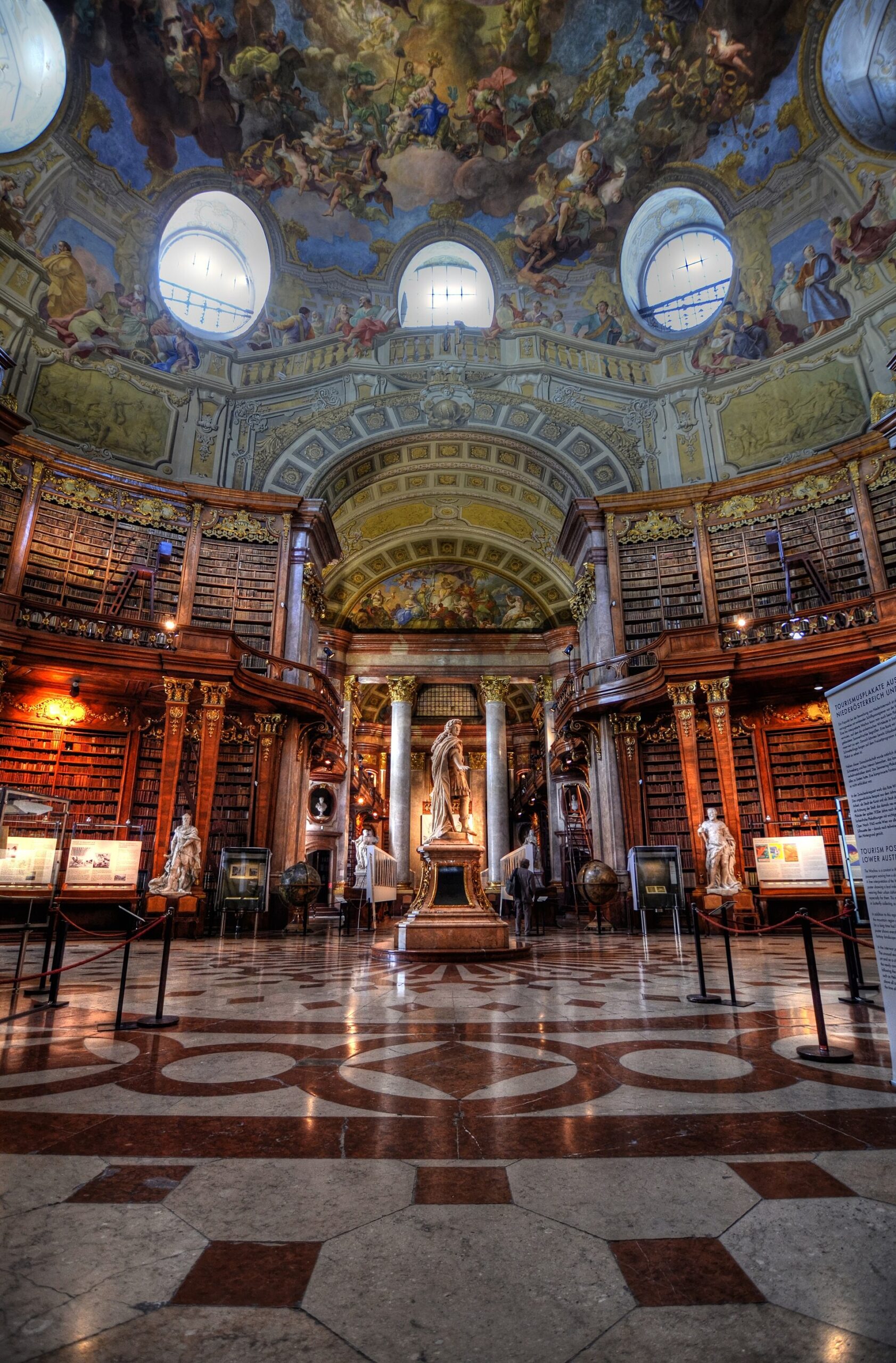
The Austrian National Library, located within the Hofburg imperial palace complex in Vienna, is Austria’s largest library and central memory institution. Founded in 1368 by Albert III, Duke of Austria, it has grown over more than six and a half centuries from a ducal book collection into a national institution holding millions of items across print, manuscript, map, globe, and digital collections. Its legal deposit mandate means every printed work published in Austria, including university dissertations, arrives by law at its doors. Among its holdings are two items on the UNESCO Memory of the World Register, and its digital portal alone provides access to 3.5 million digital objects.
Key facts
- Country: Austria
- Founded: 1368
- Founder: Albert III, Duke of Austria
- Type: national library; museum; cultural institution
- Website: https://www.onb.ac.at/
Origins and Habsburg growth
The library traces its founding to 1368, the year Albert III, Duke of Austria, commissioned the Evangeliar of Johannes von Troppau — a gospel book written in gold with elaborate Bohemian illuminations that remains the oldest identified item in the collection. The date of that commission is the date the institution counts as its own beginning.
Over the following century, Holy Roman Emperor Frederick III pushed the collection further by bringing books to Vienna from other locations, including Prague. The Habsburg holdings continued to expand through dynastic means as well: when Mary of Burgundy married Emperor Maximilian I, the books she brought as part of her marriage dowry enlarged the collection further. By 1575, when Emperor Maximilian II appointed the Dutch scholar Hugo Blotius as the first official head librarian of what was then called the Imperial Library, the collection numbered approximately 9,000 books.
One of the earliest legal deposit systems in European history took formal shape in 1624, when Emperor Ferdinand II ordered the library to begin consistently receiving obligatory copies of new works published within Habsburg territories. That arrangement, expanded under later Austrian media law, remains in force: the library is Austria’s legal deposit library and receives copies of all printed works published or produced in the country, including dissertations from Austrian universities.
The State Hall and its collections
The State Hall, the library’s baroque ceremonial room, houses notable holdings including the approximately 15,000-volume library of Prince Eugene of Savoy, bound in red, blue, and yellow Morocco leather. The hall also contains one of the largest collections of Reformation writings by Martin Luther.
In 2026 the library presented a programme of five public special exhibits selected by online visitor voting for display in the State Hall, accompanied by free expert talks, blog posts, and videos.
Rare and registered holdings
Two items in the library’s care carry inscription on the UNESCO Memory of the World Register. The Vienna Dioscurides (Codex Vindobonensis med. gr. 1) is an early 6th-century illuminated manuscript copy of Dioscorides’ pharmacological treatise De materia medica. It became the first item from the library on the Register when it was inscribed in 1997.
The Atlas Blaeu-Van der Hem followed in 2003. Spanning 50 volumes and containing more than 2,400 maps, prints, and drawings, it is considered one of the most remarkable atlases ever composed. Both items sit alongside a wide range of other material whose age and condition make the library one of the primary repositories of Central European documentary heritage.
Provenance research and restitution
In December 2003 the Austrian National Library became the first federal institution to submit a comprehensive provenance report under Austria’s 1998 Art Restitution Act. The report identified more than 52,000 objects acquired under suspicious circumstances during the Nazi period.
The practical work of restitution followed. In June 2010, the first and largest transfer of heirless books identified in that report — 8,363 individual volumes — was made to the National Fund of the Republic of Austria for Victims of National Socialism, in compliance with the Act.
Digital access and long-term strategy
The ÖNB Digital portal gives access to 3.5 million digital objects drawn from all collections of the Austrian National Library, including materials contributed to the European cultural platform Europeana.
In 2021 the library published Vision 2035, its long-term strategy titled ‘Opening Spaces’ (Wir öffnen Räume), which sets out the institution’s planned development as a modern educational, cultural, and research centre.
Leadership
Dr. Johanna Rachinger served as the library’s director general until a resolution of November 25, 2025, by which Vice Chancellor Andreas Babler formally removed her from the position after injuries from a fall prevented her return to duties. The vacancy announcement for her successor was published in November 2025.
Did you know
- The library’s oldest identified item is the Evangeliar of Johannes von Troppau from 1368 — the same year taken as the institution’s founding date. It is a gospel book with gold text and elaborate Bohemian illuminations, commissioned by Duke Albert III. (vienna-unwrapped.com)
- The Globe Museum’s oldest exhibit is a terrestrial globe by Dutch cartographer Gemma Frisius dating from around 1536, made before cartographers had settled on placing north at the top of the map. (introducingvienna.com)
- The Tabula Peutingeriana, a medieval copy of a Roman road map now held at the library, was discovered in 1494 by Conradus Celtis, the librarian of Emperor Maximilian I, in an unidentified library, and then bequeathed to the humanist Konrad Peutinger in 1508. (thebyzantinelegacy.com)
Data sources
- Wikidata
- onb.ac.at
- saltertonartsreview.com
- webarchiv.onb.ac.at
- ots.at
- unesco.at
- unesco.org
- cerebralboinkfest.blogspot.com
- wien.info
Data updated: 2026-10-30