
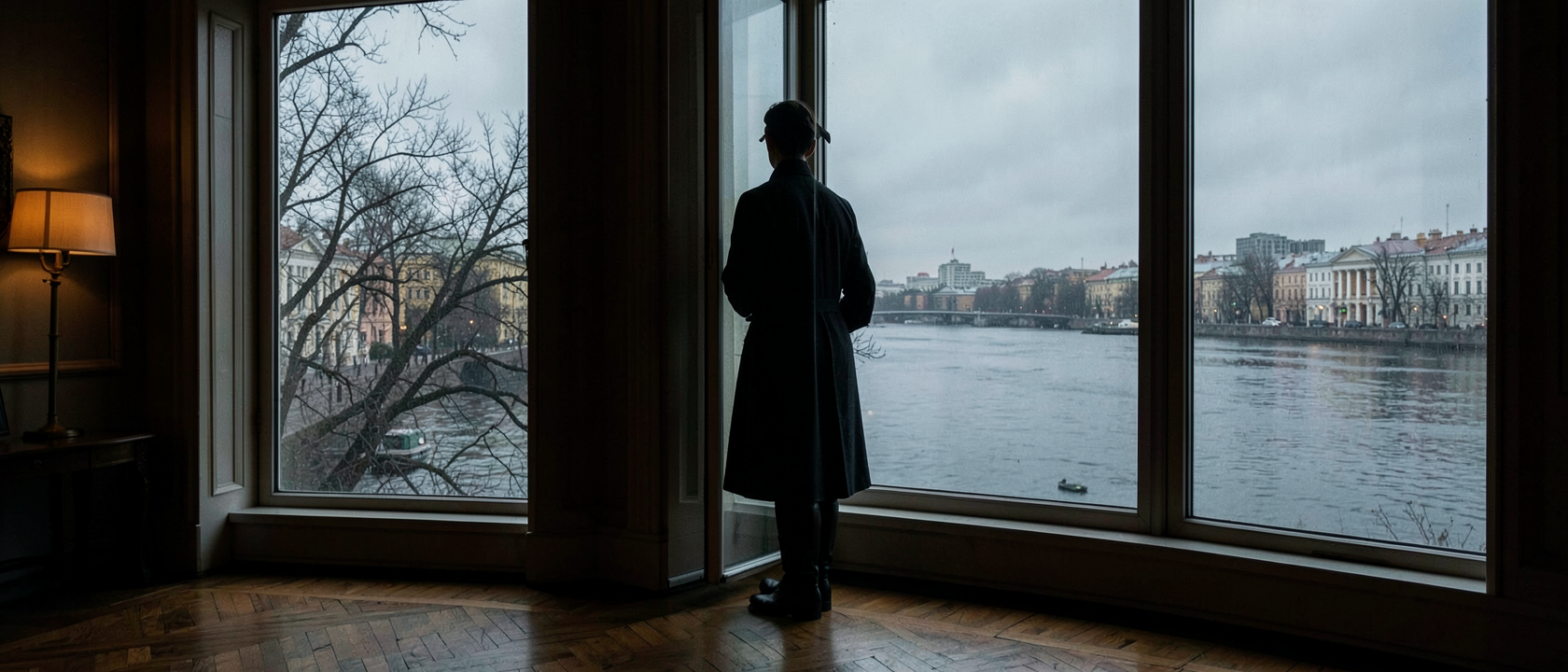
Petrograd, February 1917
In February 1917, Tsar Nicholas II signed a decree dissolving the Duma, the elected legislature that gave Russia’s opposition its only legal platform. Among the deputies sent home was Alexander Kerensky, a lawyer in his mid-thirties who had been elected to the Fourth Duma in 1912 as a member of the Trudoviks, a non-Marxist party aligned with the Socialist Revolutionaries. Kerensky had built his reputation defending revolutionaries in court, and by February 1917 he had become the parliamentary leader of the socialist opposition, known across the city for his oratory.
He did not accept the dissolution quietly. Kerensky called on the garrison soldiers stationed in Petrograd to defy their officers, revolt, and arrest the tsar’s ministers. Soldiers did exactly that. It was one of several documented sparks that, within days, brought down three centuries of Romanov rule, not the only cause of the February Revolution, but a clear and recorded one, with Kerensky’s voice behind it.
Simbirsk, before it all
Kerensky was born on May 4, 1881, in Simbirsk, a provincial town on the Volga known today as Ulyanovsk. His father, Fyodor Kerensky, taught at the local gymnasium and directed it. One of his pupils was a boy named Vladimir Ulyanov, who would later take the name Lenin. The two families were acquainted, and the record leaves it at that: a documented coincidence, mentioned by biographers but never explained by either man.
Inheriting a government with no floor under it
Kerensky entered the Provisional Government when it formed in March 1917, first as Minister of Justice, then from May as Minister of War and Navy, and by July 1917 as Minister-Chairman, effectively its prime minister. For a stretch he also sat as vice-chairman of the Petrograd Soviet, the council of workers’ and soldiers’ deputies that had sprung up alongside the government and answered to no one in it. He was the only person to hold a seat in both bodies at once.
That dual membership was not a technicality. Russia in 1917 had no settled constitution and no single agreed source of legitimacy. Two centers of power shared the same city, the government and the Soviet, and neither could act without the other’s tolerance. Kerensky had risen on skill as a courtroom lawyer and a public speaker. He had never run a ministry before, never commanded troops, never managed the machinery of a state. He now carried authority over a country at war, with nothing solid underneath it.
The decision to keep fighting
In that setting, Kerensky chose to keep Russia in the First World War, continuing the fight against Germany rather than pulling troops out. He made that choice in the spring and summer of 1917, while his government’s standing was still unproven, still contested in the streets of Petrograd and inside the Soviet sitting beside it.
Why he judged this the safer course is not something the sources lay out in his own words. What survives is the decision itself, and what came after it.
What it cost
Kerensky’s government paid for that decision over time. Through the second half of 1917, its authority wore away, worn down by a war it could neither win quickly nor afford to abandon. On November 7, 1917 (October 25 on the old Russian calendar), the Bolsheviks under Lenin took power, ending Kerensky’s months as Minister-Chairman and the Provisional Government with it. Kerensky fled to the front, tried to rally troops to defend his government, failed, and went into hiding.
No surviving account tallies the human or material cost of those months Russia spent still fighting Germany under his leadership. There are no casualty figures to cite here, no ledger of what the continued war consumed. The government built on that decision simply did not outlast it.
Putney, 1970
Kerensky lived for more than fifty years after losing power, eventually settling in the United States. He died in New York City on June 11, 1970, at the age of 89. Local Russian Orthodox churches refused to bury him, regarding him as a Freemason and holding him largely responsible for Russia’s fall to the Bolsheviks; a Serbian Orthodox church turned him away as well. His body was flown to London and buried at Putney Vale Cemetery, a non-denominational ground near Wimbledon Common.
It is the kind of detail that turns up as a pub-quiz question: the man who once called soldiers into the street against a tsar, and who had shared a hometown and a family acquaintance with the man who later deposed him, ended up in a cemetery in a London suburb, a long way from Petrograd and the war he chose to keep fighting.