
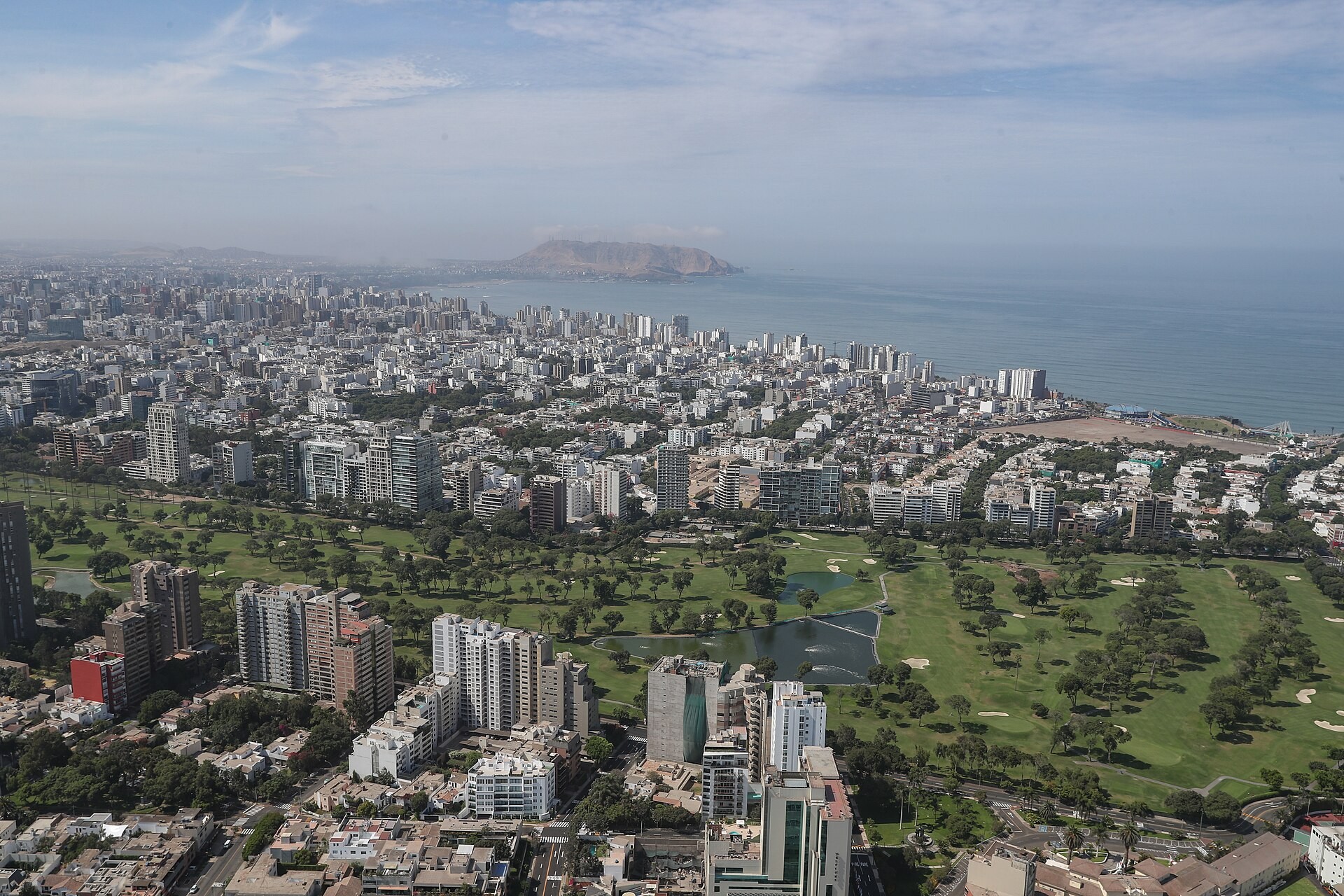
Peru is a sovereign republic on the western edge of South America, covering 1,285,216 km² and home to a population of 34,157,732. Its territory spans three sharply distinct environments: a Pacific coastal desert, the Andean highlands, and the Amazon jungle, the last of which alone accounts for roughly 60 percent of the national area. Founded as an independent state on 28 July 1821, Peru carries the remains of the largest pre-Columbian empire in the Americas and, in 2025, produced a record 2,769,794 tonnes of copper worth approximately US$28.9 billion in exports.
Key facts
- Capital: Lima
- Continent: South America
- Population: 34,157,732
- Area: 1,285,216 km²
- Official language: Spanish; Aymara; Quechua
- Currency: Nuevo sol
- Head of state: Keiko Fujimori
- ISO code: PE
- Founded: 28 July 1821
Geography
Peru’s three geographic zones are locally called the Costa, the Sierra, and the Selva. The Costa is a narrow desert strip along the Pacific; the Sierra is the Andean backbone that cuts through the country from north to south; the Selva is the Amazon basin, vast and heavily forested, covering the majority of Peru’s land area.
Mount Huascarán in the Andes is Peru’s highest point at 6,768 meters (22,205 feet) above sea level. At the other geographic extreme, Peru shares Lake Titicaca with Bolivia. The lake sits at 3,812 meters (12,507 feet) above sea level and is widely recognized as the highest navigable lake in the world. Off the Pacific coast, the Peru-Chile Trench runs for 1,770 kilometers and averages a depth of 5,000 meters.
History
The Incas emerged in the 13th century with Cusco as their capital. During the 15th century they expanded their empire across a vast region stretching from modern-day Colombia to central Chile, making it the largest political entity the pre-Columbian Americas had produced. Spanish forces ended that empire in the 16th century.
Lima was founded in 1535 by Spanish conquistador Francisco Pizarro. It became the seat of the Viceroyalty of Peru, which at its establishment held jurisdiction over all Spanish colonies in South America. The city has functioned as Peru’s capital ever since.
Peru declared independence on 28 July 1821. The country is now governed under the Political Constitution of 1993, which was ratified by referendum on October 31, 1993, and formally promulgated on December 29, 1993. That constitution established Peru as a unitary, representative, and decentralized republic.
Government
Under the 1993 Constitution, the President serves as both head of state and head of government, elected to a five-year term. The legislature is a unicameral Congress of 120 members, also elected for five-year terms. As of 2026, Keiko Fujimori holds the office of head of state.
Peru’s official languages are Spanish, Quechua, and Aymara. Beyond those three, the country has around 91 living indigenous languages, of which 44 are considered stable. Asháninka, Awajún, and Shipibo are among the most widely spoken of the remaining languages.
Economy
Copper is Peru’s dominant export commodity. The country is the world’s third-largest copper producer, a position confirmed by the US Geological Survey in 2026, after being overtaken by the Democratic Republic of Congo in 2023. In 2025, copper exports reached 2,769,794 tonnes, valued at approximately US$28.9 billion, or about 31 percent of all goods Peru sold abroad that year.
China is Peru’s leading trade partner, absorbing about 32 percent of total exports, followed by the United States at 13 percent. Peru’s economy expanded 3.4 percent year-on-year in Q3 2025, the seventh consecutive yearly expansion, with domestic demand growing 6.6 percent in the same period. Public debt in 2025 stood at 101.22 billion USD, representing 30.23 percent of GDP.
Peru is a founding member of the Pacific Alliance alongside Chile, Colombia, and Mexico, a trade bloc focused on deepening economic ties with Asia-Pacific economies. Peru is scheduled to assume the bloc’s rotating presidency in December 2026.
Culture and gastronomy
Peruvian ceviche has been recognized by UNESCO as an Intangible Cultural Heritage. The dish reflects the fusion of indigenous, African, and European culinary traditions that characterize Peruvian gastronomy more broadly.
Peru’s currency is the Nuevo sol, and its ISO country code is PE.
Did you know
- The potato was first domesticated in the Andean highlands of what is now southern Peru and northwestern Bolivia between 8,000 and 5,000 BCE. DNA evidence from a 2005 PNAS study traces all cultivated potatoes to a single domestication event near Lake Titicaca. The International Potato Center in Lima now preserves more than 4,000 potato accessions. (potatopedia.com)
- The Peruvian Amazon rainforest is larger than the entire area of France, yet it is home to approximately 60 indigenous peoples, including around 25 groups that remain uncontacted. (nicfi.no)
- The Peru-Chile Trench off Peru’s Pacific coast is 1,770 kilometers long and averages a depth of 5,000 meters, roughly equal in depth to the height of the Andes Mountains. (nationsencyclopedia.com)
- Peru ranked as the world’s second-largest copper producer for many years before being overtaken by the Democratic Republic of Congo in 2023, slipping to third place according to the US Geological Survey in 2026. (economicsobservatory.com)
Data sources
- Wikidata
- nationsencyclopedia.com
- worldatlas.com
- explorandes.com
- globalsecurity.org
- cidh.oas.org
- wipo.int
- blog.rosettastone.com
- riotimesonline.com
- tradingeconomics.com
- valenciatravelcusco.com
- 360nations.com
- worlddata.info
Data updated: 2026-10-31