
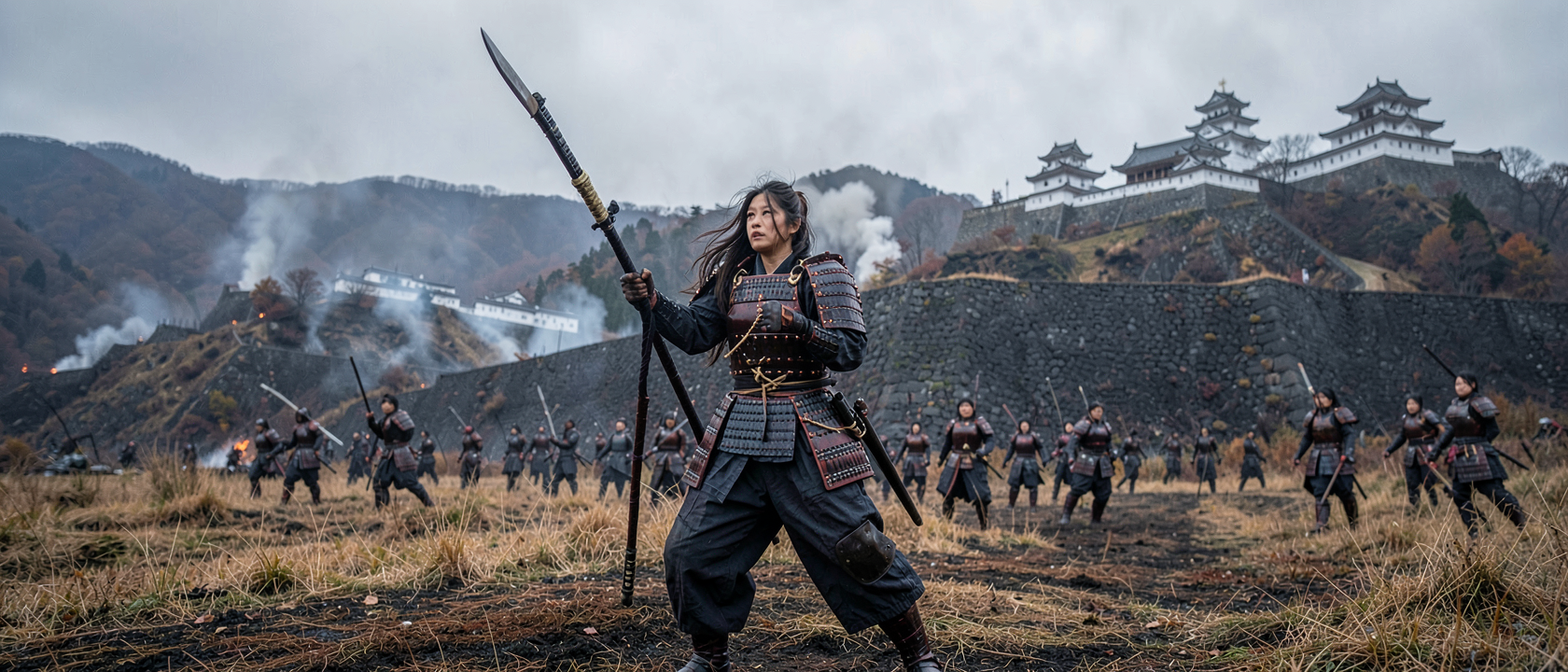
The Halberd and the Refusal
In October 1868, imperial forces were moving through Aizu domain [modern Fukushima Prefecture] fast enough that thousands of fighters and civilians had begun converging on Tsuruga Castle. Among them was Nakano Takeko, born in Edo [modern Tokyo] in April 1847, trained since childhood in naginatajutsu, the use of the naginata, a Japanese polearm with a curved blade, and in the Ittō-ryū style of swordsmanship. By 1868 she had been working as a martial arts instructor.
When she presented herself for enrollment in a male fighting battalion, senior Aizu retainers refused her, claiming her presence would signal weakness to the enemy. She responded by threatening suicide. A newly arrived commander overruled the refusal, and within days an autonomous women’s combat unit was authorized. Known retroactively as the Jōshitai, it numbered an estimated 20 to 30 fighters; the names of only 10 are recorded.
During a forward engagement, Takeko killed five or six enemy soldiers with her naginata before she was shot in the chest. She died on October 16, 1868, aged 21 by the Western count, though some sources record 22. Fighting beside her was her sister, whose name sources give as either Masako or Yūko. At Takeko’s reported request, her sister severed her head to prevent its capture as a trophy. Her head was buried at Hōkai-ji Temple in Aizubange, Fukushima; her naginata was donated to the same temple. The surviving Jōshitai members fell back to Tsuruga Castle.
What the War Was Actually Deciding
The Boshin War, which ran from January 1868 to June 1869, was not a territorial dispute in the conventional sense. Emperor Meiji’s imperial coalition was dismantling the Tokugawa shogunate, which had governed Japan since 1603, and replacing its institutions with a centralized, Western-influenced state. Conscript armies would replace hereditary warrior clans, and the samurai class that had defined rank and obligation through the Edo Period (1603–1867) would be formally dissolved.
For Aizu domain, none of this was abstract. The Aizu lords had served the Tokugawa for generations; that relationship was the foundation of their authority and identity. Aizu samurai women were trained to place duty to their lord above duty to their families, not private ethics, but an institutional arrangement backed by law. When Tsuruga Castle came under siege, the Onna-Bugeisha (“female martial arts masters”) were functioning inside a social architecture that the Meiji state was in the process of making legally extinct.
Seven Centuries of Armed Women
The Jōshitai was the final operational expression of a documented tradition stretching back at least to the Genpei War of 1180–1185. The most prominent figure from that period is Tomoe Gozen, described in The Tale of the Heike (Heike Monogatari, composed in the early 13th century) as a principal commander serving Minamoto no Yoshinaka. Her historicity, however, is disputed: she does not appear in primary accounts of the Genpei War independent of that epic, and there is scholarly doubt as to whether she existed at all. Steven T. Brown, writing in the Harvard Journal of Asiatic Studies in 1998, examined the multiple layers through which her story was transmitted; her specific battlefield exploits as recorded in the epic have almost certainly been shaped by that process. Hangaku Gozen, of the Taira-allied Jō clan, fought in the Kennin Rebellion of 1201 and was captured, not killed.
Through the Edo Period, women of samurai households received formal naginata training as a standard feature of their upbringing. Most would never see combat. The training was real regardless, and it produced the women who, in October 1868, knew exactly what to do.
Inside the Walls
Yamamoto Yaeko, aged 22 or 23 at the time, was the daughter of an Aizu domain gunnery instructor and had been trained in firearms as well as the naginata. She organized cannon operations and directed ammunition production under fire. An estimated 1,200 cannonballs were fired at her position during the siege. Nakano Kōko, Takeko’s mother and a co-founder of the Jōshitai, fought inside the castle walls alongside her younger daughter, who survived. Kawahara Asako killed her own mother-in-law and daughter to prevent their capture, then took up arms in the castle’s defense. The majority of women inside Tsuruga Castle made ammunition, treated the wounded, and held the garrison together across roughly 30 days of bombardment. Their names have not survived. Aizu surrendered after approximately 30 days.
The Bill
Under the Meiji government, women were legally barred from political meetings and all political activity. The samurai class, and with it the framework that had given Onna-Bugeisha formal standing, was dissolved. The disappearance from the official narrative was slower but equally complete: when Nitobe Inazō published Bushido: The Soul of Japan in New York in 1899, he produced a widely read account of samurai values that placed women’s role firmly in the domestic sphere. The women who had fought in Aizu in October 1868 did not appear in it.
Yamamoto Yaeko negotiated the new order with more success than most. She divorced in 1871, moved to Kyoto, converted to Christianity, and in 1876 married the Reverend Joseph Hardy Neesima. She co-founded Doshisha Girls’ School alongside American missionary Alice J. Starkweather, played a significant role in establishing Doshisha University, later joined the Japanese Red Cross, and served as a nurse in two separate wars. She died in Kyoto on June 14, 1932.
The fates of most women who survived the siege are simply absent from the record. Each autumn, during the Aizu Autumn Festival, young girls walk in procession in Nakano Takeko’s memory. Her naginata remains at Hōkai-ji Temple.