
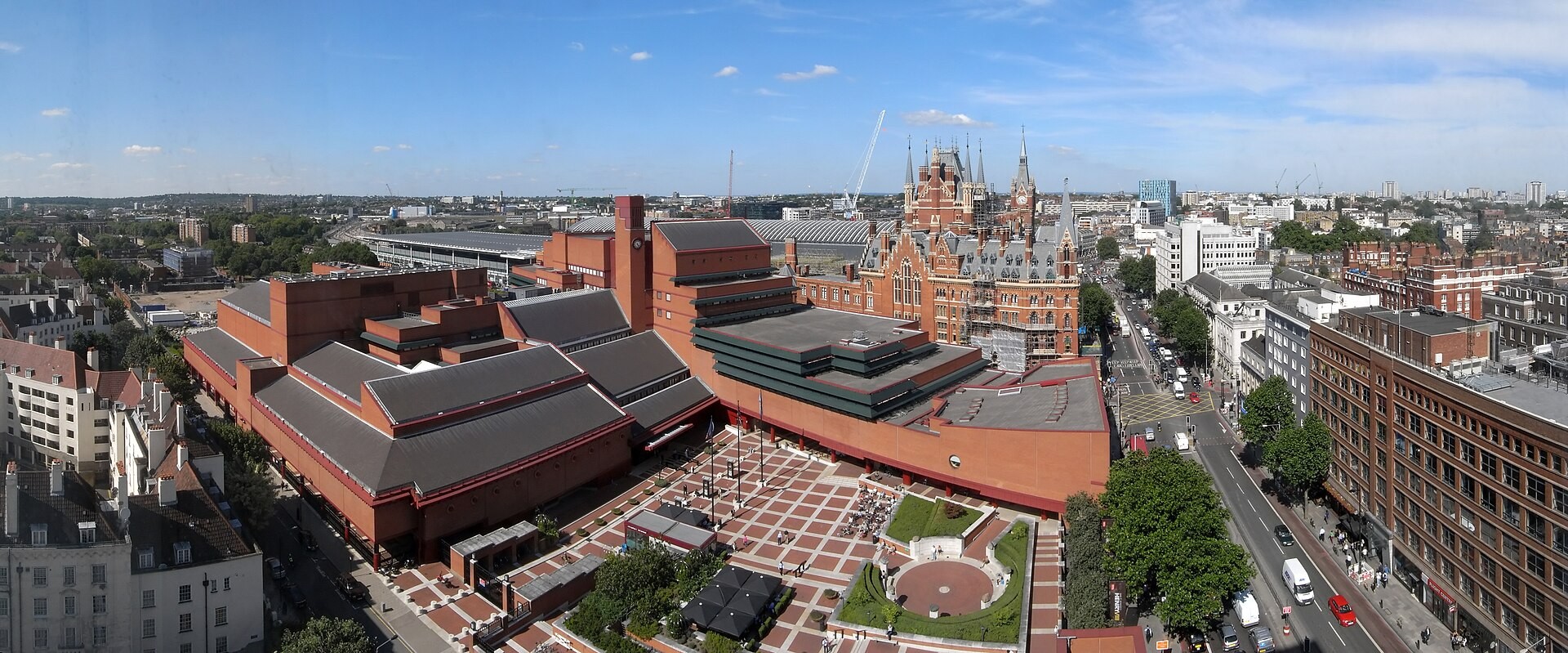
The British Library is the national library of the United Kingdom, founded on 1 July 1973 and headquartered in London. It operates as a reference, research, and universal library, holding one of the largest collections of written and printed material in the world. Its second major site, near Boston Spa in West Yorkshire, holds approximately 70 percent of the library’s total physical collection and functions as the national hub for inter-library lending and document supply.
Key facts
- Country: United Kingdom
- Founded: 1 July 1973
- Headquarters: London
- Type: national library; reference library; research library; universal library
- Website: https://bl.uk
Buildings and Sites
The library’s principal home is the St Pancras building in London, which is the largest public building constructed in the United Kingdom during the 20th century. Its design was the work of architect Colin St John Wilson, who began the project in 1962 in partnership with Leslie Martin on a scheme intended for a Bloomsbury site. Wilson described the journey from first drawings to the building’s opening in 1997 as his “30-year war.”
The second main site sits near Boston Spa, Wetherby in West Yorkshire. While less visited by the general public, it is operationally central: the Boston Spa site holds roughly 70 percent of the library’s physical holdings and manages document supply for institutions across the country.
In 2023 the British Library submitted development plans to Camden Council for a major extension of the St Pancras building, and the council approved them the same year. The planned extension will create 100,000 square feet of new public space, including new exhibition galleries that will double the size of the existing gallery space, a new learning centre, and expanded incubator spaces for entrepreneurs.
Legal Deposit and Collection Scope
Under the Legal Deposit Libraries Act 2003, the British Library is entitled to receive one copy of every printed work published in the United Kingdom within one month of publication. This right places a legal obligation on publishers rather than relying on voluntary donation, and has shaped the comprehensiveness of the collection over decades.
From 6 April 2013, the scope of legal deposit expanded significantly. Under the Legal Deposit Libraries (Non-Print Works) Regulations 2013, the British Library and five other specified legal deposit libraries became entitled to harvest content from UK-published material on UK websites and to collect UK-published e-journals and ebooks, extending the deposit framework into the digital domain.
Reading Rooms and Public Access
The British Library operates 11 reading rooms in London at St Pancras and one reading room at Boston Spa in Yorkshire. All are accessible free of charge to anyone holding a Reader Pass, making the collections open to individual researchers regardless of institutional affiliation.
The library also administers the Public Lending Right, through which authors receive payments based on loans of their books from public libraries across the UK. This function positions the library not only as a custodian of material but as an organisation with an active role in supporting the economics of authorship.
The Collection: Selected Holdings
The Sir John Ritblat Treasures Gallery hosts a permanent free public exhibition that brings together some of the most significant items in the collection. On display are two of the four surviving original 1215 Magna Carta documents, the Lindisfarne Gospels, the Diamond Sutra, Shakespeare’s First Folio, and handwritten Beatles lyrics.
The library holds 347 leaves of the Codex Sinaiticus, acquired in 1933 from the Soviet government. This constitutes the largest single share of the oldest surviving Christian Bible manuscript.
Also in the collection is Cotton MS Vitellius A XV, the unique manuscript of the Old English epic poem Beowulf. It forms part of the Cotton collection, one of the foundation collections on which the library was built.
Governance and Leadership
The British Library Board consists of the Chair and between 8 and 13 other members. All are appointed by the Secretary of State except for one member appointed by HM The King. The Chief Executive is the only full-time executive member of the Board.
Rebecca Lawrence was appointed as Chief Executive on 24 October 2024 and took up the role from 2 January 2025, succeeding Sir Roly Keating, who had led the library since 2012.
The 2023 Cyberattack
On 28 October 2023 the British Library suffered a major ransomware attack carried out by a criminal group known as Rhysida. The attackers exfiltrated approximately 600 GB of data. The library refused to pay the reported ransom of 20 bitcoins, at the time equivalent to approximately £600,000. Rhysida subsequently published most of the stolen data on the dark web.
The cost of recovering from the attack and restoring online access has been estimated at approximately £7 million. The incident drew wide attention to the vulnerability of major public institutions to ransomware, and the library’s response, including the decision not to pay, became a reference point in discussions of institutional cybersecurity policy.
Did you know
- If a visitor were to examine five items from the British Library’s collection each day, it would take over 80,000 years to view the entire collection. (britishlibrary.cn)
- The original Round Reading Room at the British Museum Library, forerunner to the British Library, was officially opened on 2 May 1857 with a “breakfast” of champagne and ice cream eaten off the catalogue desks. (britishlibrary.cn)
- The Diamond Sutra held by the British Library predates the Gutenberg Bible by roughly six centuries. It is a woodblock-printed scroll approximately 16 feet long, discovered sealed in a cave near Dunhuang on the Silk Road until around 1900. (factsmate.com)
Data sources
- Wikidata
- publishing.co.uk
- tcd.ie
- wikishire.co.uk
- c20society.org.uk
- bl.uk
- metroinsight.co.uk
- lrb.co.uk
- sps.columbia.edu
- finebooksmagazine.com
- apply-for-public-appointment.service.gov.uk
Data updated: 2026-10-31