
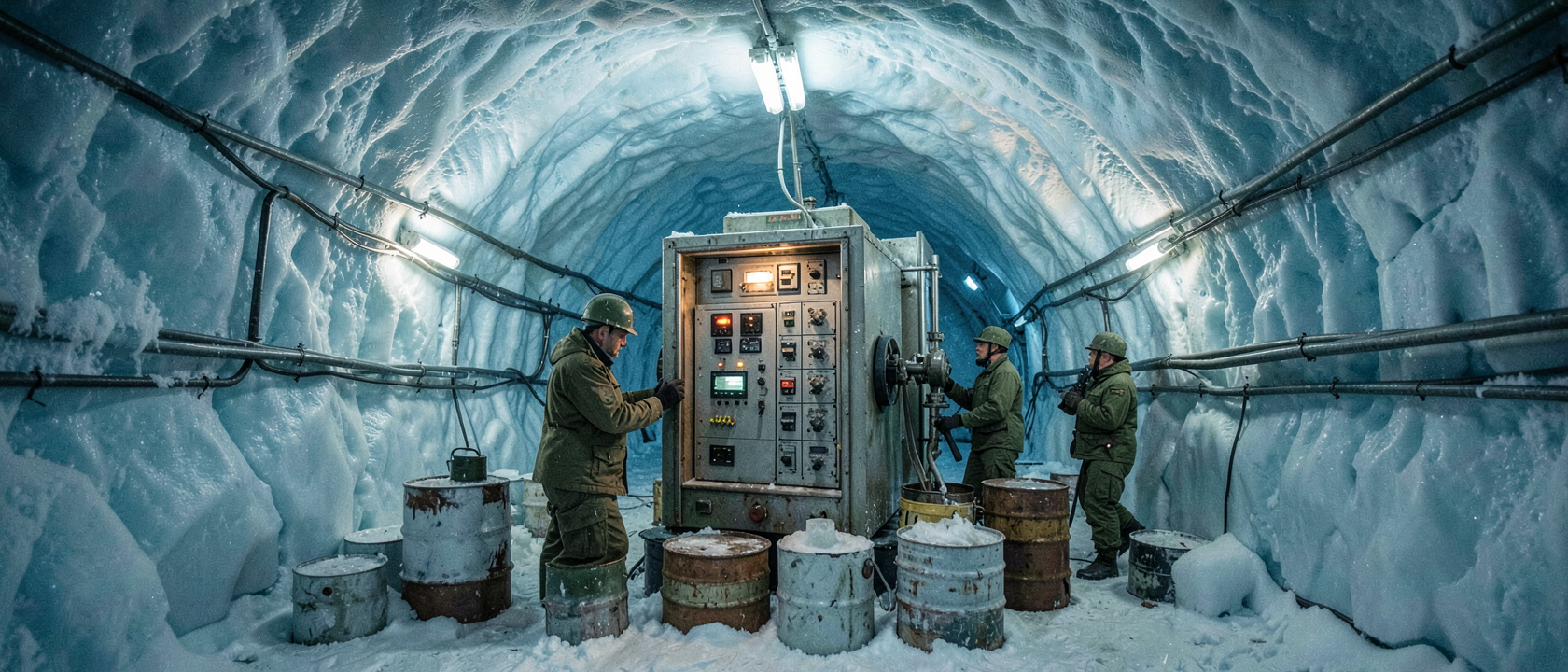
330 Tons on a Moving Floor
In July 1960, cargo aircraft and ships delivered the disassembled components of the PM-2A reactor to Thule Air Force Base on the northwestern coast of Greenland. Army engineers loaded the 330-ton shipment onto tracked vehicles and hauled everything 138 miles across the ice sheet to Camp Century, a network of 21 tunnels cut roughly 40 feet below the surface, totaling about 1.9 miles in length and housing approximately 200 men. The camp had been under construction since 1959, carved out by the Army Corps of Engineers.
In October 1960, engineers brought the PM-2A to criticality for the first time. Instruments immediately registered dangerous neutron leakage. The reactor was shut down, no fix was found, and engineers fashioned improvised shielding from lead plates and 55-gallon drums packed with ice and sawdust before running it anyway.
What Forty-Four Pounds Was Supposed to Replace
Since 1954, the Army had been developing compact reactors for remote installations. The operational problem was real: supplying Cold War outposts required continuous diesel runs across some of the most difficult terrain and sea ice on earth. Forty-four pounds of enriched uranium could, in theory, displace more than a million gallons of diesel. If that arithmetic held at scale, the Army calculated it could sustain outposts anywhere on the planet without depending on surface supply lines for fuel. The PM-2A was the third reactor in a family of eight the Army ultimately built.
What the Reactor Actually Did, and What It Left
Between early 1961 and July 9, 1963, the PM-2A ran for 33 months, setting records of 1,038 and 2,502 continuous hours after August 1962. Over its lifetime it produced just over 11.2 million kilowatt-hours of electricity, powering a camp whose actual demand ran between 300 and 500 kilowatts, well below the reactor’s design capacity of 1,560 kilowatts.
Throughout those 33 months, the known neutron leakage continued. Steel pipes and the reactor vessel grew progressively more radioactive, and cooling water leaked dozens of radioactive isotopes into the system. Army records indicate that radioactive cooling water was disposed of into a sump dug within the ice sheet.
The 1964 Shutdown and Joseph Franklin’s Two Minutes
The Army dismantled the PM-2A in 1964. During that process, Commanding Officer Joseph Franklin estimated he was exposed to a radiation field of approximately 2,000 rads per hour for around two minutes, figures that are his own estimates, not independently verified. The Army sent him to Bethesda Naval Hospital, where he set off a whole-body radiation counter designed for nuclear accident victims.
By 1964, the PM-2A was not the program’s only failure. At McMurdo Sound in Antarctica, the PM-3A reactor logged 438 documented malfunctions over a decade, including a fractured containment vessel. On January 3, 1961, the SL-1 experimental reactor in Idaho exploded during a restart procedure, killing three men, the only fatal nuclear reactor accident in U.S. history. The ML-1, the program’s only fully truck-mounted reactor, was never made reliably operational and was canceled in 1965.
Cancer, Ice Melt, and Three Countries Without an Answer
Camp Century closed in 1967. Its waste, radioactive cooling water, approximately 52,800 gallons of diesel fuel, roughly 63,400 gallons of sewage, and contaminated construction materials across about 136 acres of ice, was left in place on the assumption the ice sheet would contain it indefinitely. The PM-2A itself was removed and buried at a nuclear waste facility in Idaho.
Franklin retired as a major general. In 2002, surgeons removed a cancerous prostate and kidney; by 2015 the cancer had spread to his lungs and bones. He died on March 8, 2017, of kidney cancer.
In 2016, a scientific team led by glaciologist William Colgan published projections in Geophysical Research Letters estimating that under a high-emissions scenario, Camp Century’s buried waste could begin to be exposed by approximately 2091, when net ice accumulation at the site gives way to net ablation. The study opened a diplomatic dispute over cleanup responsibility among the United States, Denmark, and Greenland that has not been formally resolved. One cost benchmark: the SM-1 reactor at Fort Belvoir, Virginia, built for $2 million, is projected to require $68 million to remediate.
What the Record Does Not Settle
How many Camp Century personnel beyond Franklin suffered radiation-related illness is not established by the available historical record. Financial responsibility for cleanup among the United States, Denmark, and Greenland has not been formally assigned. In May 2021, the Pentagon requested $60 million for Project Pele, a program to develop a truck-transportable reactor using fuel sealed in pellets roughly the size of poppy seeds and relying on air cooling, eliminating the radioactive liquid coolant that caused PM-2A’s leakage. The foundational argument was the same one the Army made in 1960: remote operations require power that does not depend on a fuel supply chain.