The Shelves Go Empty
Before September 29, 1939, when German forces completed their occupation of Warsaw, Basia Temkin-Berman worked as a librarian at the National Library of Poland on Koszykowa Street. She was one of the very few Jews employed there. Within days of occupation, that fact became an administrative liability. Jewish lending libraries in the Jewish quarter were ordered shut; Jews were simultaneously barred from Warsaw’s public libraries. These were among the earliest administrative acts of the occupation, arriving before most of the broader apparatus of persecution was in place. For a literate, book-dependent urban community, the closures hit at the precise moment every other form of civic protection was also gone. Culture and law vanished together.
The Arithmetic of Enclosure
On October 2, 1940, Ludwig Fischer, the Nazi Governor of the Warsaw District, formally decreed the establishment of what German authorities called the Jüdischer Wohnbezirk in Warschau. By November 15 or 16, 1940 (institutional sources differ by a single day), the ghetto was sealed. A wall approximately 10 feet (3 meters) high, topped with barbed wire and broken glass, enclosed a district accounting for about 2.4% of Warsaw’s total land area. At sealing, approximately 395,000 Jews were confined inside; by the summer of 1941, as Jews from surrounding areas were forced in, the population reached an estimated 450,000 to 460,000. Twenty-two guarded gates controlled all movement, open only at set hours and requiring special permits.
184 Calories
The official German food ration for ghetto residents was set at approximately 184 calories per day, a figure that varies slightly across institutional sources, ranging from around 180 to 184, depending on which point in the occupation is measured. The actual average caloric intake in 1941, supplemented by whatever could be smuggled past the gates, has been estimated at around 1,125 calories, itself well below any threshold of adequate nutrition. By August 1941, more than 5,000 people per month were dying of starvation and disease. Estimated total deaths from starvation and disease range from roughly 80,000 to 100,000 across late 1940 through mid-1942. Organized relief concentrated on food, medicine, clothing, and warmth. That context frames what it meant to run a children’s reading library inside the ghetto.
What the Librarian Did
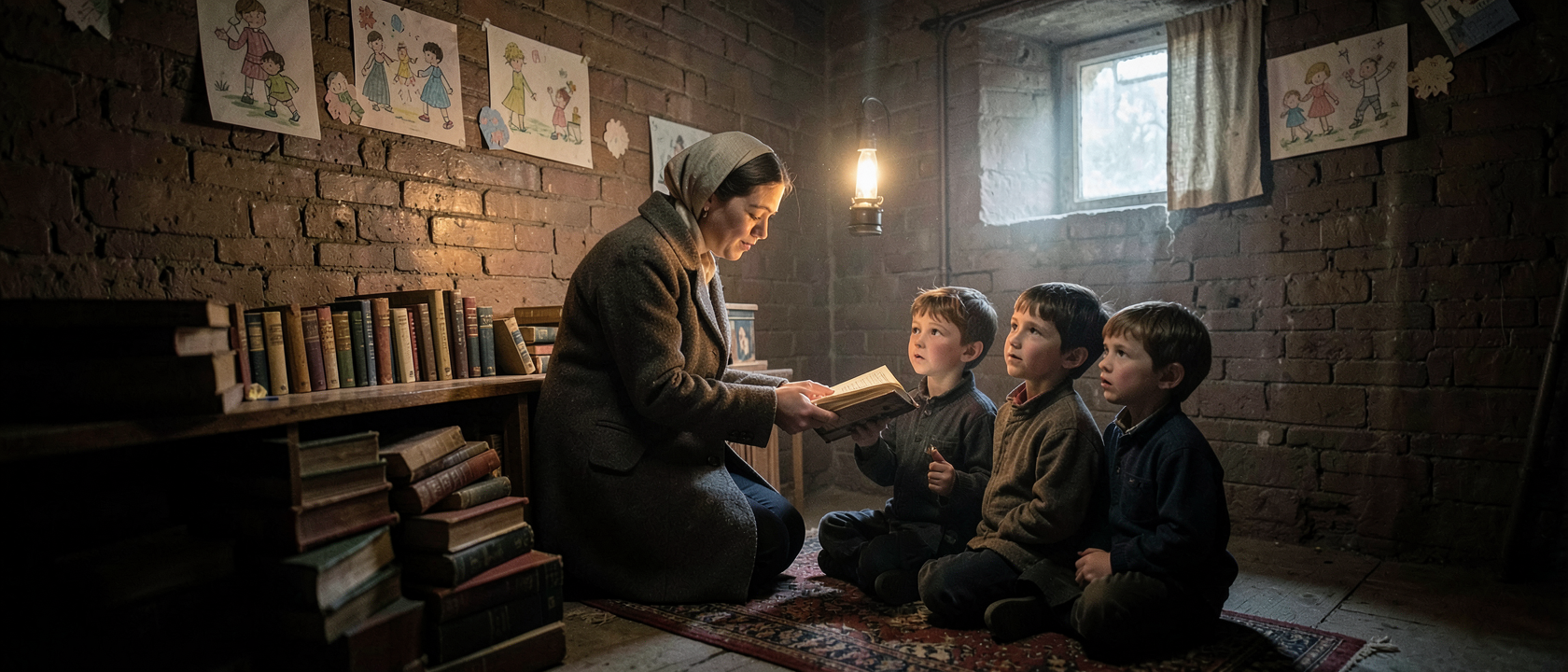
Temkin-Berman was locked inside the ghetto from November 1940 onward, together with her husband, Dr. Adolf Abraham Berman, a psychologist who served as head of CENTOS (Centralne Towarzystwo Opieki nad Sierotami, the Central Organization for Orphan Care), the primary Jewish welfare organization for children in the ghetto. Working within CENTOS, she established and ran a secret children’s library in direct defiance of the Nazi prohibition on Jewish access to books. Its clandestine character was not incidental; running it meant accepting the mortal risk it entailed.
The surviving institutional record does not establish the library’s exact opening date, the size of its collection, or how many children it served. What multiple sources confirm is the fact of its existence, its prohibited character, and Temkin-Berman’s role in running it. In March 1942, she and her husband co-founded the Anti-Fascist Bloc, an underground coalition of Jewish resistance organizations inside the ghetto. By that point she was simultaneously maintaining a secret reading library for children and helping to organize armed resistance.
Summer 1942 and the Silence After
On July 22, 1942, German authorities launched the Grossaktion Warschau. Over the following two months, approximately 265,000 Jews from the Warsaw Ghetto were deported to the Treblinka extermination camp; an estimated 35,000 more were killed inside the ghetto during the same period. The deportations ran through September 21, 1942. Adolf and Basia Berman escaped from the ghetto on September 5, 1942, during the deportation action. Whether the library was still operating when the deportations began is not recorded. What happened to its collection is not recorded.
What the Record Holds
Temkin-Berman survived the war. Between January 1944 and January 1945, living on the Aryan side of Warsaw, she kept a diary, later published as Diary from the Underground (Dziennik z podziemia). She also wrote a memoir, City Within a City. After the war she became managing director of the Central Jewish Library at the Central Jewish Committee, assembled from more than 100,000 volumes recovered from the ruins of the Warsaw Ghetto and other Polish ghettos. She died on April 30, 1953, in Petah Tikva, Israel.
The library she ran inside the ghetto left a thin documentary trace. Her name is recoverable; the library’s operational history is largely not. The children who came to borrow books from her, in a sealed district where the official daily food allowance amounted to approximately 184 calories, left no testimony that the archive has preserved. That is what the record holds, and what it doesn’t.