
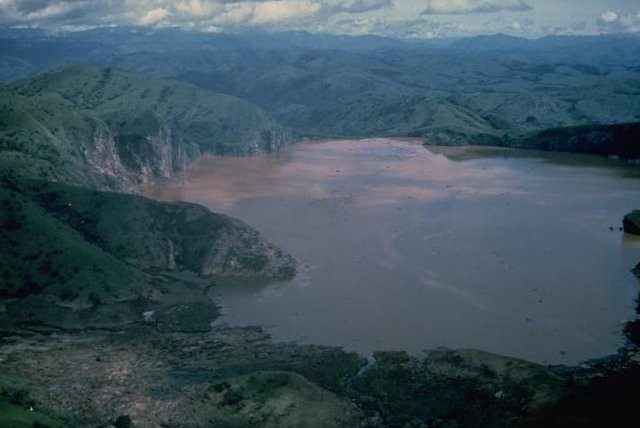
Lake Nyos is a crater lake in the Northwest Region of Cameroon, sitting at an elevation of 1.1 km above sea level within a maar roughly 1,800 m across and 208 m deep. The lake fills an explosion crater formed when a lava flow met groundwater, and geologists estimate the maar itself is about 400 years old. Its waters are permanently stratified, with CO2 concentrations rising sharply toward the bottom, a condition that made the lake one of the most dangerous bodies of water on Earth. On August 21, 1986, the lake released approximately 1.6 million tonnes of carbon dioxide in a limnic eruption that killed 1,746 people and 3,500 livestock within roughly 25 km of the shore.
Key facts
- Country: Cameroon
- Type: lake
- Located in: Northwest
- Coordinates: 6.4381, 10.2989
- Area: 2 km²
- Elevation: 1.1 km
Geology and formation
Lake Nyos occupies a maar, a type of low-relief volcanic crater produced when rising magma or lava contacts groundwater and flashes it explosively to steam. The crater is roughly circular, 1,800 m in diameter and 208 m deep. Geologists place the formation of the Nyos maar at around 400 years ago. The broader Cameroon Volcanic Line, the tectonic feature to which the lake belongs, has been volcanically active since the African and South American plates separated approximately 110 million years ago.
The lake is classified as meromictic: its water layers do not mix with the seasons as they do in most lakes. Instead, depth corresponds directly to increasing CO2 concentration and decreasing temperature. Gas-rich water from the lake’s floor stays in place indefinitely, allowing dissolved carbon dioxide to accumulate over decades and centuries. Lake Nyos is one of only three lakes in the world known to be saturated with carbon dioxide; the other two are Lake Monoun, located about 100 km away in Cameroon, and Lake Kivu, shared between the Democratic Republic of Congo and Rwanda.
The 1986 limnic eruption
On August 21, 1986, the lake underwent a limnic eruption, a sudden and catastrophic overturn of its water column that released about 1.6 million tonnes of CO2 into the atmosphere. The gas rose at nearly 100 km per hour. Because carbon dioxide is approximately 50 percent denser than air, the cloud did not disperse upward; it clung to the ground and flowed downhill through the valleys below the lake.
The villages of Nyos, Kam, Cha, and Subum were directly in the path of the descending gas. The eruption killed 1,746 people and 3,500 livestock within roughly 25 km of the lake. Survivors described smelling rotten eggs, a trace of hydrogen sulfide mixed into the CO2; many lost consciousness and woke hours later surrounded by the bodies of family members and animals.
After the eruption, the lake’s normally blue water turned a deep red. Iron-rich water drawn up from depth was oxidized when it reached the surface, producing the color change. The lake level also dropped by about one metre. Before 1986, Nyos village had been a trading community with a regional market and tourists visiting the lake; the eruption destroyed much of that economic life.
Degassing and dam works
In 2001, a single pipe was installed to draw CO2-saturated water from the lake’s depths up to the surface, where the gas could escape safely. A 2005 USGS study found that even after this pipe had been operating for several years, gas saturation in the lake remained as high as 97%. The same study modeled that five pipes would be needed to reduce gas levels by 75 to 99% by 2010, underscoring how much CO2 had accumulated over the years since 1986.
A separate concern was the natural dam at the lake’s outlet. Erosion posed a risk of dam failure, which could send a wave of CO2-saturated water downhill. Reinforcement works were completed by 2013, including a waterproof subsurface wall and a reinforced concrete slab across the spillway to manage overflow. As of 2019, the dam had demonstrated stability.
Survivors and displaced communities
Following the disaster, residents of the affected villages were evacuated and resettled in camps around the Menchum area. As of 2026, the population in those resettlement camps had grown to more than 12,000 people. Many have been calling for the right to return to their ancestral land, four decades after the eruption displaced their communities.
Did you know
- A 2005 USGS study found that after the single degassing pipe installed in 2001, gas saturation in Lake Nyos was still up to 97%. The study modeled that five pipes would be needed to remove 75 to 99% of the remaining gas by 2010, illustrating the scale of what remained trapped in the lake nearly two decades after the 1986 disaster. (usgs.gov)
- Lake Kivu, shared by the Democratic Republic of Congo and Rwanda, is approximately 2,000 times larger than Lake Nyos and is also supersaturated with dissolved gases. Geologists have found evidence of outgassing events around Lake Kivu occurring roughly every thousand years. (chelseamorning.wordpress.com)
Data sources
- Wikidata
- volcano.oregonstate.edu
- science.nasa.gov
- samplecontents.library.ph
- worldatlas.com
- solarspell-dls.sfis.asu.edu
- scienceinsights.org
- theguardianpostcameroon.com
- grokipedia.com
- hilltopvoices.com
Data updated: 2026-11-01