
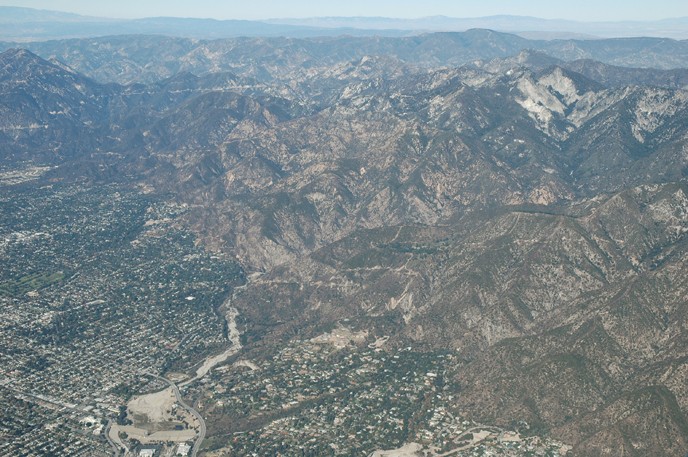
Altadena is a census-designated, unincorporated community in Los Angeles County, California, situated at an elevation of 413.92 meters along the base of the San Gabriel Mountains, just north of Pasadena. With a population of 42,846 spread across 23 square kilometers, it occupies a band of foothill terrain bounded by the Arroyo Seco, Angeles National Forest, and Eaton Canyon on three sides. Founded in 1887, the community has never incorporated as a city, a status its residents have defended more than once. In January 2025, the Eaton Fire swept through Eaton Canyon and burned across much of Altadena, killing 19 people and destroying over 9,000 structures in one of the most damaging fires in Southern California history.
Key facts
- Country: United States
- Type: census-designated place in the United States; unincorporated community
- Located in: Los Angeles County
- Coordinates: 34.1886, -118.1347
- Population: 42,846
- Area: 23 km²
- Elevation: 413.92 m
- Founded: 1887
Origins and Early Development
The land that became Altadena was once part of Rancho San Pascual, a Mexican land grant of about 14,000 acres that also encompassed the future sites of Pasadena and South Pasadena. When Pasadena incorporated during the Southern California land boom of 1886, ranchers and farmers in the highland area successfully resisted the new city’s attempt to draw them within its limits. That resistance set the trajectory for everything that followed: Altadena would remain unincorporated, governed at the county level, while its southern neighbor grew into a full municipality.
The community was formally founded in 1887, placing it squarely in the speculative era of Southern California settlement. Its elevated position above Pasadena, at 413.92 meters above sea level, gave it a distinct character from the valley towns below, and that geographic separation reinforced the political one.
The Mount Lowe Railway
One of Altadena’s most distinctive early landmarks was the Mount Lowe Railway, a scenic mountain railway built by Professor Thaddeus S. C. Lowe. The line originated at a station called Mountain Junction, located at Lake Avenue and Calaveras Street in Altadena, and opened on July 4, 1893. It used an entirely electric traction system, which was unprecedented for mountain travel at that time, and was marketed as the ‘Grandest Scenic Trip on Earth.’ The railway drew visitors from across the region to the foothills above Altadena and connected the community to the broader tourism economy of late-nineteenth-century Southern California.
Geography and Natural Setting
Altadena covers 23 square kilometers at the foot of the San Gabriel Mountains, with wilderness pressing against three of its four sides. The Arroyo Seco runs along one edge, Angeles National Forest along another, and Eaton Canyon along a third. The city of Pasadena forms its southern boundary.
Eaton Canyon Natural Area, a 190-acre zoological, botanical, and geological preserve, sits at the base of the San Gabriel Mountains on the eastern edge of Altadena. A roughly 4-mile round-trip trail within the preserve leads to a 40-foot waterfall. The canyon that lends the preserve its name also gave the 2025 fire its name.
Community Character and Diversity
Altadena’s built environment reflects more than a century of varied tastes: modest Craftsman bungalows share neighborhoods with Italianate mansions and Modernist homes. The architectural range corresponds to a social history equally varied. In 1960, Black residents made up only 4 percent of the population. Within two decades, Altadena had become one of the most significant Black middle-class enclaves in California, with unusually high rates of Black homeownership and multi-generational households.
In 2022, Altadena became the site of the first land return in Los Angeles County to the Tongva people, when a one-acre property was transferred to the Tongva Taraxat Paxaavxa Conservancy. The transfer marked a concrete, if small, step in a broader movement of land acknowledgment and restitution across California.
Notable Residents
Several people who shaped American science, literature, and sport lived in Altadena at various points. Seismologist Charles Richter, whose name became attached to the earthquake magnitude scale he developed, lived there, as did Nobel-winning physicist Richard Feynman and astronomer George Ellery Hale. Science fiction writer Octavia E. Butler lived in Altadena for years before her death in 2006 and is buried there. The family of baseball player Jackie Robinson also called Altadena home.
Butler’s 1993 novel ‘Parable of the Sower’ depicted fires ravaging Los Angeles neighborhoods in the year 2025. When the Eaton Fire destroyed much of Altadena in January 2025, the overlap between her fictional timeline and the actual event drew wide attention.
The Eaton Fire of 2025
On January 7, 2025, a fire ignited in the hills of Eaton Canyon. It burned more than 14,000 acres, killed 19 people, and destroyed over 9,000 structures across Altadena and surrounding areas. A 2025 report by Verisk, a global data analytics company serving the insurance sector, estimated the damage at between $8 billion and $10 billion.
The fire tore through neighborhoods that had developed over more than a century, erasing blocks of Craftsman houses, larger historic homes, and the kinds of multi-generational properties that had made Altadena a center of Black middle-class life in California. The community that had resisted annexation in 1886, absorbed waves of new residents across the twentieth century, and retained its unincorporated status through all of it faced rebuilding on a scale with no local precedent.
Did you know
- Seismologist Charles Richter, the man behind the Richter earthquake magnitude scale, lived in Altadena, as did Nobel-winning physicist Richard Feynman and astronomer George Ellery Hale. (altadena-now.com)
- The Mount Lowe Railway, which originated in Altadena, used an entirely electric traction system, unprecedented for mountain travel when it opened on July 4, 1893, and was marketed as the “Grandest Scenic Trip on Earth.” (waterandpower.org)
- Octavia Butler, who is buried in Altadena, wrote her 1993 novel “Parable of the Sower” depicting fires ravaging Los Angeles neighborhoods in the year 2025. The detail drew widespread notice when the actual Eaton Fire destroyed much of Altadena in January 2025. (npr.org)
- In 1960, Black people made up only 4% of Altadena’s residents. Within two decades, the community had grown into one of the most significant Black middle-class enclaves in California, with unusually high rates of Black homeownership and multi-generational households. (npr.org)
Data sources
- Wikidata
- altadenaheritage.org
- waterandpower.org
- pritzkercenter.ucla.edu
- abcnews.com
- yahoo.com
- sfgate.com
- sac.media
Data updated: 2026-11-01