
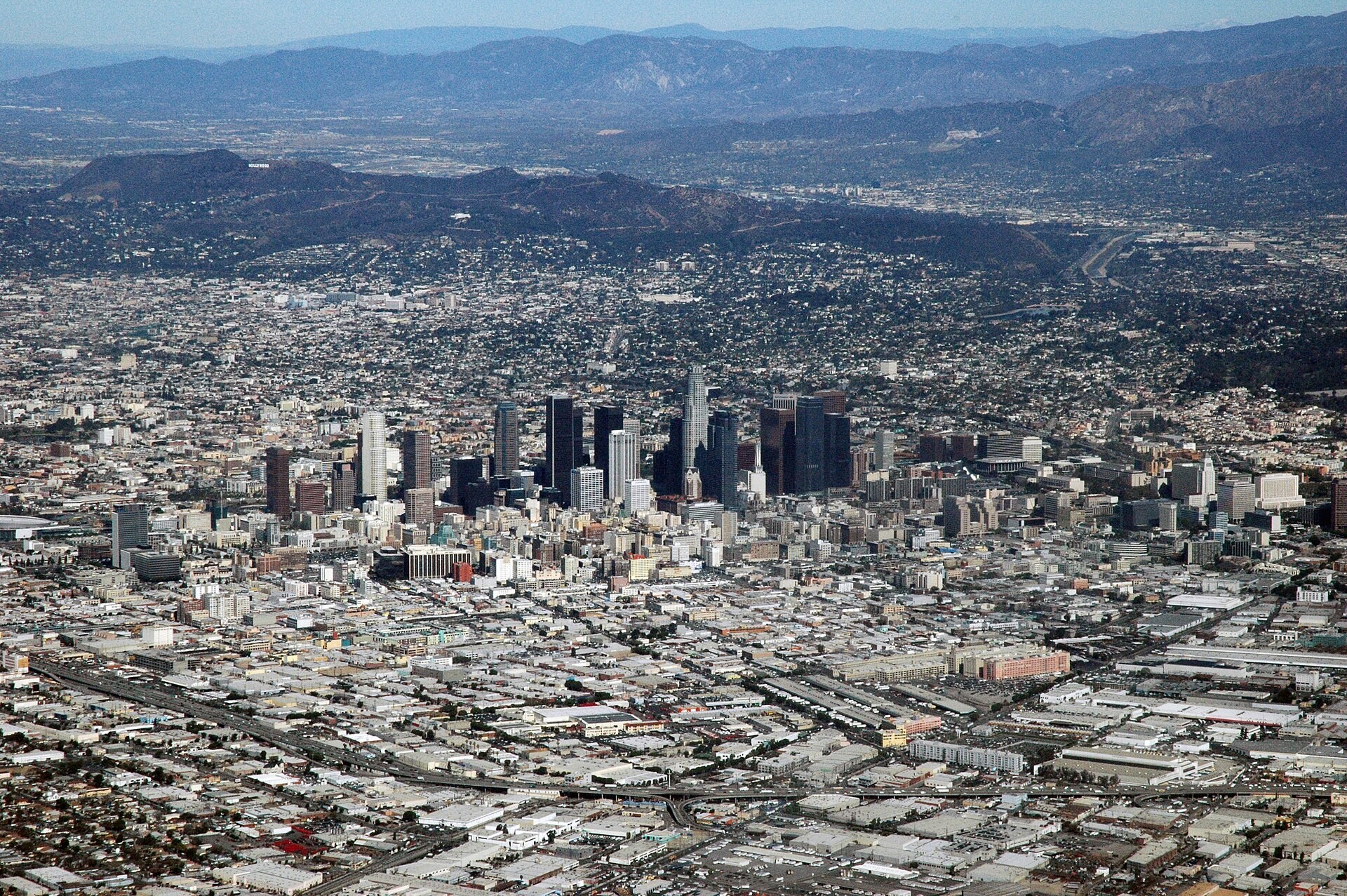
Los Angeles County is a charter county of California, established on February 18, 1850, and covering 12,308 square kilometers along the Pacific coast of Southern California. With a population of 10,014,009 and a 2024 GDP that crossed $1 trillion, it ranks second among all U.S. counties by economic output and would place 20th among the world’s nations if measured independently. Its 88 incorporated cities are spread across terrain that stretches from a 3.07-meter mean elevation near the coast up to a summit of 10,064 feet at Mount San Antonio in the San Gabriel Mountains. The county’s scale and complexity, governing roughly 1 million residents in unincorporated areas alone, has driven a series of structural reforms still working their way through the political system.
Key facts
- Country: United States
- Type: charter county of California
- Located in: California
- Coordinates: 34.0500, -118.2500
- Population: 10,014,009
- Area: 12,308 km²
- Elevation: 3.07 m
- Founded: 1850
Geography and Physical Character
The county covers 12,308 square kilometers. More than 65 percent of that area, some 2,649 square miles, is unincorporated territory rather than part of any of the 88 cities. The Pacific Ocean coastline runs approximately 70 miles (110 km), and the county’s jurisdiction extends offshore to include Santa Catalina Island and San Clemente Island in the Channel Islands archipelago.
Inland, the San Gabriel Mountains rise sharply from the basin floor. Mount San Antonio, known locally as Old Baldy Peak, reaches 10,064 feet (3,068 m) and marks the county’s highest point. The mean elevation recorded for the county is just 3.07 meters, reflecting how much of the population lives on the coastal plain and in the low-lying basin.
Early Habitation and Spanish Settlement
The Gabrielino/Tongva Nation is recognized as the aboriginal people of the Los Angeles Basin. Archaeological evidence places their settlements as far back as 6,000 BC, and more than 2,000 archaeological sites have been identified across the county. The Indian Claims Commission later determined that the Gabrielino/Tongva had been wrongly deprived of 1,553,772 acres of Los Angeles Basin land following Spanish colonization.
Spanish settlers from Sonora, Mexico formally established the pueblo of El Pueblo de la Reina de Los Angeles on September 4, 1781. The settlement grew slowly under Spanish and then Mexican administration before the United States took control of California after the Mexican-American War. The county itself was created on February 18, 1850, as one of California’s original 27 counties, several months before California was formally admitted to the Union.
Government and Structure
The California Legislature established a five-member Board of Supervisors in 1852. That body functions simultaneously as the county’s executive, legislative, and quasi-judicial authority. Members are elected to four-year staggered terms and are limited to three consecutive terms. For the approximately 1 million residents living in unincorporated areas, the Board effectively acts as a city council, providing services that incorporated cities manage for their own residents.
The arrangement created persistent questions about representation. In November 2024, county voters approved Measure G, a ballot measure to expand the Board from five members to nine and to create a directly elected county executive. The change represents the most significant structural overhaul of county government since the Board was formed in 1852.
Economy
In 2024, the county’s current-dollar GDP reached $1,002,965,029 thousand, which represents approximately 24.5 percent of California’s real GDP and 3.5 percent of the United States’ real GDP. Measured against national economies, the county’s output exceeded that of Switzerland, Poland, and Taiwan. It ranked second among all U.S. counties by GDP.
The largest employment sector in 2024 was Health Care and Social Assistance, with 650,341 workers. Retail Trade employed 469,248 workers, and Professional, Scientific, and Technical Services employed 428,980. The median household income in 2024 was $90,112, up from $87,760 the previous year.
The Port of Los Angeles, located in San Pedro, processed 10,297,352 Twenty-Foot Equivalent Units of cargo in 2024. That figure made it the busiest container port in North America and marked the completion of its 25th consecutive year at the top of Western Hemisphere rankings.
Entertainment and Culture
The film and television industry has historically concentrated in Los Angeles County to a degree unmatched elsewhere in the United States. At the start of 2023, the county was home to one in every three film and television jobs in the country. The Los Angeles County Museum of Art, situated on a 20-acre campus on Wilshire Boulevard, holds more than 140,000 objects spanning every continent and is the largest art museum in the western United States.
The county also manages 87 regional and local parks, 344 miles of horse and hiking trails, 19 golf courses, 31 public swimming pools, and 25 miles of beaches, all administered through the county’s parks system.
The January 2025 Wildfires
In January 2025, a series of wildfires swept across Los Angeles County in what became one of the most destructive urban fire events in California’s recorded history. The Eaton Fire in Altadena and the Palisades Fire in Pacific Palisades were the most damaging. Together, the fires burned more than 50,000 acres, destroyed over 16,000 structures, killed at least 31 people, and displaced more than 200,000 residents.
Property and capital losses were estimated at $131 billion. The U.S. Environmental Protection Agency’s subsequent cleanup of hazardous materials left behind by the fires became the largest wildfire hazardous materials cleanup in the agency’s history.
Did you know
- In the early 1850s, Los Angeles County was the number one wine-producing county in the entire United States. (laalmanac.com)
- At the start of 2023, Los Angeles County was home to one in every three film and television jobs in the United States. (laist.com)
- The Indian Claims Commission determined that the Gabrielino/Tongva people had been wrongly deprived of 1,553,772 acres of Los Angeles Basin land following Spanish colonization. (gabrielinotongva.org)
- The EPA’s cleanup effort following the January 2025 Los Angeles wildfires was the largest wildfire hazardous materials cleanup in the agency’s history. (epa.gov)
Data sources
- Wikidata
- hr.lacounty.gov
- gabrielinotongva.org
- laalmanac.com
- lacountyca.org
- bos.lacounty.gov
- governing.com
- peakvisor.com
- datausa.io
- portoflosangeles.org
- lacounty.gov
- visitcalifornia.com
- news.wwu.edu
Data updated: 2026-11-01