
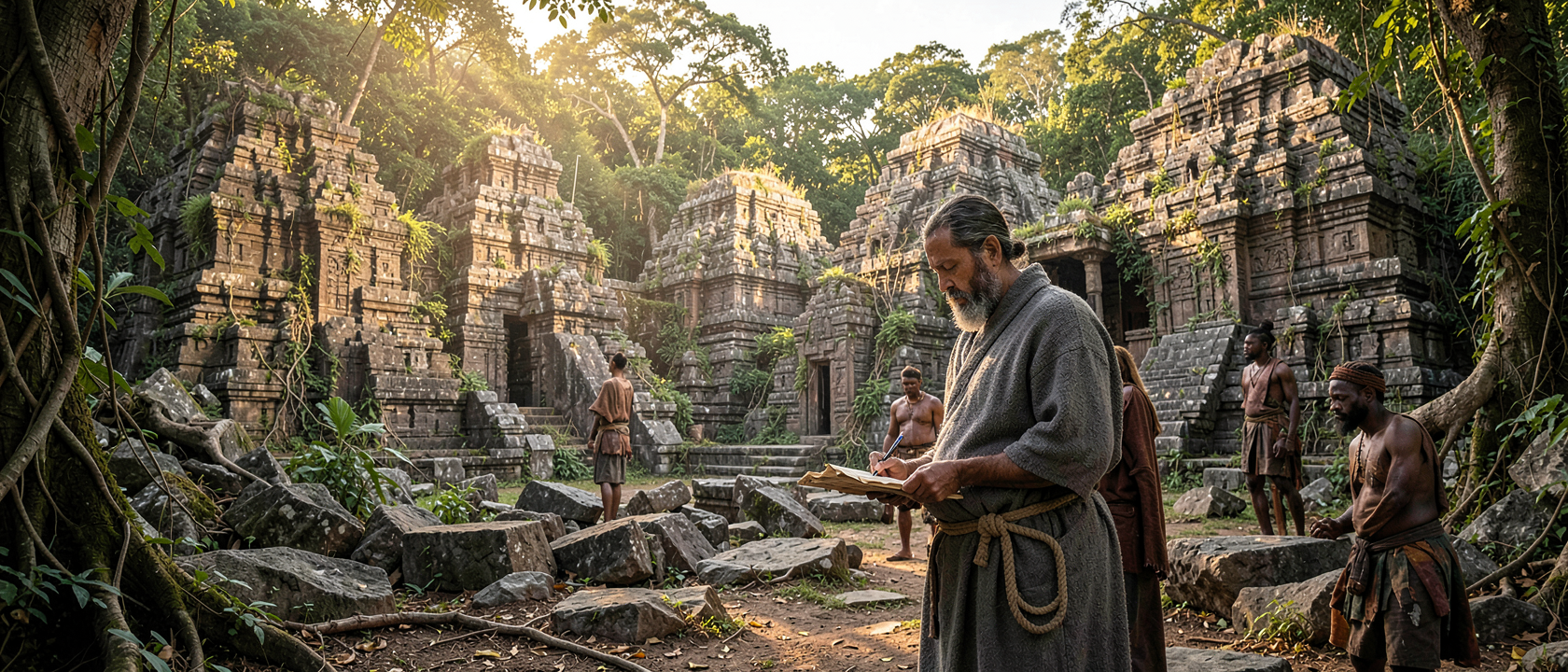
The Fire at Maní
In 1562, in the Yucatán town of Maní, the Franciscan friar Diego de Landa presided over the burning of Maya codices and sacred images, part of a campaign against what he judged to be idolatry among recently converted Maya communities. The exact date and scale of that burning come down through a single source that has not been corroborated elsewhere, but the central fact is not in question: de Landa admits to burning Maya books himself, in the very report he later wrote about his years in Yucatán. He was born in Spain in 1524, and by 1562 he had already spent years as a friar in Yucatán, close enough to Maya religious practice to judge it idolatrous. The codices he ordered destroyed were books of bark paper, painted with glyphs and calendar signs, the Maya’s own written record of ritual, history, and timekeeping.
What Was at Risk Once the Books Were Gone
The loss went beyond objects. Once the codices were burned, there was a real chance no written account of Maya religion, calendar, and script would survive at all, beyond what Maya communities carried in memory. The man who ordered the fires was, in the same years, one of the few Europeans recording in detail what his own campaign was destroying: de Landa spent years compiling an exhaustive record of Maya belief and custom, drawing on Maya informants and on knowledge he had set out to erase. Even a careful written record carried its own risk. Spain in the 1560s had no mechanism to guarantee that a manuscript like this would ever be set in type, and it could just as easily sit unread.
A Manuscript Finished in Spain
De Landa’s conduct at Maní drew accusations of excessive severity, and he was recalled to Spain to answer for it. It was there, around 1566, that he wrote Relación de las Cosas de Yucatán (later translated as Yucatan Before and After the Conquest), detailing the Maya calendar, elements of the script, religious ritual, and daily life, drawing on the same communities he had moved against a few years before. It remained a manuscript, never printed in his lifetime; the copy he wrote did not survive in its original form. De Landa later returned to Yucatán and served as bishop there from 1572 until his death in 1579, but by then the Relación had already been finished, a private document with no public life.
A Ruin Already Centuries Old
Twenty-two years after de Landa finished his report, the Franciscan friar Antonio de Ciudad Real arrived at Uxmal, in Yucatán. He was traveling as secretary to Alonso Ponce, the Franciscan order’s commissary general, on a five-year tour of New Spain’s convents that ran from 1584 to 1588; the official account was credited to Ponce, though Ciudad Real wrote it. His description of Uxmal, written in 1588, is recognized as the earliest known account of the site, and has been praised since for its detail and accuracy, down to the construction of the city’s corbel vaults. By 1588 Uxmal had already been empty for almost four hundred years, abandoned by around 1200, long before any Spaniard reached Yucatán. Ciudad Real was describing a ruin, not a living city, and his account forms a second, independent strand of documentation, by a different man in a different decade, describing standing architecture rather than belief or script.
Nearly Three Centuries Without a Reader
Both accounts, de Landa’s Relación and Ciudad Real’s description of Uxmal, sat unpublished for roughly two and a half to three centuries. De Landa’s manuscript did not reach print until the French cleric Charles Etienne Brasseur de Bourbourg published a bilingual Spanish-French edition (sources differ on the year, 1862 or 1864), nearly three hundred years after it was written. Nothing in the record explains the gap: no single event blocked it, and the accounts simply went unread, unconnected for generations to the ruins turning up across Central America. Scholars argued for decades over who had built cities like Uxmal without ever opening a 16th-century Spanish account that already described them.
New Explorers, an Old Doubt
The Relación and Ciudad Real’s account finally reached print in the 19th century, around the same period that a new wave of European and North American explorers began surveying and excavating Maya sites in earnest, mostly in the 1830s and 1840s. According to one account of this history, which this piece has not been able to confirm independently, many of these explorers doubted that Indigenous Americans had built such elaborate cities, favoring theories that traced the ruins to some lost Old World civilization. How and when that doubt gave way to accepting Maya authorship is something the sources do not spell out, a question this history leaves standing.
What It Cost
What was lost in the 1560s cannot be counted exactly. An unknown number of Maya codices and sacred images, impossible to pin down from the surviving record, went into the fires of the conversion campaigns. What survived, against the odds, was de Landa’s own written record, the document later scholars turned to for a detailed account of a civilization whose own books had mostly been destroyed. The man who burned the codices and the man who wrote down what they contained were, in this case, the same person. His report sat finished and unread from around 1566 until Brasseur de Bourbourg finally put it into print in the 1860s, nearly three hundred years after de Landa set it down, and almost three centuries after Antonio de Ciudad Real walked through the ruins of Uxmal and wrote the first account anyone had made of them.