
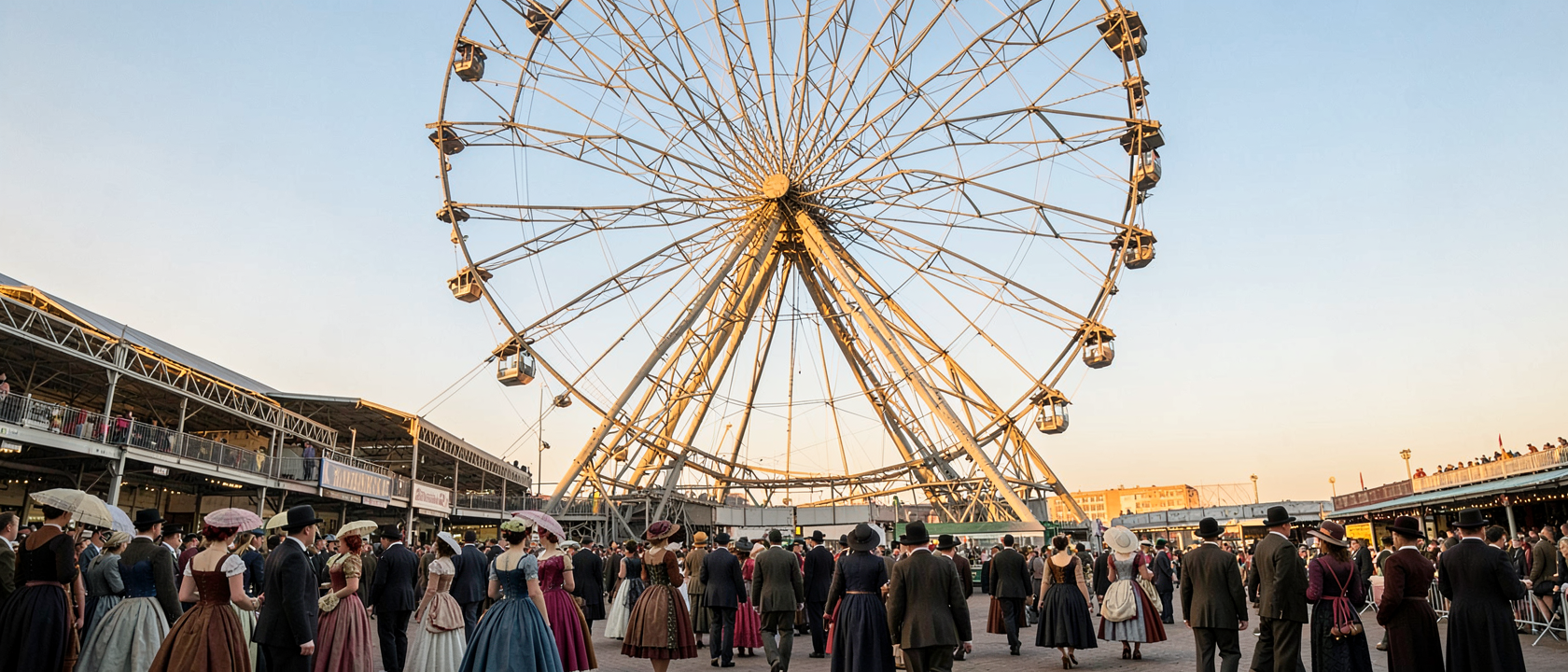
Above the White City
On June 21, 1893, a forty-piece band played “America” as the first thirty-six cars of George Washington Gale Ferris Jr.’s new wheel began to rise above the Midway in Chicago, Illinois. Each car was built to the scale of a railroad carriage, fitted with glass windows and room for up to forty passengers in revolving chairs, so a single turn of the wheel could lift as many as 2,160 people at once. The wheel itself measured 250 feet across (76.2 m), the largest ever built at that time, and reached a full height of 264 feet (80.4 m). Scientific American and the local press recorded the dimensions and the crowds in detail that summer. From the top, the view took in the fair’s plaster-and-stucco buildings directly below. Beyond them lay the industrial edge of the city, and past that, the open water of Lake Michigan.
The Chicago Challenge
The basic idea behind Ferris’s wheel was not new. Small wooden “pleasure wheels,” carrying riders in individual compartments, had existed since the eighteenth century, and the engineer and historian Henry Petroski later observed that what Ferris changed was not the concept but the scale. What forced that change was a tower: at the 1889 Exposition Universelle in Paris, Gustave Eiffel’s new iron structure made every earlier fairground attraction look modest, and the organizers of the 1893 World’s Columbian Exposition in Chicago wanted an answer of the same scale.
Committees reviewed hundreds of proposals, including wooden towers meant to outreach Eiffel’s and tents the size of city blocks, before settling on something stranger: an engineer named George Washington Gale Ferris Jr., who ran a company that tested structural steel, proposed a giant wheel modeled on the mechanics of a waterwheel from his childhood in Carson Valley, Nevada, and on the structure of a bicycle wheel. The fair’s directors approved the design but refused to put up public money for it, so Ferris alone had to raise the funds. Contemporary accounts of the final bill do not even agree with each other: some put the construction cost at $380,000, others closer to $400,000.
Replicating the Circle
The engineering held under real strain. The wheel turned on a forged steel axle 45 feet long (13.7 m) and 32 inches (0.81 m) in diameter, weighing 70 tons (63.5 metric tons), carried on steel towers 140 feet tall (42.7 m) and sunk 35 feet (10.7 m) into the ground. Even the total weight of the structure became a matter of dispute: Guinness World Records now lists it at roughly 2.866 million pounds (1,300 metric tons), while contemporary reports in Scientific American put the figure closer to 5,000 tons. Whatever the true number, the design worked, and it drew crowds fast enough that the idea crossed the Atlantic within four years.
English engineer Walter Basset commissioned and financed the Vienna Riesenrad, built to a design by Harry Hitchins and Hubert Cecil Booth of the London firm Maudslay, Sons and Field to mark the fiftieth anniversary of Emperor Franz Joseph I‘s reign. It stood 212 feet tall (64.75 m), with a diameter of exactly 200 feet (60.96 m), and was completed on June 21, 1897, four years to the day after the Chicago wheel’s first turn. By 1906, the Eli Bridge Company of Illinois was manufacturing smaller, take-apart wheels built to travel with county fairs, turning a one-time exposition centerpiece into a standard carnival ride.
Scrap Metal and Shrapnel
The original Chicago wheel did not last. Within a few years of the fair’s close it was dismantled and sold for scrap; the record does not preserve an exact date, only that the machine which had carried fairgoers through the summer of 1893 was gone by the first years of the twentieth century. Its Vienna counterpart had its own ordeal: the Riesenrad suffered serious fire damage in 1944 and did not reopen until 1947, rebuilt with fifteen gondolas in place of the original thirty. After the 1920 demolition of the Grande Roue de Paris, a taller wheel in the French capital, the Riesenrad became the world’s tallest operating Ferris wheel, a title it held for 65 years, until 1985. It has since appeared in the film The Third Man and in a James Bond picture, and it remains in operation, making it the oldest continuously running Ferris wheel anywhere.
The Unknown Ledgers
Ferris’s physical record is precise down to the inch, but the financial one is not. The names and exact shares of the private investors who covered the $380,000 to $400,000 it took to build were never fully set down in public records. What the ride earned afterward is just as unsettled: one account holds that nearly 1.5 million tickets were sold for a profit of $395,000, while another puts total receipts at $725,000 against the roughly $400,000 invested. Years of litigation over gate receipts and patent rights followed the fair, and none of it settled what Ferris personally kept. He died on November 22, 1896, at thirty-seven, from typhoid fever, in the middle of a reorganization of the Ferris Wheel Company that had dogged him for years. Guinness records list him as having died a poor man, on a machine whose smaller descendants, built for county fairs and used in classrooms to teach trigonometry, are still turning.