
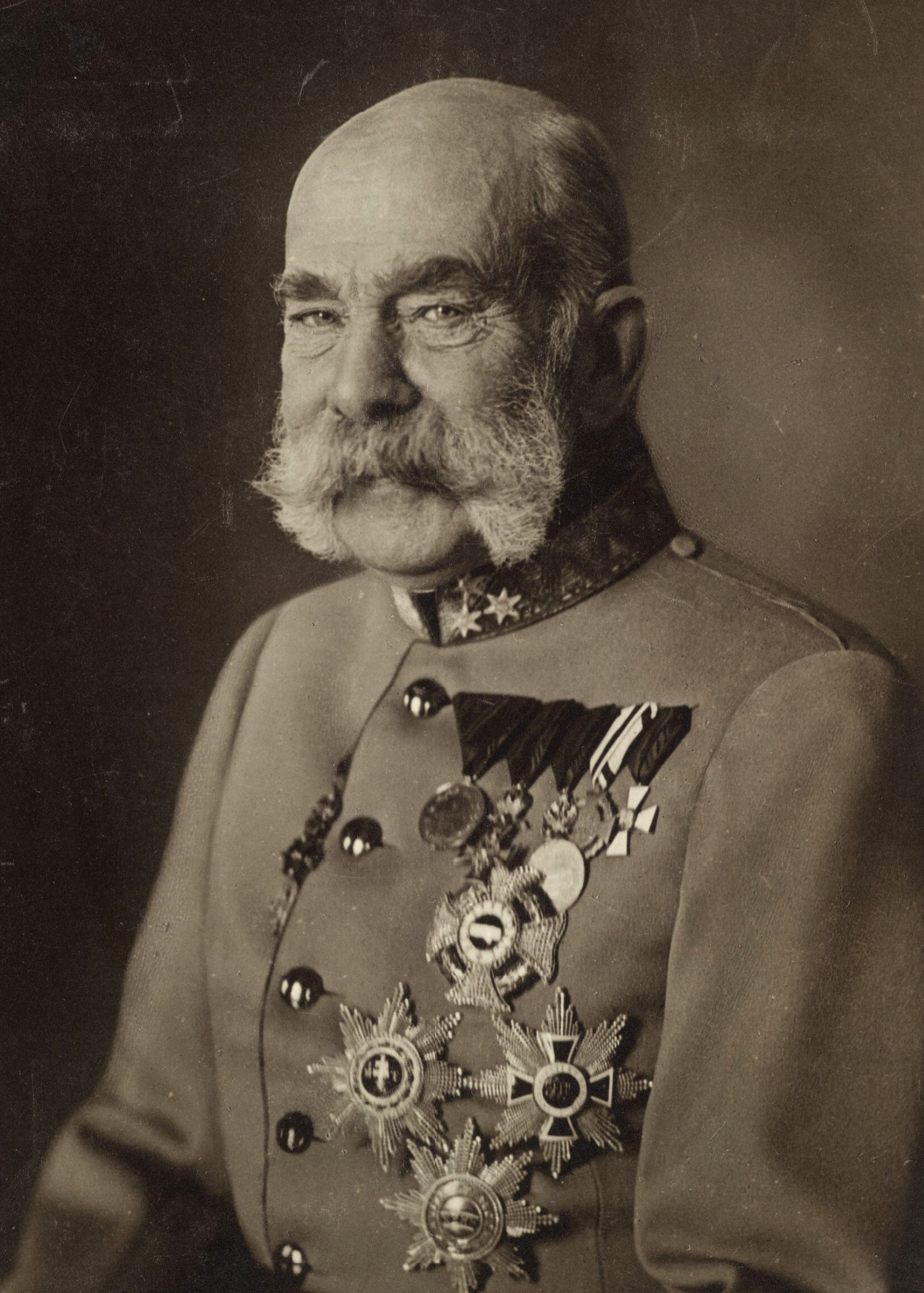
Franz Joseph I ruled the Austrian Empire and, from 1867, the Austro-Hungarian Dual Monarchy for one of the longest reigns in modern European history. Born on 18 August 1830 at Schönbrunn Palace in Vienna, he came to the throne on 2 December 1848 at the age of eighteen, in the middle of the revolutions convulsing Europe, and he died at the same palace on 21 November 1916, at the age of 86, while the war his government had set in motion was still being fought. His personal motto, “Viribus Unitis” (With united forces), summarized the central problem of his reign: holding together a state that contained a dozen nationalities, each with its own language, church, and political ambitions.
Key facts
- Born: 18 August 1830
- Birthplace: Schönbrunn Palace
- Died: 21 November 1916
- Place of death: Schönbrunn Palace
- Country: Austrian Empire; Cisleithania
- Occupation: politician; monarch
- Field: politics
- Awards: Pour le Mérite; Knight of the Order of the Golden Fleece; Grand Cross of the Military Order of Maria Theresa; Order of the Black Eagle
Upbringing and preparation for rule
Franz Joseph was born to Archduke Franz Karl and Archduchess Sophie, herself a Bavarian princess. Sophie took firm charge of her son’s education from the start, shaping his character around duty, discipline, and loyalty to the Habsburg dynasty. The schedule she and his tutors imposed was punishing by any measure. By the age of six he was receiving between thirteen and eighteen hours of instruction per week; by seven, that figure had risen to thirty-two hours; and by sixteen, his daily regime ran from six in the morning to nine at night.
The pace took a physical toll. At thirteen he fell seriously ill under the strain, and by fifteen he was studying 56 hours per week. His thirteenth birthday also brought a military appointment: Colonel of the Dragoons Regiment, after which the emphasis of his education shifted toward military strategy and tactics. Prince Metternich, who had been one of the architects of the post-Napoleonic European order, personally gave the young prince instruction in political systems as part of his preparation for the office of emperor.
Accession in 1848
The revolutions of 1848 forced a dynastic reorganisation. Emperor Ferdinand I abdicated, and Archduke Franz Karl renounced his own rights to the succession. The plan was devised by Minister President Felix zu Schwarzenberg, who wanted a new emperor untainted by the compromises of the revolutionary year. Franz Joseph was proclaimed emperor at Olmütz on 2 December 1848, eighteen years old and formally unencumbered by any concessions Ferdinand had made to the revolutionaries.
He served as President of the German Confederation from 1 May 1850 until 24 August 1866, a position he held until Austria’s defeat in the Austro-Prussian War ended any serious Habsburg claim to leadership of the German states.
Marriage and family
On 24 April 1854, Franz Joseph married his cousin Elisabeth of Bavaria in Vienna. Elisabeth, known widely as Sisi, was sixteen years old at the time of the wedding and seven years younger than the emperor.
On 10 September 1898, Elisabeth was killed in Geneva. A 25-year-old Italian anarchist named Luigi Lucheni stabbed her in the heart as she walked along the promenade of Lake Geneva on her way to board a steamship.
The Compromise of 1867 and the Dual Monarchy
Austria’s defeat by Prussia in 1866 weakened the empire’s position among the German states and forced a reckoning with the demands of Hungarian leaders. The result was the Ausgleich, the Compromise of 1867, which restructured the empire as a dual monarchy: Austria and Hungary each had its own parliament and government, linked by a common monarch, a common army, and shared foreign policy.
On 8 June 1867, Franz Joseph and Elisabeth were crowned King and Queen of Hungary in Budapest, the ceremony conducted with the Crown of St. Stephen. Hungarian Prime Minister Count Andrássy and the Primate of the Catholic Church officiated. The arrangement gave Hungarian political leaders what they had sought since 1848, and it gave Franz Joseph a stable domestic framework for the next half century, though it did little to resolve the aspirations of the other nationalities within the empire.
Vienna and the Ringstrasse
On 20 December 1857, Franz Joseph signed an imperial decree ordering the demolition of Vienna’s medieval city walls and the construction of a grand boulevard in their place. The Ringstrasse project transformed Vienna’s urban core over the following decades, placing the Opera, the Parliament building, the Rathaus, and several major museums along a sweeping ring road. The result was a capital comparable in scale and ambition to Paris and Berlin.
In 1853, an assassination attempt against the emperor had produced another landmark building. Franz Joseph survived, and his brother Archduke Ferdinand Maximilian organised a fundraising campaign across Europe to pay for a votive church in thanksgiving. The resulting Votivkirche, built in Vienna, became one of the city’s major Gothic Revival structures.
Bosnia, the assassination of 1914, and the outbreak of war
Austria-Hungary had occupied Bosnia and Herzegovina since the Congress of Berlin in 1878. In October 1908, Franz Joseph formally annexed the territories, a move that provoked what became known as the Bosnian Crisis and sharpened Serbian nationalist sentiment in the region.
On 28 June 1914, Archduke Franz Ferdinand, Franz Joseph’s nephew and heir to the throne, was assassinated. Franz Joseph approved the harsh ultimatum issued to Serbia in response, and Austria-Hungary declared war on Serbia on 28 July 1914. The chain of alliances that followed launched the First World War.
Franz Joseph died on 21 November 1916 at Schönbrunn Palace, at the age of 86, of pneumonia he developed after catching a cold during a walk in the palace park. The war he had authorised was still being fought when he died, and he never saw its conclusion.
Habits and private life
Franz Joseph’s personal habits were austere. He rose before 4 a.m. each day, began with prayer at a prie-dieu set before a crucifix, and then moved to his desk, where he worked through a fixed daily schedule he maintained well into his eighties. His stated maxim on the subject was direct: ‘One must work until one drops from exhaustion.’ Despite occupying Schönbrunn Palace, one of the largest royal residences in Europe, he used only two rooms as his personal quarters, keeping the rest for official functions. His study accumulated, over the decades, a collection of mementos related to his wife Elisabeth, their children, and thirteen grandchildren.
Did you know
- At the 1900 World Exposition in Paris, Danish inventor Valdemar Poulsen recorded Franz Joseph’s voice on his Telegraphone magnetic wire recorder. The approximately 10-second recording is believed to be the oldest surviving magnetic audio recording in existence. (historyofinformation.com)
- Franz Joseph rose every day before 4 a.m., knelt to pray at his prie-dieu before a crucifix, and then worked at his desk through a strict daily timetable he maintained into his eighties. His personal maxim was: “One must work until one drops from exhaustion!” (schoenbrunn.at)
- Franz Joseph lived in only two rooms of his vast Schönbrunn Palace, using the others only for official occasions. His study held a collection of mementos of his wife Elisabeth, their four children, and thirteen grandchildren. (schoenbrunn.at)
- After Crown Prince Rudolf’s death in 1889 at Mayerling, Franz Joseph had the hunting lodge converted into a Carmelite convent in the same year. The convent is operated by a silent order and still receives more than 100,000 visitors per year. (habsburger.net)
Data sources
- Wikidata
- historycrunch.com
- habsburger.net
- unofficialroyalty.com
- archontology.org
- artsandculture.google.com
- timetravel-vienna.at
- enumis.shop
Data updated: 2026-10-30