
The Order to Undo
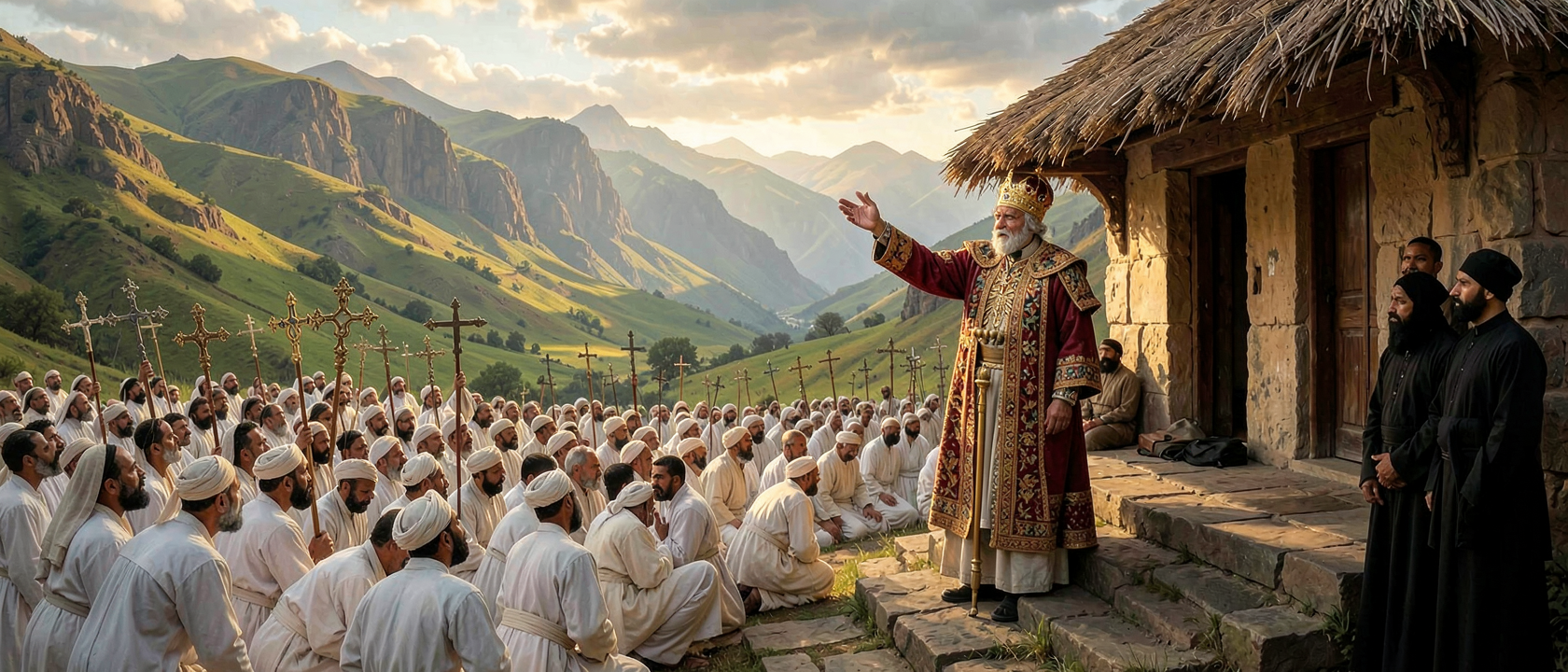
On June 14, 1632, Emperor Susenyos of Ethiopia, who had ruled since 1607, handed the throne to his son Fasilides. In the same declaration he rescinded the decree that had made Catholicism the religion of the state. Ethiopians who wished to remain Catholic could do so, he said, but no one would be forced into it again. The old Alexandrine liturgy and altars, banned under his own reforms, were to be returned to anyone who wanted them.
“Let the people have their own altars for the sacrament and their own liturgy,” Susenyos said, “and let them be happy.” The Portuguese Jesuit Afonso Mendes, patriarch of the Catholic mission in Ethiopia, confirmed to the court that the order truly reflected the emperor’s own wish.
It was one proclamation undoing roughly a decade of religious policy that the same man had spent years building.
A Church Older Than Rome’s Quarrel With It
Ethiopia had been a Christian kingdom since the fourth century, long before Susenyos or his Jesuit visitors were born. Its royal house traced its line to the Queen of Sheba, and its church followed the Alexandrine tradition, also known as Miaphysite Christianity. From Rome’s point of view, that church had been apostate since the Council of Ephesus in 431, when the wider Christian world split over the nature of Christ.
Jesuit missionaries reached Ethiopia in 1557 with a long-term goal: bringing the Ethiopian church into union with Rome. They found their opening in Susenyos, crowned emperor in 1607, whom the Portuguese priest Pedro Páez converted to Catholicism. Páez was remembered as tolerant of Ethiopian custom; he died before the mission’s next chapter began. In 1622, Susenyos ended years of concealment and publicly confirmed his new faith, telling his court it was no foreign import but “the faith of our old fathers and of… the Nicea Council.”
What the Jesuits Asked Ethiopia to Give Up
The reforms Susenyos enforced went well beyond doctrine. Circumcision, an old fasting calendar, Saturday Sabbath observance, and traditional divorce customs sat at the center of everyday Ethiopian Christian life, and the mission wanted all four abolished. Circumcision drew the sharpest objection from the missionaries. For ordinary Ethiopians, this meant changing not what they believed on a point of theology, but how they lived from week to week: which day they rested, how they fasted, how a marriage could end.
The emperor’s own subjects took to calling him “the black Portuguese,” a name measuring how far he had drifted, in their eyes, from Ethiopian identity toward a foreign one. Whether that name reflects a real current of popular anger or a phrase later chroniclers sharpened for effect is not something the record settles.
The Mission Turns on Itself
Afonso Mendes reached the Ethiopian coast in 1624 and took formal charge of the mission. In 1626 he staged a ceremony at court proclaiming the primacy of Rome and condemning Ethiopian practices, in an opening address that reportedly ran to some 30,000 words. Rebellion broke out within days.
Not everyone resisted. The historian Richard Pankhurst has estimated that 100,000 people in the districts of Dembiya and Wegera alone took up Catholicism, though contemporary accounts note that many did so under threat of imprisonment or after being defeated in battle rather than by persuasion.
The unrest did not stay contained. By 1630, rebels in the province of Begemder, led by its viceroy, went so far as to proclaim Susenyos’s own son, Fasilides, emperor in his place, even though Fasilides would not actually take the throne for another two years. Fasilides had by then sided with the old Ethiopian church over his father’s new one. By 1629, Mendes himself was privately doubting the mission could survive, writing of prophecies of doom for the project he had been sent to lead.
The Battle That Broke Him
The engagement usually cited as the final blow came in 1631, when Susenyos’s forces crushed a rebel army estimated at 25,000. No precise casualty count survives, but the losses on both sides were heavy enough that historians point to this battle, more than any sermon or decree, as the moment his resolve to continue the religious policy gave way. Some records instead tie the decisive massacre to a specific clash on June 7, 1632, only a week before the abdication; the sources do not agree on which encounter was the final one. What is clear is that by 1631, every victory over the rebels was costing Susenyos more of the authority he needed to rule at all.
The Bill
The 1631 battle alone is remembered as costing lives by the thousands, though no exact figure survives, and it followed years of earlier rebellion whose casualties were never tallied. By the time Susenyos gave up the throne, the uprisings, including the rival proclamation of his own son as emperor in 1630, had already stripped him of control over much of the empire he had ruled since 1607.
Susenyos died at Dangaz on September 17, 1632, roughly three months after his abdication, at 59 or 60 years old. He was, by contemporary accounts, worn down by the conflict his conversion had set in motion. He died restored to the Alexandrine church he had spent a decade trying to replace.
What the Record Doesn’t Say
Some parts of this story resist a clean date. Susenyos hid his conversion to Catholicism for years before confirming it publicly in 1622; exactly when he first adopted the new faith in private is not recorded. No source offers an overall death toll for the decade of rebellion that followed, only the scattered, heavy losses of individual battles like the one in 1631.
The insults that circulated about the Jesuits and their emperor are just as hard to weigh. Ethiopians reportedly called the missionaries “Franks,” “sons of Leo,” and “relatives of Pilate,” and blamed them for locust plagues and for using impure ingredients in the Eucharist. Susenyos himself was mocked as “the black Portuguese.” Whether these were beliefs genuinely held by ordinary people, or phrases chroniclers later sharpened into shorthand for a decade of resentment, is not something the record can settle. What survives is the outline of the crisis, not a full tally of what it cost the people who lived through it.