
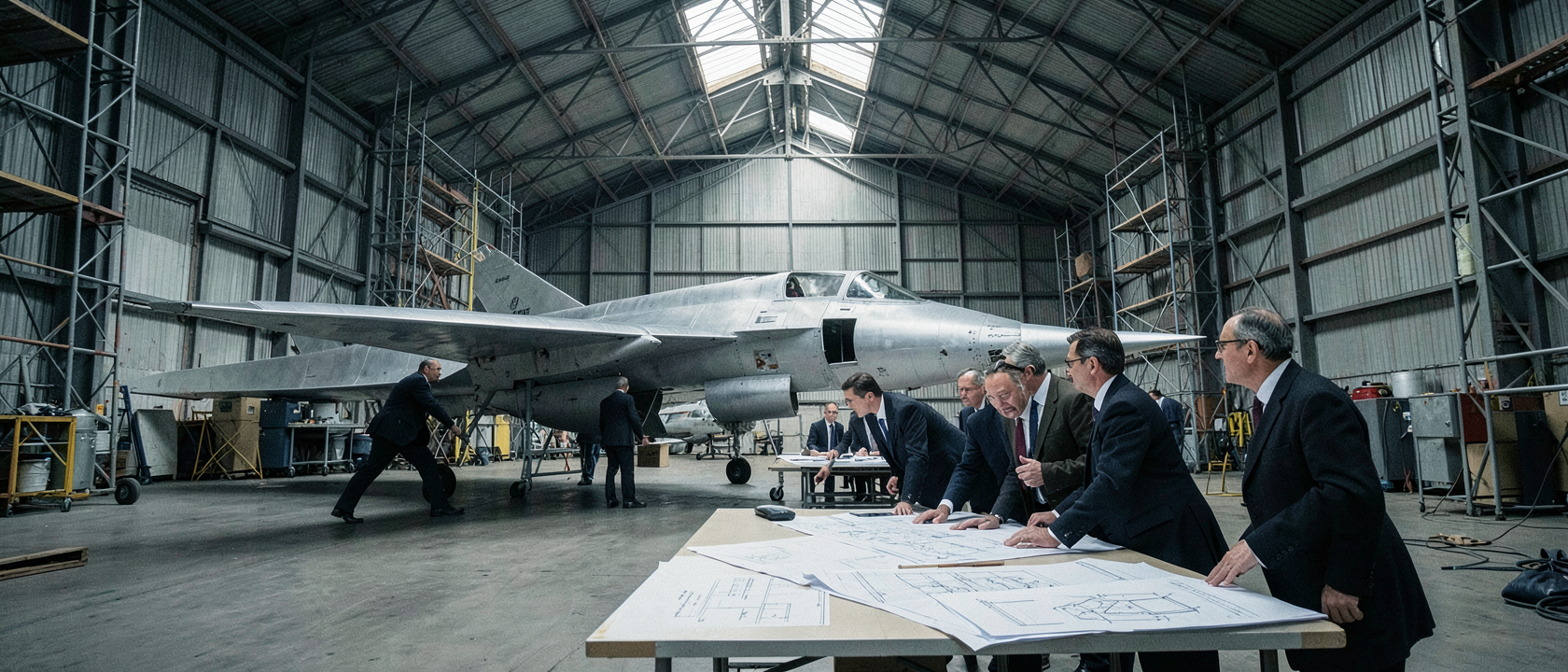
Two Companies, One Drawing Board
In 1964, officials from Britain and France began talking about building a combat aircraft together instead of separately. Handel Davies co-chaired the British side of the working group; his French counterpart was Ingénieur-Général Lecamus. Out of those talks came two proposals, and in May 1965 the two governments signed a memorandum committing to both.
One, based on a Breguet design, became the Jaguar, a smaller strike and training aircraft with France’s Breguet Aviation in the lead on the airframe and Rolls-Royce leading the engine. The other was bigger and harder to build: a supersonic combat aircraft with variable-geometry wings, able to sweep back for speed and forward for lift, so one airframe could do work that had previously needed several specialized types. This was the BAC/Dassault AFVG, short for Anglo-French Variable Geometry. Britain’s British Aircraft Corporation (BAC) was to lead the airframe design, while the engine, a joint SNECMA/Bristol Siddeley project, put France’s SNECMA in the junior role, the leadership split reversed from Jaguar’s.
This was not a license deal, where one country simply builds what the other designs. It was meant to be a single aircraft, designed, funded, and built jointly, with two air forces and two industries committed to the same drawing board.
What Was Riding on One Aircraft
Britain needed AFVG badly. The RAF’s TSR-2 strike bomber had been cancelled in 1965, and by mid-1967 British planning had settled on AFVG to fill the strike role that cancellation had left open. France’s stake was different but no smaller: the aircraft was meant to give the French Navy’s Aéronavale a carrier-based fighter, while also covering interception, strike, and reconnaissance duties for the RAF.
For Britain’s Labour government, AFVG carried more weight than one airframe could reasonably bear. The 1966 Defence White Paper described it, in the government’s own words, as “operationally and industrially … the core of Britain’s long-term aircraft programme.” It sat alongside Concorde, joint helicopters, and guided missiles as proof that Britain and France could build aircraft and weapons together on equal terms, sharing cost, technology, and strategic standing rather than each buying alone or turning to the United States.
That was the wager sitting inside AFVG. Succeed, and Britain gained both an aircraft and a lasting partner. Fail, and it stood to lose both at once.
A Letter, Not a Headline
On June 19, 1967, the French government sent formal notice to London that it was withdrawing from AFVG. There was no press conference in Paris and no public rupture. It arrived as a government-to-government communication, the kind of document that moves between ministries rather than across front pages.
The British public learned the substance of it from Parliament. On July 5, 1967, the House of Commons was told that Paris had given one reason: money. The French government said it was acting “for budgetary reasons,” under pressure on its defense budget for years ahead, even though the two sides had already agreed on the aircraft’s specification and on its development and production costs. France’s defense minister, M. Messmer, assured his British counterpart that the decision would not touch other joint civil and military projects already agreed, nor rule out further cooperation later. The British government’s public response called the decision a matter of “great regret” and made clear it accepted no share of responsibility for it.
The Verdict, Three Months Later
In September 1967, the British trade magazine Flight International offered its own reading of what had happened. It was not writing about one cancelled aircraft. It was writing about the Labour government’s larger hope, built up since 1965, for a lasting defense-industrial partnership with France.
The magazine’s judgment on that hope, after AFVG, was that it had “suffered a wound that has failed to heal.” Coming weeks after the withdrawal rather than years afterward, that line reads less like history and more like a diagnosis written in the moment, by people watching the industry in real time who saw a diplomatic letter end more than a single plane.
The Bill, So Far as It Can Be Read
What can be counted here is not measured in currency. No figures survive in the record for money spent on design work, for jobs affected at BAC or Dassault, or for compensation paid in either direction. The cost was strategic, and it landed in three places.
The RAF lost the aircraft it had settled on to fill the strike role left open by TSR-2’s cancellation. British industry lost the major joint program it had been leading on the airframe side. And the Labour government lost its flagship case for a larger argument: that Britain and France could build a defense-industrial partnership as equals. That ambition did not disappear overnight, but by the trade press’s own account it did not heal quickly either.
What the Record Leaves Open
The documented record used here has a boundary, and it is worth naming rather than papering over. It does not explain what actually drove Paris’s decision beyond the budgetary language given to Parliament, whether that was the whole story or only the part said aloud. It does not name what aircraft, if any, eventually took AFVG’s place in British planning. And it does not say whether, or when, Anglo-French defense cooperation recovered from the wound Flight International described.
What is documented is the shape of the loss: a letter dated June 19, 1967, a reason entered into the parliamentary record, and a trade magazine’s judgment, three months on, that the damage had not healed. Beyond that, the file closes.