
The Anglo-Burmese Wars were three successive armed conflicts fought between the British East India Company (and later the British crown) and the Konbaung dynasty of Burma between 1824 and 1886, ending with Burma’s full absorption into the British Empire. Stretching across six decades, they were driven by expanding borders, commercial rivalry, and diplomatic friction along the northeastern frontier of British India. The human cost was extraordinary: of approximately 40,000 British and Indian troops sent to Burma during the first war alone, 45 percent never returned, and disease killed far more men than Burmese arms. The outcome dismantled one of Southeast Asia’s most assertive royal states and reordered the region’s trade and politics for generations.
Key facts
- Country: Konbaung dynasty; British Empire; Myanmar
- Type: series of wars
- Start: 1824
- End: 1886
- Location: Myanmar
- Participants: East India Company; Konbaung dynasty
The Road to War: Konbaung Expansion
Under King Bodawpaya, the Konbaung dynasty pursued an aggressive programme of territorial growth that fundamentally altered the balance of power in mainland Southeast Asia. Burma annexed Arakan in 1784 and pushed further west, taking control of Assam and Manipur between 1817 and 1819. These advances brought Burmese forces into direct contact with the northeastern frontier of British India, creating a volatile border where two expansionist powers now faced each other.
The immediate trigger for the First Anglo-Burmese War was the Burmese occupation of Shapuree Island near Chittagong, territory claimed by the British East India Company. Skirmishes in the Bengali region followed, and the Company deployed troops along the frontier. On 5 March 1824, Britain formally declared war.
The First Anglo-Burmese War, 1824–1826
The military campaign opened with a seaborne strike. On 10 May 1824, a force composed mainly of Madras Army troops under General Sir Archibald Campbell landed at the lightly defended city of Rangoon. The city offered little resistance, but the Burmese interior proved far harder. The campaign dragged on for nearly two years.
Disease, not battle, defined the war’s casualty list. At least 15,000 British and Indian soldiers died in the conflict, and three-quarters of those deaths were caused by malaria, dysentery, and dengue fever. The financial toll matched the human one: the East India Company spent between five million and thirteen million pounds sterling on the war, a sum that contributed directly to a severe economic crisis in British India in 1833. The strain on Company finances was severe enough to accelerate greater British government intervention in Company affairs during the 1830s.
The Second Anglo-Burmese War, 1852–1853
The second conflict, fought from 5 April 1852 to 20 January 1853, had origins that one historian later called ‘trivial incidents in Rangoon’: two British sea captains had lodged complaints about extortion by Burmese port authorities. Governor-General Lord Dalhousie, whose administration was driven by commercial ambitions in Lower Burma, used the dispute as a pretext for military action.
British forces took the province of Pegu, which included Lower Burma and its valuable teak forests. No formal peace treaty was signed by the Burmese court. The absence of a diplomatic settlement left the two sides in an uneasy half-peace and, within the Konbaung court, produced immediate political consequences. King Pagin Min was replaced by his half-brother Mindon Min, who ruled from 1853 to 1878 and attempted to modernise the Burmese state and economy to resist further encroachments.
The Third Anglo-Burmese War, 1885
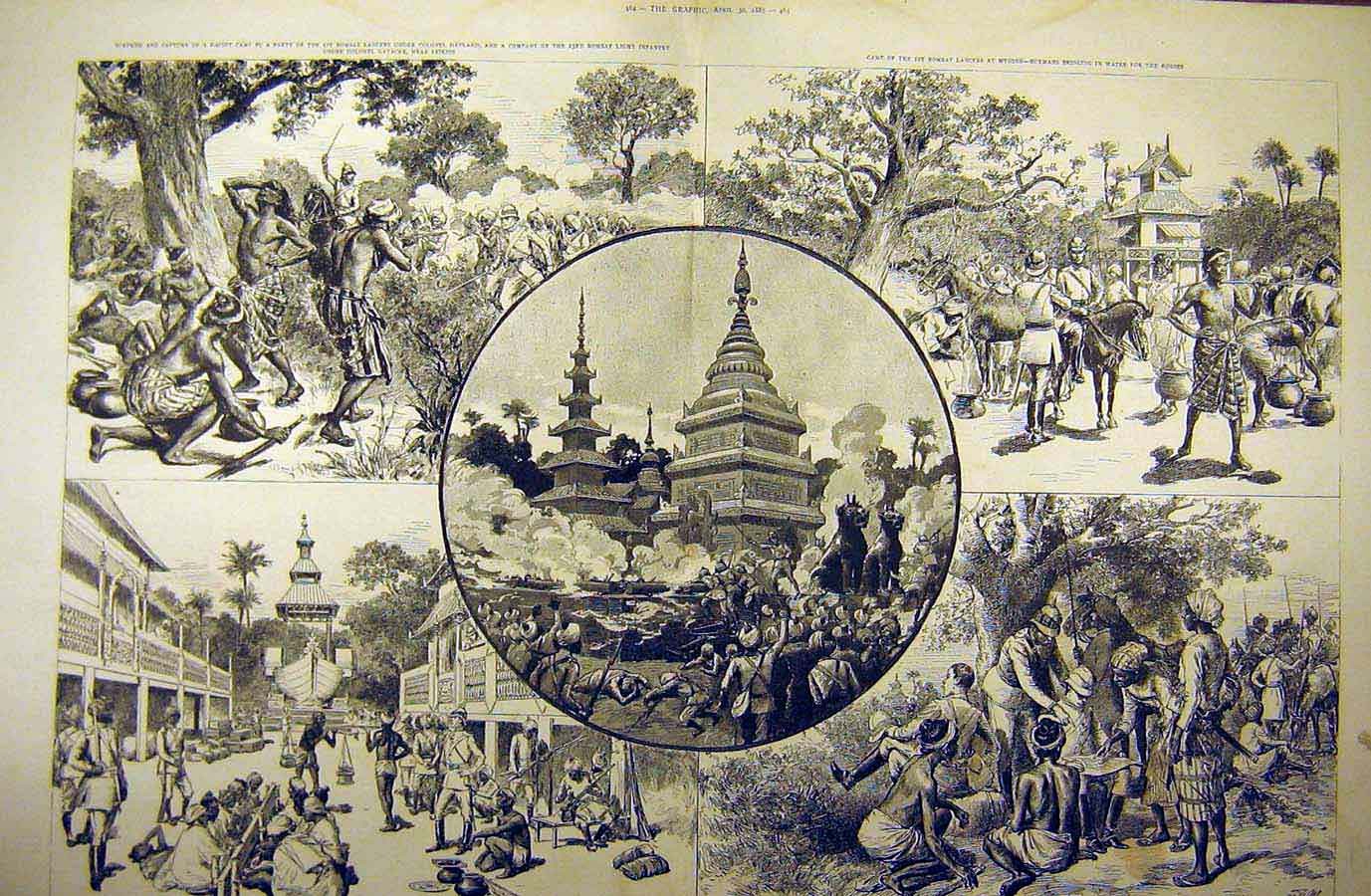
The final conflict had its proximate cause in a commercial dispute. Burma’s King Thibaw imposed fines on the Bombay and Burma Trading Corporation, accusing the company of under-reporting its teak logging and failing to pay its Burmese employees in full. Britain responded on 22 October 1885 with an ultimatum. When the ultimatum went unanswered, British forces moved into Upper Burma. The campaign was swift and, unlike the first war, militarily decisive.
By 1886 the Konbaung dynasty had ceased to exist as a political entity, and Burma was incorporated into British India as a province.
Consequences
The three wars reshaped the political order of the region entirely. British, Indian, and Chinese merchants extended their influence throughout Burmese economic life as the wars opened Burma’s trade networks to outside actors. The social composition of Burma’s commercial class shifted accordingly.
The financial damage inflicted by the first war also had consequences reaching well beyond Burma. The enormous expenditure by the East India Company contributed to the decline of the Company as an independent political force and drew the British government into deeper supervision of Indian administration during the 1830s. The events that began with a border dispute on the Bengali frontier in 1824 thus fed into the restructuring of British imperial governance across South Asia.
Did you know
- Captain Frederick Marryat, who later became a well-known Victorian novelist, served as Senior Naval Officer in Rangoon during the First Anglo-Burmese War of 1824. He drew on his military experiences when writing his naval fiction. (timewisetraveller.co.uk)
- Of the approximately 40,000 British and Indian troops sent to Burma during the First Anglo-Burmese War, 45 percent never came out. Of those who died, 96 percent were killed by disease rather than by battle. (factsanddetails.com)
- One historian described the origin of the Second Anglo-Burmese War as ‘trivial incidents in Rangoon’: the war grew out of complaints by two British sea captains about extortions by Burmese port authorities, with no major strategic confrontation preceding it. (factsanddetails.com)
Data sources
Data updated: 2026-10-30