
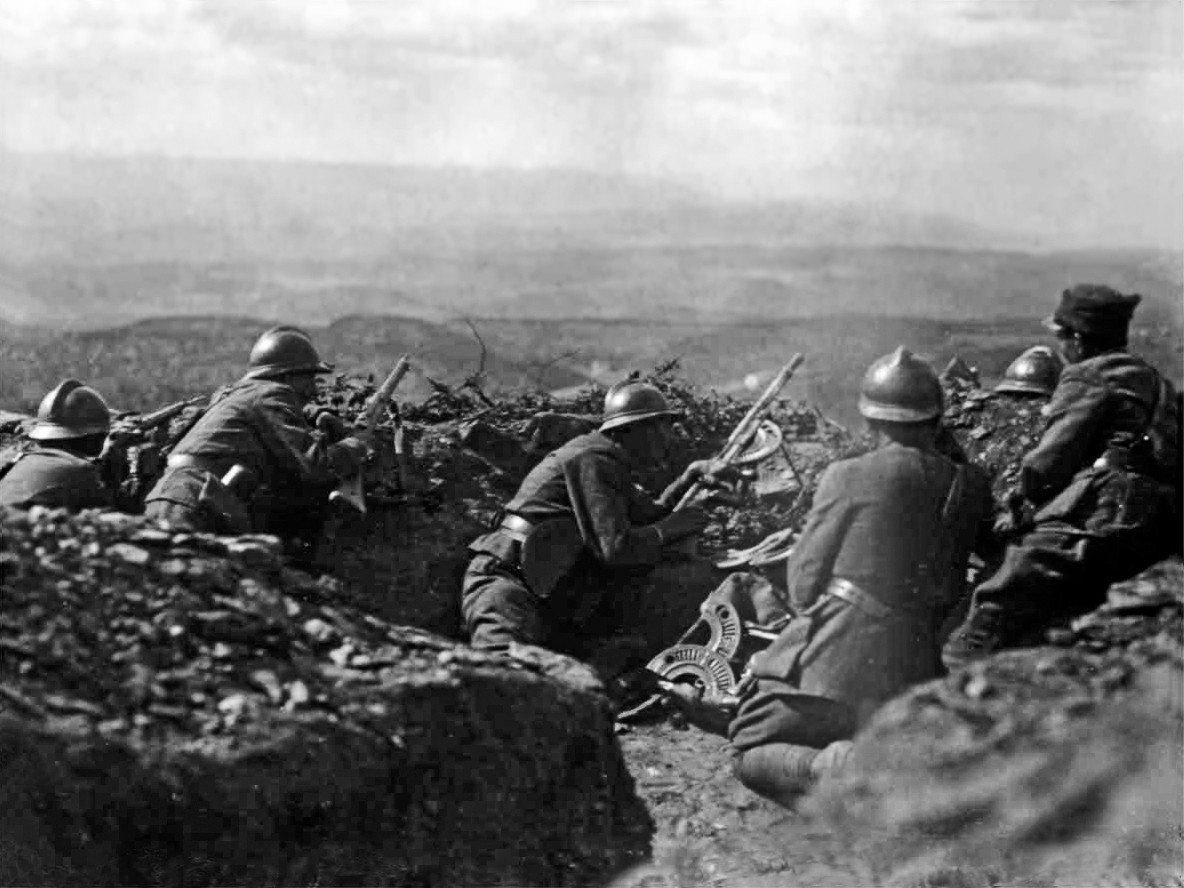
The Battle of Dumlupınar, fought from 26 to 30 August 1922 near the town of Dumlupınar in western Anatolia, was the decisive engagement between the forces of the Grand National Assembly of Turkey and the Kingdom of Greece during the Greco-Turkish War. It opened the Great Offensive (Büyük Taarruz), the largest and last military operation of the Turkish War of Independence, which ran from 26 August to 18 September 1922. The Greek army was broken in five days, its senior field commander captured, and the political settlement that followed reshaped the map of the eastern Mediterranean. The Treaty of Lausanne, signed on 24 July 1923, recognised the independence of the Republic of Turkey and its sovereignty over Anatolia, Istanbul, and Eastern Thrace.
Key facts
- Country: Turkey
- Type: battle
- Start: 26 August 1922
- End: 30 August 1922
- Location: Dumlupınar
- Participants: Government of the Grand National Assembly; Kingdom of Greece
Background and command
In Turkish the battle is known as Başkumandanlık Meydan Muharebesi, meaning “Field Battle of the Commander-in-Chief.” The name reflects the fact that Mustafa Kemal Pasha personally commanded the Turkish forces, an unusual arrangement that underlined how much political weight the Grand National Assembly attached to the operation. The Greek side entered the fighting with a command structure already in crisis: General Nikolaos Trikoupis had been promoted to Commander-in-Chief of the Greek Army, but he received the news only after his capture by Turkish forces.
Course of the battle
The Turkish breakthrough hinged on control of high ground. The Turkish 4th Corps under Colonel Sami seized the 5,000-feet-high peak of Erkmentepe, a gain that opened the Greek rear to cavalry. General Fahrettin then led his horsemen into those rear areas, throwing the Greek formations into disarray from which they could not recover.
The collapse of Greek resistance at Dumlupınar ended organised opposition across the front. Following the victory, Mustafa Kemal issued the order that defined what came next: “Armies, your first objective is the Mediterranean!” The pursuit drove Greek forces toward Smyrna and brought the wider Great Offensive to its conclusion by 18 September 1922.
Capture of General Trikoupis
Among the prisoners taken was General Nikolaos Trikoupis, who surrendered unaware that he now held the highest command in the Greek military. He and fellow captive generals were interned at a military camp in Kirshehir, in central Turkey, for five months before being repatriated to Greece through a prisoners-of-war exchange.
Political consequences
The military result at Dumlupınar fed directly into diplomacy. The Treaty of Lausanne, signed on 24 July 1923, recognised Turkey’s independence and fixed its borders over Anatolia, Istanbul, and Eastern Thrace. Those terms would not have been achievable without the collapse of Greek forces that the battle set in motion.
August 30 was declared an official national holiday in Turkey in 1926, under the name Victory Day (Zafer Bayramı). The first formal observance had already taken place on 30 August 1923, a year after the battle ended.
Commemoration and the Victory Monument
The scale of early commemoration at Dumlupınar gives some sense of the site’s remoteness. At the first major post-war ceremony in 1924, organisers relied not only on 25 cars and 15 trucks but on 100 ox carts to bring participants to the plain.
A permanent Victory Monument followed decades later. The Ministry of National Defense held a two-stage architectural competition in 1962 in which a jury evaluated forty projects in the first phase. The winning design by architects Levent Aksüt and Yaşar Marulyalı uses triangular granite blocks ranging from 3 to 14 meters in height, clad in Kestanbol granite. Each cluster of forms is meant to represent a different phase of Turkey’s National Struggle.
Did you know
- Greek commander Nikolaos Trikoupis only learned of his own appointment as Commander-in-Chief of the Greek Army after his capture. The Greeks had promoted him to the top command while he was already a Turkish prisoner of war. (thenationalherald.com)
- After the Dumlupınar victory, Mustafa Kemal issued the order “Armies, your first objective is the Mediterranean!” launching the rapid pursuit of Greek forces toward Smyrna. (dailysabah.com)
- The Dumlupınar Victory Monument’s triangular granite blocks rise from 3 to 14 meters in height and are clad in Kestanbol granite. Each grouping symbolises a different phase of Turkey’s National Struggle. (yapikatalogu.com)
- On 4 April 1953, a Turkish submarine named TCG Dumlupınar, named in honour of the battle, sank in the Dardanelles Strait after a collision with the Swedish ship Naboland, killing 81 sailors. (hurriyetdailynews.com)
- The first major post-war commemorative ceremony at Dumlupınar, held in 1924, required 25 cars, 15 trucks, and 100 ox carts to transport participants to the remote plain. (nottomissmoments.com)
Data sources
- Wikidata
- hurriyetdailynews.com
- trtworld.com
- mlahanas.de
- en.majalla.com
- yapikatalogu.com
- thenationalherald.com
Data updated: 2026-10-27