
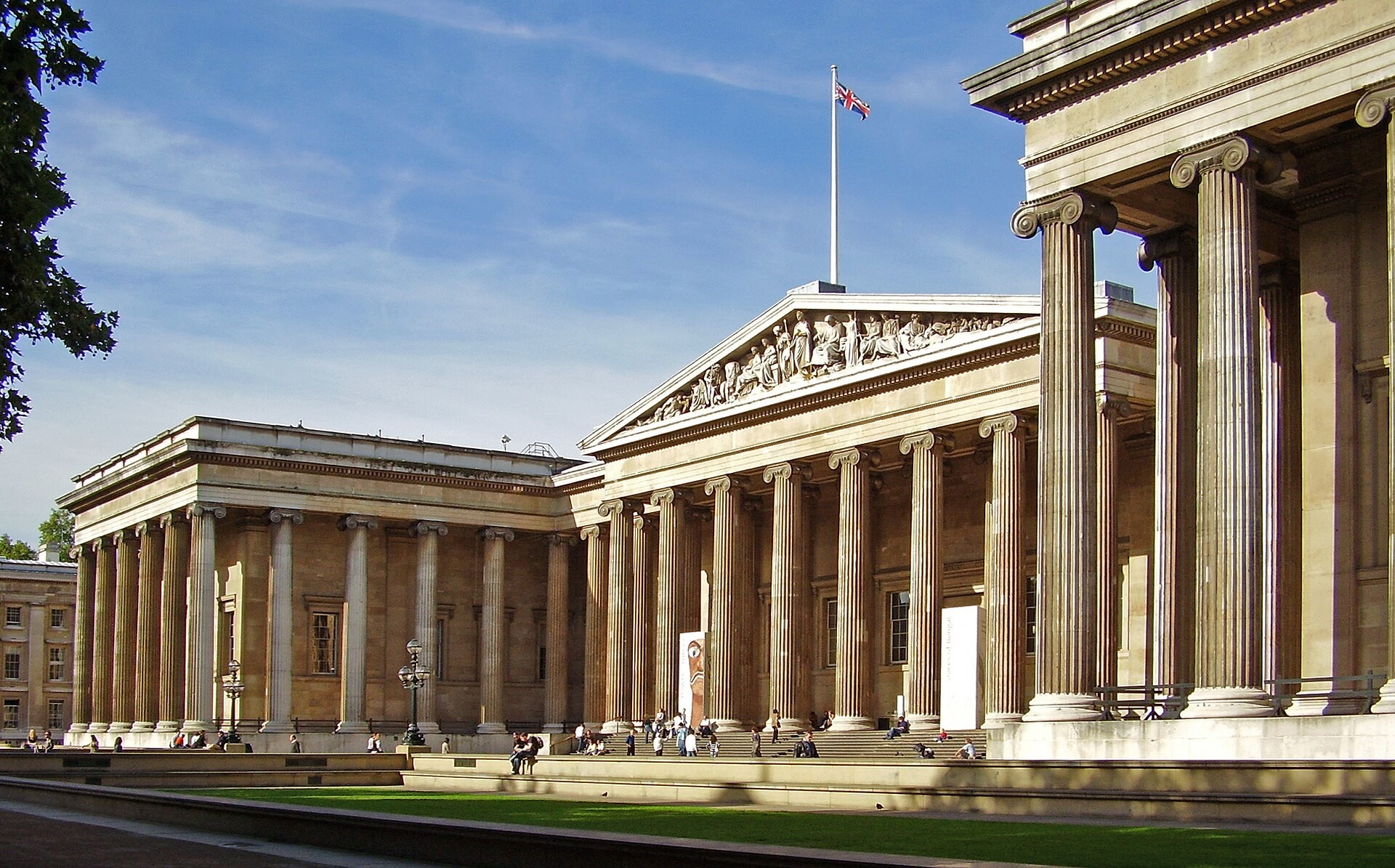
Founded in 1753, the British Museum holds one of the world’s most extensive permanent collections of human history and culture, spanning continents and millennia under a single roof in Bloomsbury, London. It is a non-departmental public body and a national museum, governed by a board of Trustees whose appointment of the Director requires the approval of the Prime Minister. In 2025 the museum attracted 6,440,120 visitors, placing it sixth among the most visited museums in the world and second in the United Kingdom that year. Among its millions of objects, the Rosetta Stone, transferred to the collection in 1802, remains the single most visited item on display.
Key facts
- Country: United Kingdom
- Founded: 1753
- Type: national museum; non-departmental public body; art museum; museum
- Website: https://www.britishmuseum.org/
Origins and governance
Governance rests with the Board of Trustees. The Director, who leads the institution’s day-to-day operations, is appointed by the Trustees subject to the approval of the Prime Minister, a constitutional arrangement that reflects the museum’s status as a national public body.
The Rosetta Stone and the permanent collection
The Rosetta Stone arrived at the museum in 1802 following the Treaty of Alexandria and has been on almost continuous public display since that date. Decades after its arrival it remains the object that draws more individual visitors than any other in the collection.
The collection as a whole is documented across an estimated 2.4 million records. In October 2023, the museum announced a five-year plan to digitise and formally document every one of those records, a project costed at £10 million and funded through private donations.
The Great Court
The Queen Elizabeth II Great Court, designed by architect Lord Foster, opened on 6 December 2000. By enclosing the museum’s inner courtyard with a glass roof, the project created what became the largest covered public square in Europe.
At the centre of the Great Court stood the historic Reading Room, a circular space whose iron bookstacks were built specifically to carry the weight of books and to resist fire.
The 2023 theft and the Recovery Programme
A theft of objects from the collection, discovered in 2023, prompted the museum to establish a dedicated Recovery Programme. By the time of the 2023–24 annual report, the programme had already secured the return of more than 600 of the stolen items.
The Masterplan and Western Range redevelopment
The museum is pursuing a long-term Masterplan estimated to cost at least £1 billion. The project covers the renovation of the Western Range galleries, which account for approximately a third of the museum’s total space, along with new visitor welcome pavilions and a new collection storage and research facility to be built near Reading.
In February 2025, Paris-based Lina Ghotmeh Architecture was selected as the lead architect for the Western Range redevelopment, chosen from a shortlist of five practices.
On 17 October 2026, the museum announced a £30 million donation from an unnamed longstanding supporter specifically directed towards the Masterplan, representing a further step in assembling the funding the project requires.
The Parthenon marbles question
In October 2026, British Museum Chair George Osborne put forward an arrangement under which the Parthenon marbles would spend periods on display in both Athens and London. The proposal represented a marked departure from the museum’s longstanding position, under which it had consistently declined to discuss the possibility of returning the sculptures to Greece.
Did you know
- The bookstacks of the Reading Room were constructed from iron for two practical reasons: to bear the considerable weight of the books stored on them and to offer protection against fire. End to end, they stretched a total of 3 miles. (designingbuildings.co.uk)
- Karl Marx and Mahatma Gandhi are among the notable figures who used the British Museum’s Reading Room. Gandhi is specifically recorded as having worked there during his time in London. (mikehigginbottominterestingtimes.co.uk)
- In October 2026, British Museum Chair George Osborne proposed that the Parthenon marbles could spend periods in both Athens and London. The suggestion was a significant departure from the museum’s historically firm refusal to engage with the question of their return to Greece. (theconversation.com)
Data sources
- Wikidata
- archiseek.com
- britishmuseum.org
- arce.org
- assets.publishing.service.gov.uk
- museumsassociation.org
- artwalkway.com
- ianvisits.co.uk
Data updated: 2026-10-27