
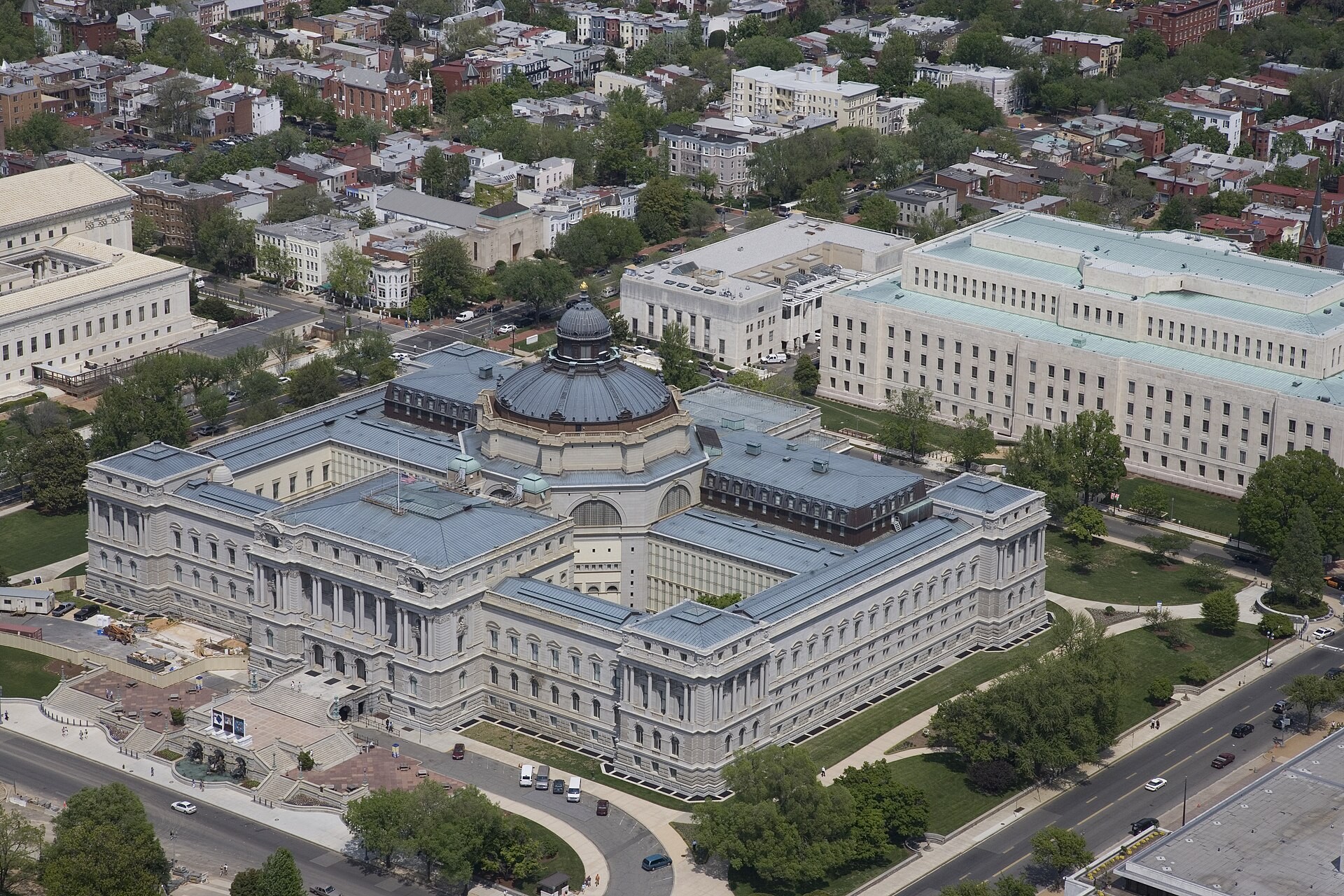
The Library of Congress, founded on April 24, 1800, is the de facto national library of the United States, operating as a legislative branch agency headquartered in Washington, D.C., with a staff of 3,242 employees. Its collections span approximately 470 languages, with roughly half of its book and serial holdings in languages other than English. Each working day, the Library receives approximately 15,000 items, adding more than 10,000 of them permanently to its collections.
Key facts
- Country: United States
- Founded: 24 April 1800
- Headquarters: Washington, D.C.
- Type: national library; United Nations Depository Library; parliamentary archives; legislative branch agency
- Employees: 3,242
- Website: https://loc.gov/
Origins and Early History
Congress established the Library on April 24, 1800, primarily to support legislative research. After the Library’s holdings were destroyed in a fire, Congress moved to rebuild the collection. On January 30, 1815, Congress approved the purchase of former President Thomas Jefferson’s personal library of 6,487 books for $23,950, making it the foundation of the reconstituted Library.
Jefferson had organized his books using a subject arrangement he derived from Sir Francis Bacon’s division of knowledge. The Library of Congress adopted this classification system and used it to organize its book collection for nearly a century.
Disaster struck again on December 24, 1851, when a second fire destroyed approximately 35,000 volumes, including nearly two-thirds of Jefferson’s original donated books. The Library rebuilt once more and continued expanding. By the end of 1901, it became the first American library to reach one million volumes.
Scope and Collections
Copyright law reshaped the Library’s collecting reach. In 1870, Congress centralized all U.S. copyright registration and deposit activities at the Library, making copyright deposits a core source for its collections. The Copyright Office now functions as a national registry for creative works, and copyright deposits account for a significant share of acquisitions across categories including maps, music, motion pictures, and photographs.
In 1903, President Theodore Roosevelt issued an executive order transferring the records of the Continental Congress and the personal papers of six Founding Fathers to the Library to be preserved and made more accessible. The Library’s collecting scope extends well beyond formal documents: it holds more than 2,000 baseball cards from the turn of the 20th century, locks of hair from Presidents Abraham Lincoln and Ulysses S. Grant, and a coil of hair from composer Ludwig van Beethoven.
The American Folklife Center, created by Congress on January 2, 1976, functions as the national repository for folklife documentation. It incorporates the Archive of Folk Culture, which was established within the Library in 1928 and contains the largest collection of American Indian music and spoken word in existence, including the earliest ethnographic field recordings made anywhere in the world.
Audio-Visual and Film Preservation
Under the National Film Preservation Act of 1988, the Librarian of Congress selects 25 films each year deemed culturally, historically, or aesthetically significant for preservation in the National Film Registry. As of 2025, 925 films had been selected in total.
The physical work of preserving audio-visual materials takes place at the Library’s Packard Campus for Audio-Visual Conservation, located on 45 acres near Culpeper, Virginia. The facility is primarily underground and houses 6.3 million collection items across 124 nitrate film vaults, the largest concentration of such vaults in the Western Hemisphere. Drawing on these holdings, the Library presents the National Jukebox, a free online service that makes historical sound recordings available to the public.
Cultural Programs and Honors
The Librarian of Congress appoints the Poet Laureate Consultant in Poetry annually. The position runs from October to May and is intended to raise national awareness of poetry.
Among the Library’s most prized individual items is its Gutenberg Bible, purchased in 1930 as part of a $1.5 million congressional acquisition. It is one of only three perfect, complete copies of the Bible printed on vellum known to survive in the world; the other two are held by the Bibliothèque Nationale de France and the British Library.
Did you know
- The Library’s Gutenberg Bible, purchased in 1930 as part of a $1.5 million congressional acquisition, is one of only three perfect, complete copies of the Bible printed on vellum known to survive in the world; the other two are held by the Bibliothèque Nationale de France and the British Library. (thehistoryblog.com)
- Each working day the Library receives approximately 15,000 items and adds more than 10,000 of them to its permanent collections, making it one of the fastest-growing library collections in the world. (loc.gov)
- The Library holds a lock of President Abraham Lincoln’s hair collected after his assassination in 1865, a lock of President Ulysses S. Grant’s hair that Grant sent his wife as a gift in 1864, and a coil of hair from composer Ludwig van Beethoven collected by a fan after his death in 1827. (cbsnews.com)
- The Library’s Archive of Folk Culture contains the largest collection of American Indian music and spoken word in existence, including the earliest ethnographic field recordings made anywhere in the world. (loc.gov)
- By the end of 1901, the Library of Congress became the first American library to reach one million volumes, marking a milestone in the history of public access to knowledge in the United States. (cool.culturalheritage.org)
- The Library holds a collection of more than 2,000 baseball cards from the turn of the 20th century, illustrating the remarkable breadth of its collecting mandate beyond books and manuscripts. (cbsnews.com)
- Jefferson’s 6,487-volume library, purchased in 1815, was organized using a subject arrangement he derived from Sir Francis Bacon’s division of knowledge, a classification system the Library of Congress used to organize its book collection for nearly a century. (guides.loc.gov)
Data sources
Data updated: 2026-10-30