
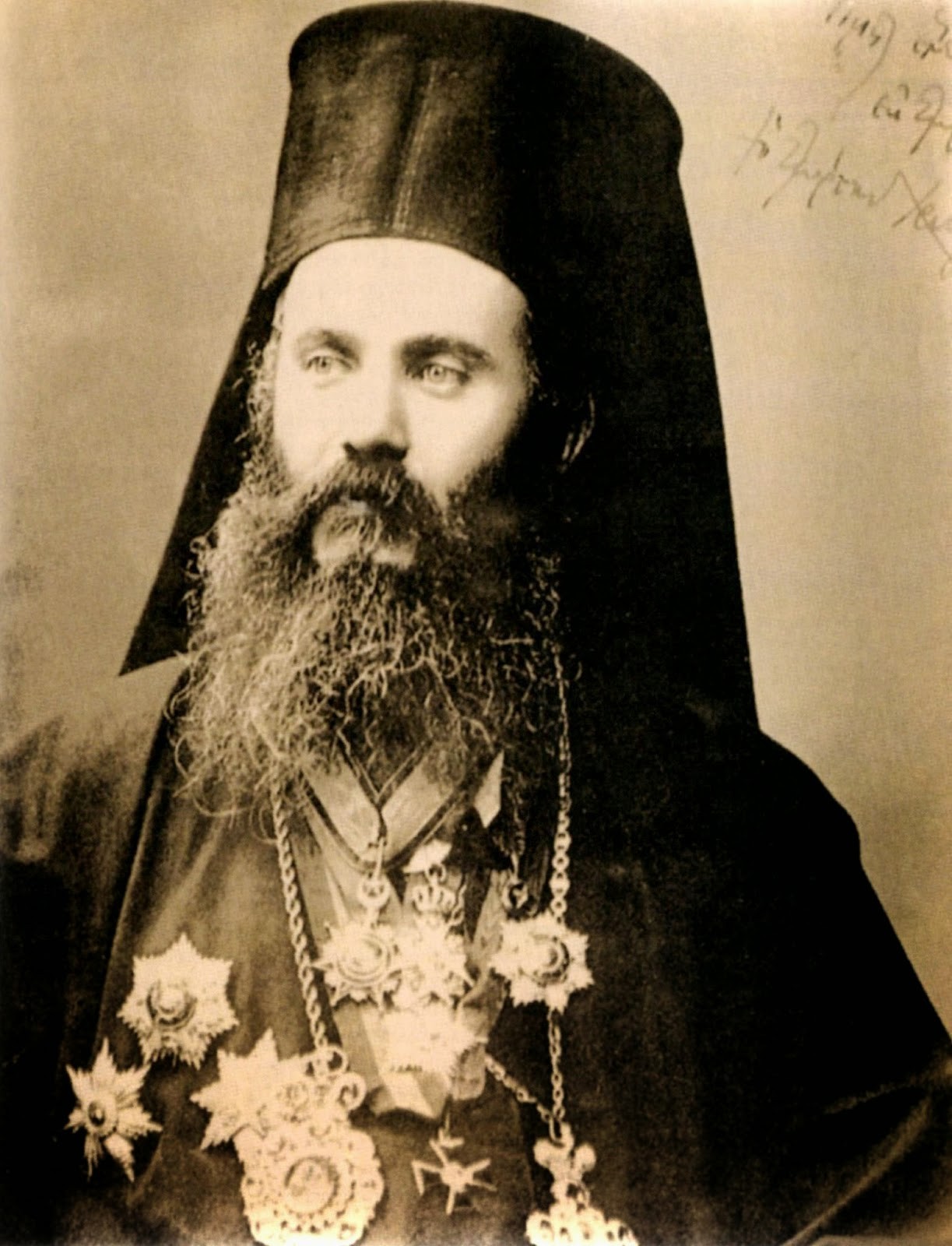
Chrysostomos Kalafatis, born on 8 January 1867 in Triglia, Bithynia, served as Metropolitan of Smyrna from 1910 until his death on 27 August 1922, when Turkish commandant Nureddin Pasha arrested him following the Divine Liturgy in the Church of Saint Photini and surrendered him to a mob. During his episcopate he organized relief for refugees numbering in the tens of thousands and documented the persecution of Christian minorities in two published books. The Holy Synod of the Church of Greece declared him a martyr and saint on 4 November 1992, and confirmed the title of Ethnomartyr by encyclical on 5 July 1993.
Key facts
- Born: 8 January 1867
- Birthplace: Triglia
- Died: 27 August 1922
- Place of death: İzmir
- Country: Greece
- Occupation: Christian minister; metropolitan; writer
- Education: Halki seminary
Early Life and Education
Chrysostomos Kalafatis was born on 8 January 1867 in Triglia, Bithynia, at the time part of the Ottoman Empire, the son of Nikolaos and Kalliopi Lemonidos Kalafatis and one of eight children. His early schooling in Triglia included instruction in Turkish from Christophoros Moumouzis, in French from Nikolaos Hatzichrysafis, and in ecclesiastical music from Papa-Theodosis.
He pursued theological studies at Halki Seminary. After graduating, he took up a position as Archdeacon to Metropolitan Konstantinos Valiadis of Mytilene, a churchman who would later become Ecumenical Patriarch Constantine V in 1897. He subsequently served as chancellor of the Great Church, that is, the Ecumenical Patriarchate, before moving into a diocesan role.
Metropolitan of Drama (1902–1910)
Patriarch Joachim III ordained Chrysostomos Metropolitan of Drama in 1902. Drama lay in Eastern Macedonia and was then under Ottoman administration. He directed his energies toward building up the Greek community there, encouraging the construction of schools, churches, hospitals, athletic centers, and nursery schools, and working to reclaim churches that had come under Bulgarian occupation.
His nationalist activities drew the attention of the Sublime Porte, which demanded his removal. On 30 August 1907 he was exiled from his metropolis and withdrew to Triglia. He attempted to return to Drama, but on 20 January 1909 the Porte again judged him a threat to public order and transferred him back to Triglia a second time.
Metropolitan of Smyrna (1910–1922)
On 11 March 1910 Chrysostomos was appointed Metropolitan of Smyrna, succeeding Basileios of Smyrna; the formal election followed on 10 May 1910. During World War I he helped members of the Greek population of Anatolia reach safety in the Greek islands of the Aegean, and acted as spokesman for the civilian population to diplomatic officials and the international press.
A first removal from Smyrna in 1914 saw him confined in Constantinople, where he wrote two books: one in Greek, titled ‘The Hellenism of Asia Minor and the New Turkey,’ and one in French, titled ‘The Persecution of Christians,’ both documenting crimes against Christian minorities.
After the Armistice of Mudros in 1918 he returned to Smyrna, and was reinstated as metropolitan bishop when the Hellenic Army occupied the city in 1919. He organized a humanitarian campaign to provide food, housing, and support to approximately 40,000 refugees who had arrived in Smyrna itself, and to a further 80,000 who had reached the nearby coastline, while opposing the anti-Christian policies of Ottoman commander Rahmi Bey. His relations with the Greek administration were not without friction: the Greek High Commissioner Aristeidis Stergiadis, appointed by Prime Minister Venizelos in 1919, interrupted a cathedral service after Chrysostomos introduced political commentary into his sermon.
Death in 1922
On 27 August 1922, following the Divine Liturgy in the Church of Saint Photini, Chrysostomos was arrested by Turkish commandant Nureddin Pasha and surrendered to a crowd outside. The New York Times, in a story published on 18 September 1922, described the manner of his death as ‘fiendish torture.’
The Anglican vicar Reverend Charles Dobson declared that ‘Chrysostomos was truly a martyr, because he had no false optimism and knew what his fate would be at the hands of the Turk.’
Writings and Theological Work
Beyond the two books written during his confinement in Constantinople, Chrysostomos authored a two-volume theological work titled ‘On the Church.’ He also contributed articles to the ecclesiastical periodicals Ekklesiastiki Aletheia and Ieros Polykarpos.
Canonization and Veneration
The Holy Synod of the Church of Greece declared Chrysostomos a martyr and a saint on 4 November 1992. On 5 July 1993, the Holy Synod issued Encyclical 2556, unanimously confirming his title as Ethnomartyr and Saint of the Orthodox Church.
His feast day falls on the Sunday before the Exaltation of the Holy Cross, which places it between 7 and 13 September each year. He is commemorated jointly with four other Holy Hierarchs of Asia Minor: Ambrosios of Moschonision, Euthymios of Zela, Gregorios of Kidonion, and Procopius of Iconium.
Did you know
- When the French steamship Niger carried Chrysostomos to Smyrna in 1910 upon his appointment as Metropolitan, the French captain ordered his crew to present honors at the moment of his disembarkation. (groups.google.com)
- At his consecration as Metropolitan of Drama in 1902, Chrysostomos made a reportedly prophetic statement declaring that his miter “will be converted to the crown of thorns of martyrdom of a hierarch” — a remark cited decades later in connection with his violent death in 1922. (johnsanidopoulos.com)
- The square in Nea Smyrni, Athens, named after Chrysostomos of Smyrna, hosts an annual wreath-laying ceremony at his statue in the Garden of Remembrance, as documented for 7 September 2025. (daysofart.gr)
Data sources
- Wikidata
- findagrave.com
- orthochristian.com
- orthodoxwiki.org
- groups.google.com
- johnsanidopoulos.com
- pappaspost.com
- thenationalherald.com
Where it appears
- Smyrna, September 1922: fire on the quay as a Greek city burned October 30, 2026
Data updated: 2026-10-27