
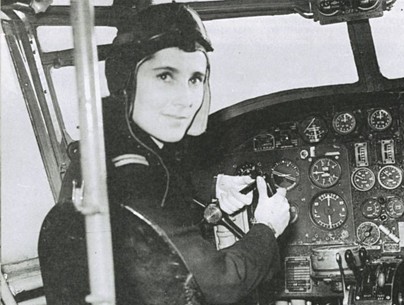
Diana Barnato Walker (15 January 1918 – 28 April 2008) was a British aviator who flew 80 types of aircraft and delivered 260 Spitfires for the Air Transport Auxiliary during the Second World War, then, at 45, became the first British woman to break the sound barrier. Born in London during a Zeppelin raid into a family whose fortune traced to the De Beers mining company, she moved from debutante to ferry pilot to supersonic record-holder across decades of flying. Her 1994 autobiography, Spreading My Wings, published by Patrick Stephens Limited, sets out that career in 224 pages.
Key facts
- Born: 15 January 1918
- Birthplace: London
- Died: 28 April 2008
- Place of death: Surrey
- Country: United Kingdom
- Occupation: aircraft pilot
- Employer: Air Transport Auxiliary
- Education: Queen’s College London
- Awards: Member of the Order of the British Empire; Fellow of the Royal Aeronautical Society
Origins and early life
Diana Barnato came into the world on 15 January 1918 in Camden Town, London, while a Zeppelin raid was in progress overhead. Her paternal grandfather was Barney Barnato, a co-founder of the De Beers mining company in Johannesburg, and her father was Woolf Barnato.
She was educated at Queen’s College London. In 1936, at 18, she was presented to King Edward VIII at Buckingham Palace as a debutante. That same year she took up flying at the Brooklands Flying Club, within the famous Surrey motor racing circuit, where she learned on a de Havilland DH.82 Tiger Moth. Her first solo followed after only six hours of dual instruction, and she earned her pilot’s licence at 18.
War service: nursing and the ATA
Shortly after the outbreak of the Second World War she volunteered as a Red Cross nurse. In 1940 she was serving in France before the evacuation of the British Expeditionary Force from Dunkirk, and subsequently drove ambulances in London during the Blitz.
R. O. On 9 May 1942 she joined No. 15 Ferry Pool at RAF Hamble, Hampshire, initially delivering low-powered single-engine aircraft from factories to storage units and RAF and Naval flying units. By the end of the war she had flown 80 types of aircraft and delivered 260 Spitfires.
Service with the ATA was not without hazard or controversy. Her unarmed aircraft were attacked twice by German fighters; she emerged uninjured on both occasions. In May 1943 she was reprimanded for appearing at Windsor Races wearing trousers and a side cap, and the following month was again reprimanded for the diversion of an operational aircraft, receiving a demotion to 3rd Officer.
Marriage, the Brussels flight, and its consequences
On 6 May 1944 she married Wing Commander Derek Ronald Walker at St. Jude’s Church, Englefield Green, Surrey. In October 1944 their honeymoon took an unauthorized form: she flew a Mk IX Spitfire across the English Channel into occupied Europe, landing in Brussels. The price was steep: both she and her husband were fined three months’ pay.
Wing Commander Walker was killed on 14 November 1945 while flying a North American Mustang in bad weather between two UK airfields. Diana never remarried. She entered a 30-year relationship with Whitney Straight (1912–1979), an American-born Grand Prix driver, Battle of Britain Hurricane pilot, and later head of British Overseas Airways Corporation. Their son, Barney Barnato Walker, was born in 1947.
Post-war flying and the 1948 fire
After the war Diana gained her commercial flying licence and for many years volunteered as a pilot with the Women’s Junior Air Corps (WJAC), giving air-experience flights to teenage girls to encourage them into the aviation industry. On 11 July 1948, an aircraft she was flying for the WJAC caught fire near White Waltham. Rather than bail out and lose the corps’ aircraft, she switched off the fuel and glided back to the airfield.
The 1963 sound barrier and world speed record
On 26 August 1963, having obtained approval from Secretary of State for Air Sir Hugh C. P. J. Fraser MBE, Diana flew through the sound barrier in an English Electric Lightning T.4, setting a women’s world air speed record. She was 45 years old. The RAF required her to pass an official decompression test beforehand because the flight reached 56,000 feet; had she failed the test the flight would not have been authorised.
The flight made her the first woman pilot to join the Ten Ton Club, whose 350 members had all flown above 1,000 mph; at the time of her entry, only two other women in the world held membership. For the achievement she received the Jean Lennox Bird Trophy in 1963, presented by Lord Brabazon, awarded annually to a British woman pilot for notable achievement in aviation.
Shortly after the 1963 flight, Diana was found to have cancer and underwent three operations, ultimately recovering.
Recognition and later life
On 12 June 1965, Diana was appointed a Member of the Order of the British Empire (MBE) for services to the Air Transport Auxiliary and the Girls Venture Corps.
In her later years she farmed sheep in Surrey and served as master of the Old Surrey and Burstow foxhounds for thirteen seasons. She remained connected to aviation: at age 88 she took the controls of a twin-seat Spitfire trainer, and when asked why, replied, ‘It would be impolite not to.’
Diana Barnato Walker died of pneumonia on 28 April 2008 in a hospital near her sheep farm in Surrey. She was survived by her son Barney. She is buried in Englefield Green Cemetery, Englefield Green, Surrey, beside her husband Wing Commander Derek Walker and her father Woolf Barnato.
Autobiography
Her memoir, Spreading My Wings, was published in 1994 by Patrick Stephens Limited. The 224-page volume carries a foreword by Lord Shawcross and covers her wartime ATA service, the Brussels flight, and her later record-breaking career.
Did you know
- Her first solo at Brooklands Flying Club came after only six hours of dual instruction, at £3 per hour, for a total cost of £18. Most students at the time needed nine or more hours before going solo. (simanaitissays.com)
- During her ATA service, German fighters attacked her unarmed aircraft on two separate occasions. She was uninjured each time. (kda132.com)
- When an aircraft she was flying for the Women’s Junior Air Corps caught fire on 11 July 1948 near White Waltham, she switched off the fuel supply and glided the aircraft back to the airfield rather than bail out and lose the corps’ plane. (samilhistory.com)
- At 45, Diana became the first woman pilot to join the Ten Ton Club, a group of 350 pilots who had all exceeded 1,000 mph. When she joined in August 1963, only two other women in the world were members. (thisdayinaviation.com)
- At age 88, she took the controls of a rare twin-seat Spitfire trainer. Asked to explain herself, she said: ‘It would be impolite not to.’ (thisdayinaviation.com)
- Her partner Whitney Straight was married to Lady Daphne Finch-Hatton throughout their 30-year relationship. Diana never asked him to leave his wife, saying she was ‘perfectly content’ and had her own identity. (kda132.com)
- The RAF insisted she pass a formal decompression test before permitting her 1963 Lightning flight, which was conducted at 56,000 feet. A failed test would have cancelled the flight entirely. (thisdayinaviation.com)
Data sources
- Wikidata
- thisdayinaviation.com
- motorsportmemorial.org
- samilhistory.com
- people.elmbridgehundred.org.uk
- ata-ferry-pilots.org
- books.google.com
- findagrave.com
Data updated: 2026-10-28