
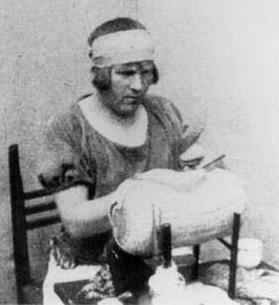
Dora Richter (16 April 1892 – 26 April 1966) was a German trans woman, born in Seifen (now Ryžovna), a small town in the Ore Mountains region of Bohemia, into a poor farming family. She is identified by historians as the first known person to undergo a complete male-to-female gender-affirming surgery, including vaginoplasty, performed in Berlin in June 1931. Working for much of her adult life as a cook, waiter, and domestic servant, she spent years at Magnus Hirschfeld’s Institut für Sexualwissenschaft before the Nazi raids of 1933 forced her out of Berlin entirely. For decades she was believed to have died in those raids, but archival research by Clara Hartmann confirmed she had lived until 26 April 1966, reaching the age of 74.
Key facts
- Born: 16 April 1892
- Birthplace: Ryžovna
- Died: 26 April 1966
- Country: Germany
- Occupation: domestic worker; waiter; cook; flower seller
- Employer: Berta Kolitsch
Early Life and Family
Richter was born on 16 April 1892 in Seifen, Bohemia (now Ryžovna), the second of seven children. Her father, Josef Richter, was a musician; her mother was Antonia Richter, née Kraus. The family farmed under modest circumstances in the Ore Mountains region.
From early childhood, Richter displayed what her doctor later documented as ‘a tendency to act and carry on in a feminine way.’ When she was six years old, she attempted self-surgery using a cord as a tourniquet. In response, her parents allowed her to dress and live as a girl through her childhood years.
As a young adult, Richter trained as a baker’s apprentice and at some point joined a wandering theater troupe before eventually moving to Berlin.
Life in Berlin Before the Institute
In Berlin, Richter found work in the hotel trade as a cook and waiter, doing so under her birth name and presenting as male during the busy summer season, then living openly as a woman in the off-season. This arrangement left her vulnerable under laws that criminalized cross-dressing in public.
She was arrested multiple times for appearing in women’s clothing and was sent to male prisons on each occasion. The cycle ended when a sympathetic judge chose not to send her back to prison but instead released her into the care of Magnus Hirschfeld at the Institut für Sexualwissenschaft.
In 1916, Richter was drafted into the German army. She was discharged after only two weeks.
At the Institut für Sexualwissenschaft
Richter arrived at the Institute in early 1923 and took up work there as a domestic servant, one of five transgender staff members employed in that capacity. Hirschfeld gave her the affectionate diminutive nickname ‘Dörchen.’ Through his advocacy, the Berlin police issued her a Transvestitenschein, a permit that allowed her to wear women’s clothing in public without risk of arrest.
In April 1925, Richter applied to the Czechoslovakian consulate in Berlin for two passports: one in the name Dora for use in Germany, and a second in her birth name for travel home to visit family.
The Institute also became the setting for the medical documentation of her case. In 1924, Werner Holz, an assistant physician at the Oberlin district hospital in Nowawes near Potsdam, wrote what is considered probably the first dissertation on a trans-related topic, using Richter’s case under the pseudonym ‘Rudolph R.’ as its primary subject.
The Surgeries of 1931
In early 1931, Institute physician Ludwig Levy-Lenz performed a penectomy on Richter. In June 1931, surgeon Erwin Gohrbandt carried out a vaginoplasty at the Urban Hospital in Kreuzberg, Berlin. Most researchers identify Richter, not the better-known Danish trans woman Lili Elbe, as the first person to undergo a complete and successful gender-affirming surgery including vaginoplasty. Elbe underwent a vaginoplasty a few weeks after Richter’s procedure.
Institute psychiatrist Felix Abraham published a case study of Richter’s surgeries later that year, in 1931, under the title ‘Genitalumwandlungen an zwei männlichen Transvestiten’ in the Zeitschrift für Sexualwissenschaft und Sexualpolitik (vol. 18, pp. 223–226), referring to her as ‘Rudolph (Dora) R.’
Richter’s case is credited by historians at the Homolulu Berlin memorial project with having shifted Hirschfeld’s own scientific position. He had initially opposed surgical interventions but revised his view after physicians Werner Holz, Felix Abraham, and Heinrich Stabel reported positive outcomes for Richter and others.
Later Years in Berlin and the 1933 Film
By late 1931, Richter had taken up work as a chef at Restaurant Kempinski at Kurfürstendamm 27 in Berlin, in the building that later became Hotel Bristol.
In 1933, footage of Richter appeared alongside Toni Ebel and Charlotte Charlaque in the Austrian film Mysterium des Geschlechtes (Mystery of Gender), directed by Lothar Golte and Carl Kurzmayer. All three women appeared anonymously and without credit. The film ran in Viennese cinemas for approximately two weeks in April 1933 before being banned, and it was never publicly screened in Germany.
Return to Bohemia and Life After Berlin
In 1934, the president of Czechoslovakia granted Richter a legal name change to Dora Rudolfine Richter (Czech form: Dora Rudolfa Richterová). She then moved back to her birthplace of Ryžovna, where she worked as a lacemaker.
For many years, scholars believed Richter had been killed during the Nazi raid on the Institut für Sexualwissenschaft in May 1933. Archival research by Clara Hartmann, drawing on the Czech National Archives, records from remote towns, and the Red Cross Holocaust tracing service, established that Richter had in fact survived the raid and remained in Ryžovna until the 1946 expulsion of Germans from Czechoslovakia.
After the expulsion, Richter moved to Allersberg, Germany, where she lived until her death on 26 April 1966. In 2024, Hartmann also located her unmarked grave in a cemetery in Allersberg. Residents of the town whom Hartmann interviewed remembered her warmly.
Commemoration
A commemorative plaque honoring Richter was unveiled on 21 August 2026 at the Vivantes Klinikum Am Urban, the Berlin hospital where her final surgery was performed. The plaque was funded by the Hannchen-Mehrzweck Foundation and supported by TransInterQueer e.V. and the Bundesverband Trans*.
A second plaque, featuring a QR code linking to the Queere Held*innen audio tour, is installed at Richter’s former residence at Motzstrasse 11 in Berlin, at the window of the Magnus Pharmacy.
Did you know
- At age six, Richter attempted to remove her penis by tying a cord around it as a tourniquet. Her parents responded by allowing her to live as a girl through her childhood. (protomag.com)
- Magnus Hirschfeld had initially been firmly against surgical interventions, writing: ‘In the beginning I was strongly opposed to these methods, which I judged to be very dangerous to health.’ He changed his position after physicians Werner Holz, Felix Abraham, and Heinrich Stabel reported positive outcomes, including those seen in Richter’s case. (zagria.blogspot.com)
- Felix Abraham’s 1931 case study paper on Richter’s surgeries was not translated into English until 1998, when The International Journal of Transgenderism published it as ‘Genital Reassignment on Two Male Transvestites.’ (zagria.blogspot.com)
- Residents of Allersberg interviewed by researcher Clara Hartmann remembered Richter as ‘a cheerful old woman’ who carried a pigeon in her handbag on her walks around the town. (wearequeeraf.com)
- The Austrian film Mysterium des Geschlechtes (1933), in which Richter appeared alongside Toni Ebel and Charlotte Charlaque, ran in Viennese cinemas for roughly two weeks in April 1933 before being banned. It was never publicly screened in Germany. (zagria.blogspot.com)
Data sources
- Wikidata
- electricliterature.com
- zagria.blogspot.com
- protomag.com
- legacyprojectchicago.org
- majusculelit.com
- homoluluberlin.de
- wearequeeraf.com
- visitberlin.de
Data updated: 2026-10-27