
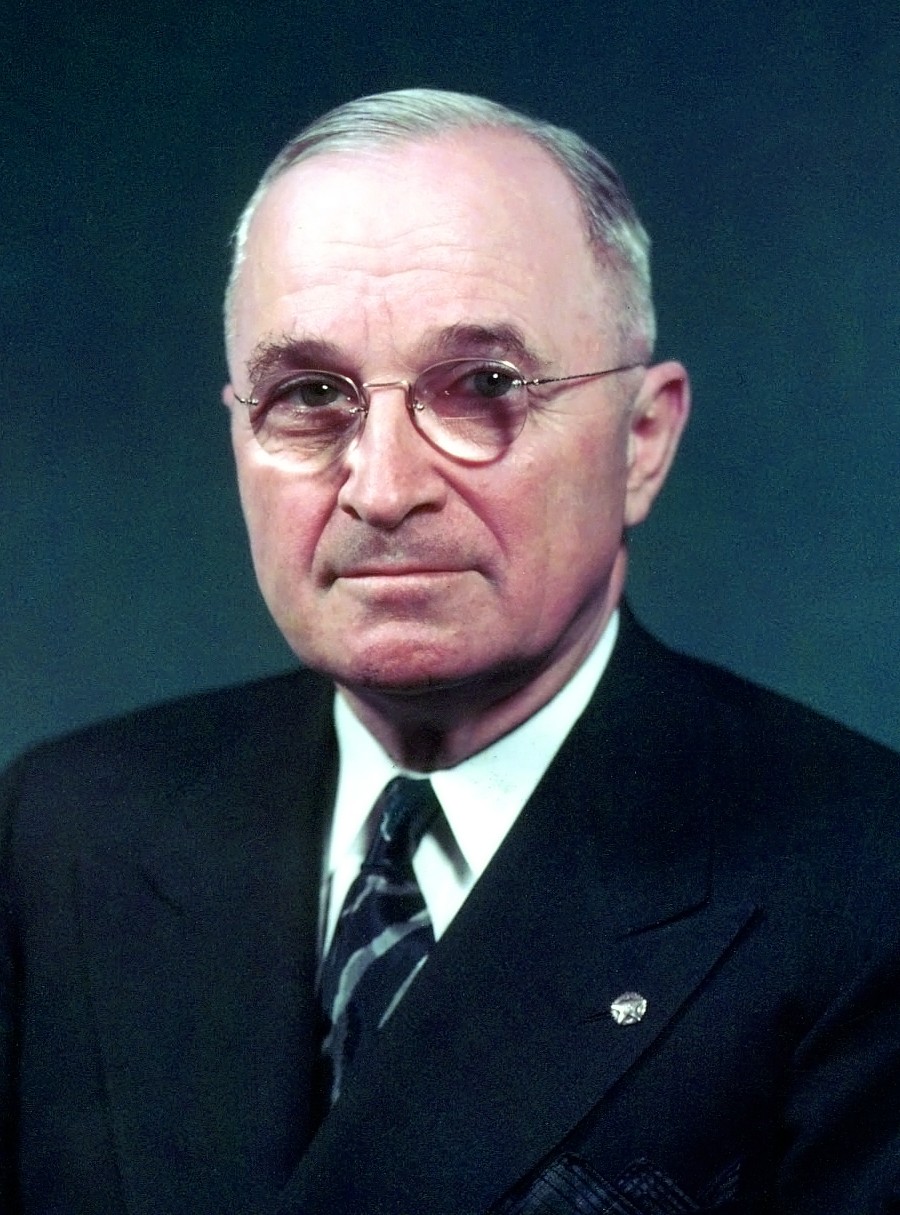
Harry S. Truman (May 8, 1884 – December 26, 1972) was the 33rd President of the United States, holding office from April 12, 1945, when Franklin D. Roosevelt died, until January 1953. He came to the presidency without forewarning and in the final months of World War II authorized decisions that shaped the postwar world, including the use of atomic bombs against Japan and U.S. membership in NATO. By his own estimate, a Senate committee he chaired saved the federal government $15 billion by rooting out waste and corruption in wartime defense contracts. He left office with a Gallup approval rating of 32 percent and a historical reputation that has risen steadily in the decades since.
Key facts
- Born: 8 May 1884
- Birthplace: Harry S Truman Birthplace State Historic Site
- Died: 26 December 1972
- Place of death: Research Medical Center
- Country: United States
- Occupation: politician; judge; businessperson; military officer
- Education: University of Missouri–Kansas City; William Chrisman High School
- Awards: Congressional Gold Medal; Armed Forces Reserve Medal; World War II Victory Medal; Silver T-Square Award
Early Life and Education
Truman was born on May 8, 1884, and grew up in Independence, Missouri. He graduated from William Chrisman High School in 1901. His eyesight, which left him legally blind in his left eye, blocked any path to the U.S. Military Academy at West Point, and he did not attend university at that stage. After high school he worked as a timekeeper for a railroad construction contractor, then as a clerk in two Kansas City banks. In 1906 he returned to farm work, where he remained for years.
Later in life, while serving as presiding judge of Jackson County, Truman studied law at night school for three years. He did not complete a degree, choosing to leave out of respect for the judicial role he held.
Military Service
From 1905 to 1911, Truman served in the Missouri National Guard. He had memorized the eye chart to pass the enlistment vision test, having already been turned away from West Point for the same deficiency. When the United States entered World War I in 1917, Truman helped organize the 2nd Regiment of Missouri Field Artillery, which was called into federal service as the 129th Field Artillery and deployed to France.
On April 23, 1918, he was promoted to captain and given command of Battery D. His unit saw action in the Vosges, Saint Mihiel, and Meuse-Argonne campaigns, making him the only American president of the modern era to have seen combat in World War I. After the armistice, Truman remained in the Officers’ Reserve Corps. He retired with the rank of colonel on January 31, 1953.
Before the Presidency: Business, Law, and Politics
On June 28, 1919, Truman married Bess Wallace, whom he had known since childhood. Their only child, Mary Margaret, was born on February 17, 1924. That same postwar period saw Truman try his hand at commerce: from 1919 to 1922 he ran a men’s clothing store in Kansas City with his wartime friend Eddie Jacobson. The store failed in the postwar recession and went bankrupt in 1922. Truman refused to declare personal bankruptcy and spent years repaying his creditors.
In 1922, Thomas J. Pendergast, the Democratic political boss of Kansas City, asked Truman to run for a judgeship on the county court of Jackson County’s eastern district. Truman won the seat and served as a county-level administrator overseeing the budget and roads. The connection to Pendergast’s machine helped launch his political career, and he eventually moved to the U.S. Senate, where he chaired the Senate Special Committee to Investigate the National Defense Program. That committee, known widely as the Truman Committee, identified corruption, cost overruns, and waste in defense contracts during World War II. By Truman’s own estimate, the investigations saved the government $15 billion.
The Presidency
Truman assumed the presidency on April 12, 1945, upon the death of Franklin D. Roosevelt. He had been vice president for fewer than three months. The decisions that followed in the first months of his presidency included the use of atomic bombs against Japan, a subject that has generated sustained debate ever since. Revisionist scholars have argued the bombing was unnecessary; others contend it prevented a costly land invasion of Japan. The controversy remains one of the most documented in American presidential history.
The Korean War, which began in 1950, brought another defining confrontation. On April 11, 1951, Truman fired General Douglas MacArthur as commander of U.N. forces in Korea after MacArthur repeatedly criticized the administration’s policy of limiting the war and directly challenged Truman’s authority as commander in chief.
On November 1, 1950, two Puerto Rican nationalists, Oscar Collazo and Griselio Torresola, attempted to assassinate Truman at Blair House in Washington, D.C., where he was residing during White House renovations. Secret Service agent Leslie Coffelt was killed defending the president. Torresola was shot dead during the attack, while Truman was unharmed. The entire gun battle occurred in front of an estimated 2,000 witnesses on Pennsylvania Avenue.
Approval Ratings and Historical Reputation
Truman left office in January 1953 with a Gallup approval rating of 32 percent. His lowest recorded rating, 22 percent in February 1952, was the lowest of any modern U.S. president at the time. His reputation recovered substantially in subsequent decades. In the C-SPAN 2021 Presidential Historians Survey, he received a score of 713 and was ranked 6th overall among all U.S. presidents. That ranking was consistent with earlier surveys: 6th in 2017, 5th in 2009, and 5th in 2000.
Awards and Recognition
During his life Truman received the Congressional Gold Medal, the Armed Forces Reserve Medal, the World War II Victory Medal, and the Silver T-Square Award.
Later Life and Death
After leaving the White House, Truman based himself at the Harry S. Truman Presidential Library in Independence, Missouri, which opened in 1957. For nearly ten years after the library opened, he worked in his office there five days a week and personally taught the early docents how to give tours of the exhibits.
Truman died on December 26, 1972, at Research Medical Center in Kansas City, Missouri, at age 88. He is buried in the courtyard of the Harry S. Truman Presidential Library and Museum in Independence, alongside his wife Bess.
Did you know
- The “S” in Harry S. Truman’s name does not stand for anything. His parents chose it as a compromise to honor both of his grandfathers, Anderson Shipp Truman and Solomon Young, whose names each began with the letter S. (trumanlibrary.gov)
- To enlist in the Missouri National Guard in 1905, Truman memorized the eye chart before his vision test. He had already been rejected from West Point because he was legally blind in his left eye. (explorethearchive.com)
- The Chicago Tribune was so confident Thomas Dewey would win the 1948 presidential election that it printed the banner headline “Dewey Defeats Truman” on the night of November 2, 1948. Truman was photographed holding a copy of the paper after securing his actual victory with 303 electoral votes. (constitutioncenter.org)
- When the assassination attempt unfolded at Blair House on November 1, 1950, Truman was upstairs taking an afternoon nap. He was unharmed, and the entire gun battle played out in front of an estimated 2,000 witnesses on Pennsylvania Avenue. (ghostsofdc.org)
- After leaving the White House, Truman reported to his office at the Harry S. Truman Library five days a week for nearly ten years after the library opened in 1957, and he personally trained the early docents who gave tours of the exhibits. (csmonitor.com)
Data sources
- Wikidata
- trumanlibrary.gov
- historynet.com
- havefunwithhistory.com
- millercenter.org
- nato.int
- ebsco.com
- cfr.org
- presidents.website
- c-span.org
- nps.gov
- historynewsnetwork.org
Data updated: 2026-10-28