
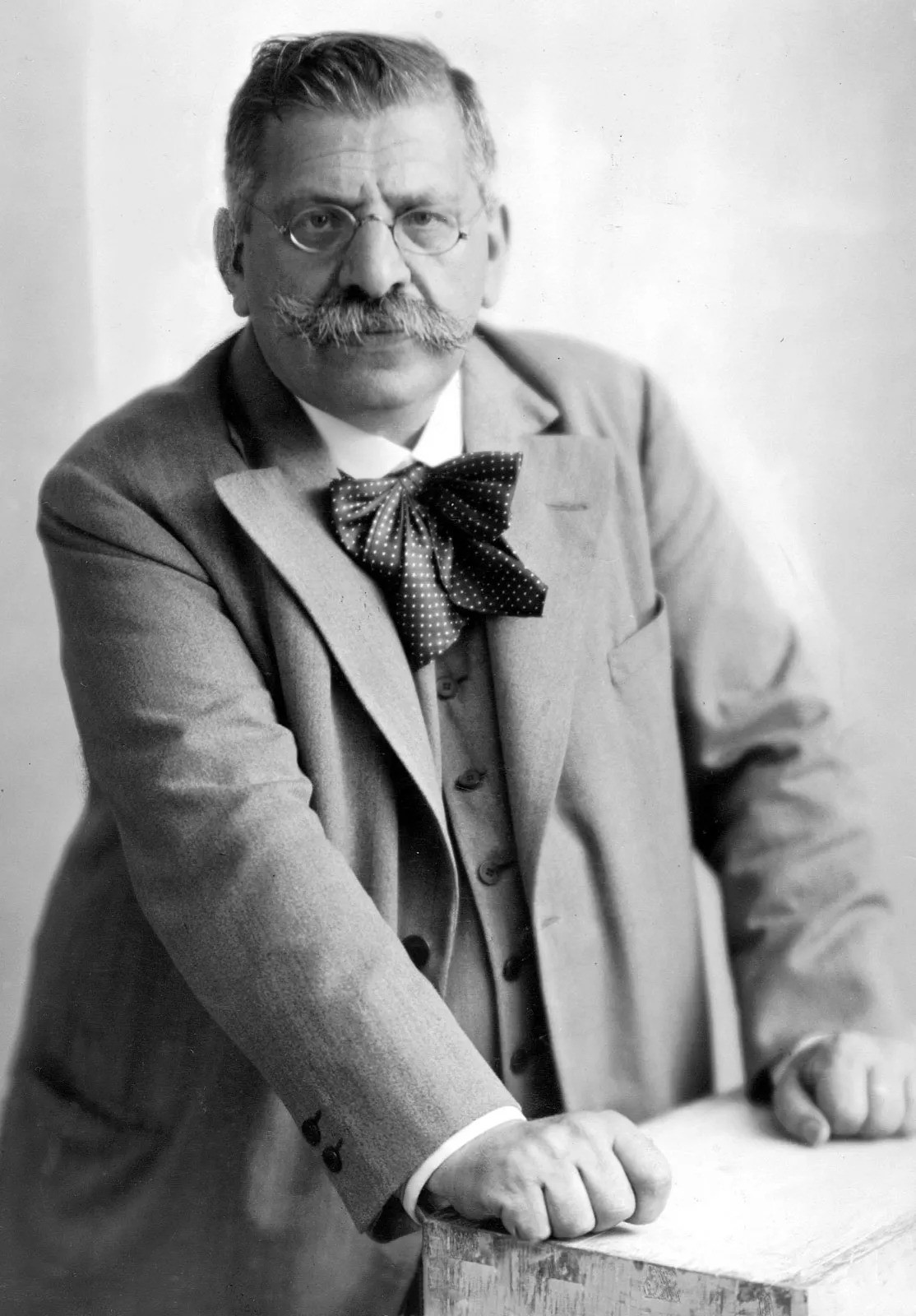
Magnus Hirschfeld (14 May 1868 – 14 May 1935) was a German physician, sexologist, and LGBTQ rights activist whose work made Berlin, briefly, the center of organized scientific inquiry into human sexuality. Born in Kołobrzeg and trained across four universities, he founded in July 1919 the world’s first institution dedicated to the scientific study of sex, the Institut für Sexualwissenschaft, and spent decades arguing in print and before public audiences that homosexuality was a biological variant rather than a crime. The Institute’s library, before its destruction in 1933, held over 20,000 volumes and 35,000 photographs.
Key facts
- Born: 14 May 1868
- Birthplace: Kołobrzeg
- Died: 14 May 1935
- Place of death: Nice
- Country: Germany
- Occupation: physician; LGBTQ rights activist; writer; sexologist
- Field: physician
- Education: LMU Munich; University of Strasbourg; Heidelberg University; Frederick William University Berlin
Early life and education
Hirschfeld was born on 14 May 1868 in Kołobrzeg (then Kolberg, Prussia) into a large medical family. His parents, Friederike and Hermann Hirschfeld, had eleven children, of whom four died young. Hermann Hirschfeld was himself a physician who served in the Prussian medical service during the Franco-Prussian War of 1870–71 and held the honorary title of Sanitätsrat (senior medical officer).
As a youth, Hirschfeld attended Kolberg Cathedral School, which at the time was a Protestant institution. He began university studies in 1887–1888, reading philology in Breslau before switching to medicine and natural sciences. He studied at LMU Munich, the University of Strasbourg, Heidelberg University, and Frederick William University in Berlin, earning his medical degree in 1892.
After qualifying, Hirschfeld spent eight months in the United States, visiting the World’s Columbian Exposition in Chicago and financing the journey with articles written for German journals.
Early activism and publications
In 1896, Hirschfeld published his first sexological work, Sappho und Sokrates, under the pseudonym ‘Th. Ramien.’ The book argued that homosexuality was a natural biological phenomenon and should not be criminalized, setting out the position he would defend for the rest of his career.
In 1899, he began editing and publishing the Jahrbuch für sexuelle Zwischenstufen (Yearbook for Sexual Intermediate Stages), a scholarly annual he would continue to produce until 1923. Together with his staff, he assembled a 20,000-page text collection in its pages.
Hirschfeld co-founded the Scientific-Humanitarian Committee, which gathered more than 6,000 signatures on a petition calling for the repeal of Paragraph 175, Germany’s law criminalizing homosexual acts between men. Among the signatories were Albert Einstein, Thomas Mann, Hermann Hesse, Rainer Maria Rilke, and Leo Tolstoy.
The Institut für Sexualwissenschaft
In July 1919, Hirschfeld opened the Institut für Sexualwissenschaft in a Berlin Tiergarten villa at In den Zelten 10. It was the first institution of its kind in the world. The Institute operated under the Latin motto ‘Per scientiam ad justitiam’ (Through science to justice) and combined a research library, a counseling practice, a photographic archive, and a lecture program under one roof.
That same year, 1919, Hirschfeld co-wrote and partially funded the silent film Anders als die Andern (Different from the Others), directed by Richard Oswald and starring Conrad Veidt. The film was the first to portray homosexuality sympathetically and to call openly for the decriminalization of homosexual acts.
She died in 1931 of complications following her final surgery.
Violence and international work
In October 1920, following a lecture in Munich, a right-wing mob attacked Hirschfeld with such violence that he suffered a fractured skull and other serious injuries. Press dispatches to the United States initially reported him dead. Some accounts in the American press described the assault as ‘the first pogrom in Germany.’
In 1928, the World League for Sexual Reform was officially established at a congress in Copenhagen, with Hirschfeld co-founding it alongside Havelock Ellis and Auguste-Henri Forel.
In 1930, Hirschfeld placed his life partner Karl Giese in charge of the Institute and left Germany on a global lecture tour that took him through the United States, Japan, China, the Philippines, Indonesia, India, Egypt, and Palestine. During a lecture in Shanghai, he met Li Shiu Tong, a Hong Kong medical student, who became his companion and collaborator for the remainder of his life. Hirschfeld never returned to Germany.
Destruction of the Institute and exile
On 6 May 1933, the Berlin chapter of the German Student Union, accompanied by SA forces, raided and looted the Institut für Sexualwissenschaft. Four days later, on 10 May 1933, the confiscated books, manuscripts, and files were publicly burned at the Opernplatz (now Bebelplatz) in Berlin. Among the items thrown into the flames was a bronze bust of Hirschfeld himself.
Hirschfeld was in Paris when the Institute was destroyed. Learning of the raid and the book burning, he subsequently attempted to establish a new institute for sexology in France, though the project did not come to fruition.
Death and burial
Hirschfeld died of a heart attack on 14 May 1935, at his apartment at 63 Promenade des Anglais in Nice. The date was his 67th birthday. His body was cremated and his ashes interred at the Caucade Cemetery in Nice, where the tombstone is engraved with his Latin motto ‘Per Scientiam ad Justitiam’ and bears a bronze bas-relief portrait by sculptor Arnold Zadikow, himself also a native of Kolberg.
Legacy and commemoration
The 150th anniversary of Hirschfeld’s birth was marked on 14 May 2018 at the former location of the Institute for Sexual Science, now the House of the Cultures of the World in Berlin. Nearly 900 guests attended, among them 14 relatives of Hirschfeld who traveled from Australia, the United States, and Italy.
The Berlin Senate officially established ‘Magnus Hirschfeld Day’ on May 14 and held the first Berlin-wide commemoration on 14 May 2024, marking the date as both his birthday and the anniversary of his death.
Did you know
- The American Hearst newspaper chain coined the nickname ‘the Einstein of Sex’ for Hirschfeld in 1931, during one of his U.S. lecture tours. The moniker spread internationally and remained attached to his name long after his death. (makinggayhistory.org)
- The right-wing mob attack on Hirschfeld in Munich in October 1920 was characterized by some American journalists at the time as ‘the first pogrom in Germany,’ reflecting the antisemitic as well as homophobic character of the assault. (forummuenchen.org)
- When the Nazi-led book burning took place at the Opernplatz on 10 May 1933, the crowd burned the Institute’s library of over 20,000 volumes and 35,000 photographs and also threw a bronze bust of Hirschfeld himself into the flames. (explaininghistory.org)
- Hirschfeld was born on 14 May 1868 and died on 14 May 1935. His 67th birthday was the day of his death, a coincidence noted in multiple historical records. (magnus-hirschfeld.de)
Data sources
- Wikidata
- stadtmuseum.de
- online.visual-paradigm.com
- magnus-hirschfeld.de
- irishtimes.com
- mh-stiftung.de
- ncbi.nlm.nih.gov
- makingqueerhistory.com
- nyclgbtsites.org
- encyclopedia.ushmm.org
- pinktrianglelegacies.org
- elisarolle.com
- berlin.de
Where it appears
Data updated: 2026-10-27