
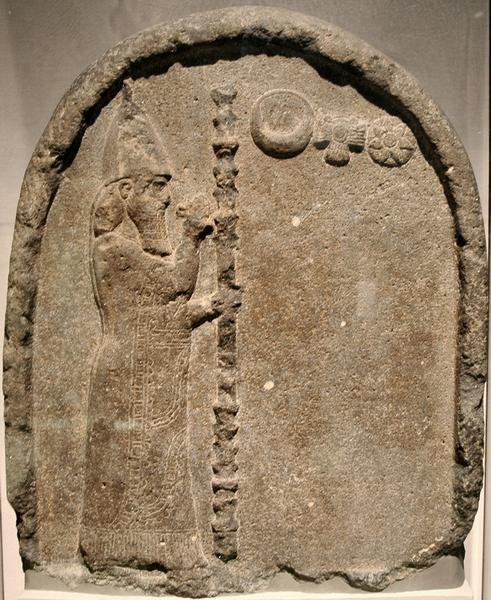
Nabonidus, born around 615 BC in Harran and died around 538 BC in Carmania, was the final king of Babylon. He came to power in 556 BC and ruled until the Persian conquest brought his reign to an end. His origins were outside the established Babylonian royal bloodline, his religious priorities were controversial among the priestly establishment, and the record of his kingship has been filtered through sources that were openly hostile to him. Despite that, the documentary evidence he left behind, from foundation cylinders to campaign records, gives a sharper picture of his reign than those hostile accounts suggest.
Key facts
- Born: -615
- Birthplace: Harran
- Died: -538
- Place of death: Carmania (Satrapy)
- Country: Assyrian Empire; Babylon
- Occupation: king
Origins and family
Nabonidus was born in Harran, in what was then Assyrian territory, around 615 BC. His mother, Adad-guppi, was of Assyrian ancestry and devoted her life to the cult of the moon god Sin at Harran, where she held a position as priestess. It was through her connections that Nabonidus was introduced to the Babylonian royal court, where he met Nebuchadnezzar II and Neriglissar.
That courtly introduction shaped his entire adult career. The Babylonian historian Berossus, writing later, described Nabonidus before his accession as a ‘priest of Bêl,’ a designation that points to a religious rather than military or administrative background and may explain why he left so little trace in the political records of the years before he became king.
Accession and military campaigns
Nabonidus came to the throne in 556 BC. In the first year of his reign he led a military campaign into Hume in eastern Cilicia. The operation was a success: he returned to Babylon with prisoners and treasures. It was a conventional demonstration of royal authority, the kind expected of a new Babylonian king, and the records treat it as such.
Building works and religious programme
Among the surviving documents connected to his reign, the Nabonidus Cylinder from Sippar stands out as a detailed statement of his religious priorities. In it, he describes restoration work on three temples: the sanctuary of Sin in Harran, the temple of Shamash in Sippar, and the shrine of the warrior goddess Anunitu, also in Sippar. Foundation cylinders of this type were standard Babylonian practice, deposited beneath or within temples as records of royal piety, but the specific choices here reflect his particular attachment to Harran and to the moon god his mother had served.
That attachment would become the central charge levelled against him by his opponents. The priesthood of the Esagila temple in Babylon, keepers of the cult of Marduk, produced a text known as the Verse Account of Nabonidus after his fall from power. The poem was designed to discredit him and to frame Cyrus of Persia as a liberator. Scholars at the Max Planck Research Library have characterised it as presenting ‘a premeditated and detailed system of manipulative misinterpretations,’ a judgement that requires reading it with care rather than as straightforward historical testimony.
Fall and death
Nabonidus died around 538 BC in Carmania, following the Persian conquest of Babylon. The propagandistic literature produced by his opponents after the conquest shaped how he was remembered for centuries, framing his reign as one of religious neglect and political failure. The physical record he left, including the cylinder from Sippar and the campaign annals, offers a different set of emphases.
Did you know
- Nabonidus’s daughter Ennigaldi-Nanna established what is recognised as the world’s first known public museum around 530 BC in the city of Ur. Artifacts were displayed there and labelled with clay cylinders inscribed in three languages, making them the earliest known museum labels on record. (messynessychic.com)
Data sources
Where it appears
- Babylon, Jerusalem, Babylon Again: A Cycle of Abandoned Gods October 30, 2026
Data updated: 2026-10-27