
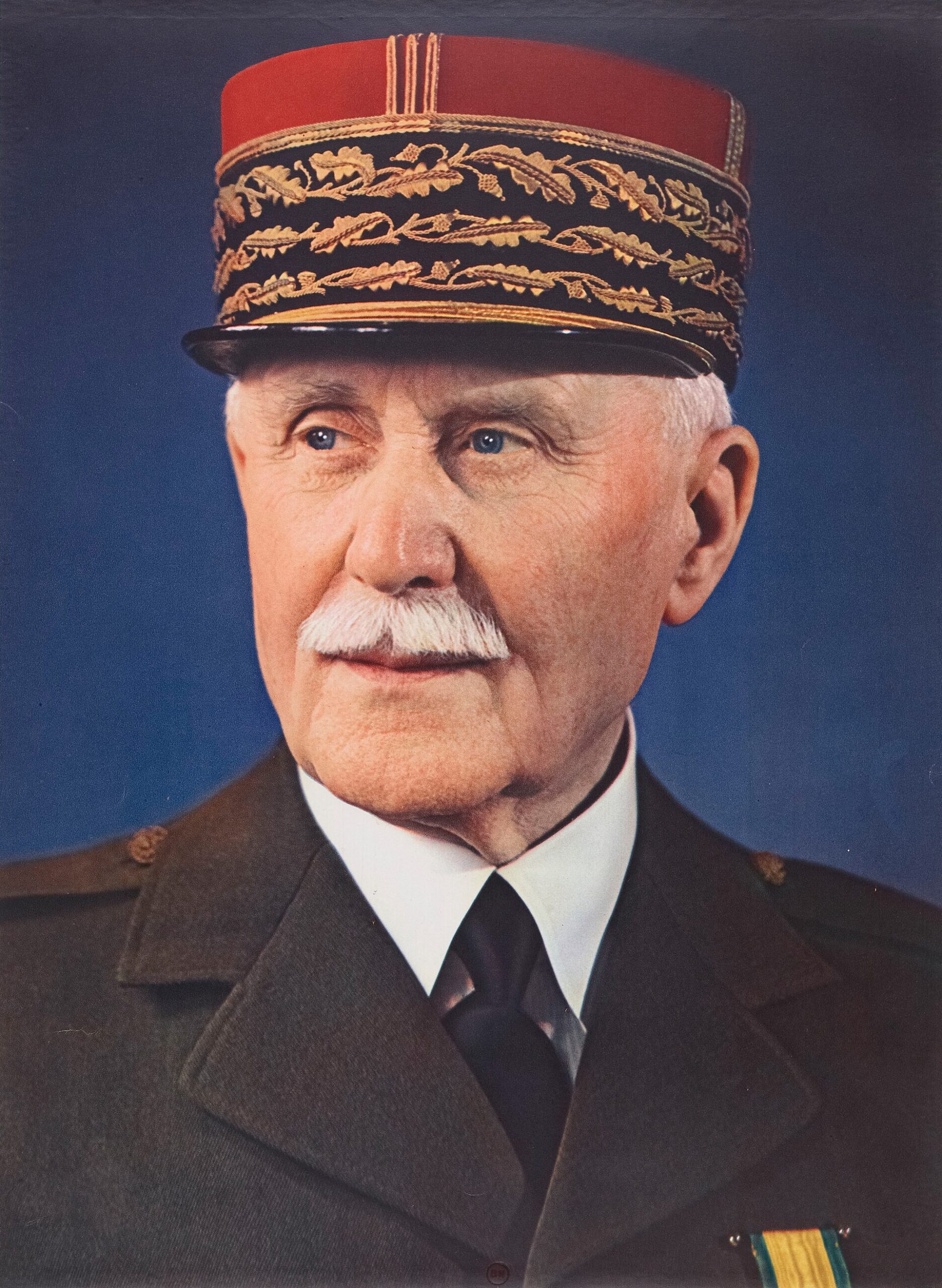
Philippe Pétain (1856–1951) was a French military officer and politician who commanded at Verdun in 1916 and later, in 1940, became head of the authoritarian French State known as Vichy France. He rose from an obscure peasant background to hold the highest offices in both military and political life, and his career ended with a conviction for treason on 15 August 1945. Few figures in French history have generated such lasting and unresolved controversy: the general credited with holding Verdun is also the signatory of anti-Jewish laws that historians have found, in some respects, harsher than the German ordinances issued alongside them.
Key facts
- Born: 24 April 1856
- Birthplace: Cauchy-à-la-Tour
- Died: 23 July 1951
- Place of death: Port-Joinville
- Country: France
- Occupation: politician; diplomat; military officer; military personnel
- Field: politician
- Education: École Spéciale Militaire de Saint-Cyr
- Awards: Order of the White Eagle (Second Polish Republic); Médaille militaire; Croix de guerre 1914–1918; Inter-Allied Victory medal (Belgium)
Early Life and Education
Philippe Pétain was born on 24 April 1856 in Cauchy-à-la-Tour, in the Pas-de-Calais department of northern France. His father, Omer-Venant Pétain, was a farmer, and his mother, Clotilde Legrand, died when Philippe was only 18 months old. He was the only son among five children. After his father remarried, Philippe was raised by relatives rather than within the immediate family home.
His schooling began at the Catholic boarding school of Saint-Bertin in Saint-Omer, where he showed particular aptitude for geography and arithmetic. In 1875, with the specific goal of preparing for entrance to the military academy, he enrolled in the Dominican college of Albert-le-Grand in Arcueil. He subsequently gained admission to the École Spéciale Militaire de Saint-Cyr, the path taken by the great majority of French career officers.
A Slow Climb Through the Ranks
Pétain’s progress through the officer corps before 1914 was notably sluggish. Without military family connections and coming from a peasant background, he accumulated years in each grade: five years as a second lieutenant, seven as a first lieutenant, and ten as a captain. Promotion came through merit assessed on paper rather than through patronage, and the army’s culture of the period rewarded neither his social origins nor his tactical views.
Those views set him apart from the prevailing doctrine. While French military thinking before 1914 placed heavy emphasis on offensive spirit and the bayonet charge, Pétain argued that an army must first achieve fire superiority before launching any assault. He backed this position with studies of the Anglo-Boer War of 1899–1902 and the Russo-Japanese War, arguing that concentrated rifle, machine-gun, and artillery fire could neutralize an entrenched opponent. The argument found few enthusiastic listeners in peacetime.
World War I: Verdun and Rapid Ascent
When war broke out in August 1914, Pétain was 58 years old and held the rank of colonel commanding an infantry brigade. The scale of the conflict created openings that peacetime promotion had denied him for decades. He assumed command of the 6th Division in September 1914, the 33rd Corps in October 1914, and then the Second Army in June 1915.
The command that defined his reputation came on 25 February 1916, the same day Fort Douaumont fell to German forces, when he was placed in charge of French forces at Verdun. His organizational response to the siege became famous. He established the supply road that troops called the Voie Sacrée and introduced the noria rotation system, cycling divisions in and out of the front-line trenches at regular intervals so that no single unit wore itself to destruction. The combination of sustained resupply and managed troop rotation held the French position through the months of attritional fighting that followed.
Between the Wars
Pétain had remained a bachelor until his sixties. On 14 September 1920, he married Eugénie Hardon in Paris. Hardon had previously been married to François de Hérain; that earlier marriage had ended in divorce in March 1914.
His wartime standing brought him awards including the Médaille militaire, the Croix de guerre 1914–1918, the Inter-Allied Victory medal (Belgium), and the Order of the White Eagle from the Second Polish Republic. In the interwar period his public profile remained that of the general who had held Verdun, a reputation that shaped the political possibilities that opened to him in 1940.
Vichy France: Power and Policy
On 10 July 1940, the French National Assembly voted to grant Pétain full powers, dissolving the Third Republic. The resulting regime, the French State, established its administrative capital in the city of Vichy. Pétain held authority over both the unoccupied southern zone and, formally, over the whole of French territory.
In October 1940, the Vichy government passed the Statut des Juifs without any German pressure, according to historians who have examined the record. The legislation defined who was classified as Jewish under French law and imposed sweeping restrictions on employment and public life. Historians have established that these laws were in some respects more severe than the corresponding German ordinances in force in the German-occupied northern zone.
The depth of Pétain’s personal involvement became concrete when a draft of the first Statut des Juifs, dated 3 October 1940, resurfaced in 2010. The document carried annotations in Pétain’s own hand. Analysis of those annotations showed that he had deliberately hardened the antisemitic terms of the law beyond the version that had been presented to him.
Trial, Sentence, and Death
After the Liberation, Pétain returned to France to face judgment. His trial before the French High Court of Justice opened on 23 July 1945. Over three weeks, 18 witnesses testified for the prosecution and 41 for the defense. On 15 August 1945, the court convicted him of treason and sentenced him to death.
Pétain died on 23 July 1951 in Port-Joinville.
Contested Legacy
Debate over Pétain’s record has continued in France since 1945 without resolution. On 15 November 2025, a mass was held in his honor in Verdun, organized by an association dedicated to restoring his reputation. Remarks made at the event prompted French authorities to announce legal action, describing the statements as ‘clearly revisionist.’ The episode illustrated that the question of how to assess his role has not settled into any stable consensus.
Did you know
- Pétain’s great-uncle, Father Abbe Lefebvre (1771–1866), was a Catholic priest who had served in Napoleon’s Grande Armée. He told the young Philippe stories of military campaigns, and this family connection is said to have pointed Pétain toward a career in the army. (ww2gravestone.com)
- Pétain’s pre-war promotions were extraordinarily slow. He spent five years as a second lieutenant, seven years as a first lieutenant, and ten years as a captain. His peasant background and absence of military-family connections kept him from advancing at the pace typical of better-connected peers. (baike.baidu.com)
Data sources
- Wikidata
- ww2gravestone.com
- the-past.com
- roadstothegreatwar-ww1.blogspot.com
- encyclopedia.pub
- yadvashem.org
- ina.fr
- harpers.org
- france24.com
Data updated: 2026-10-28