
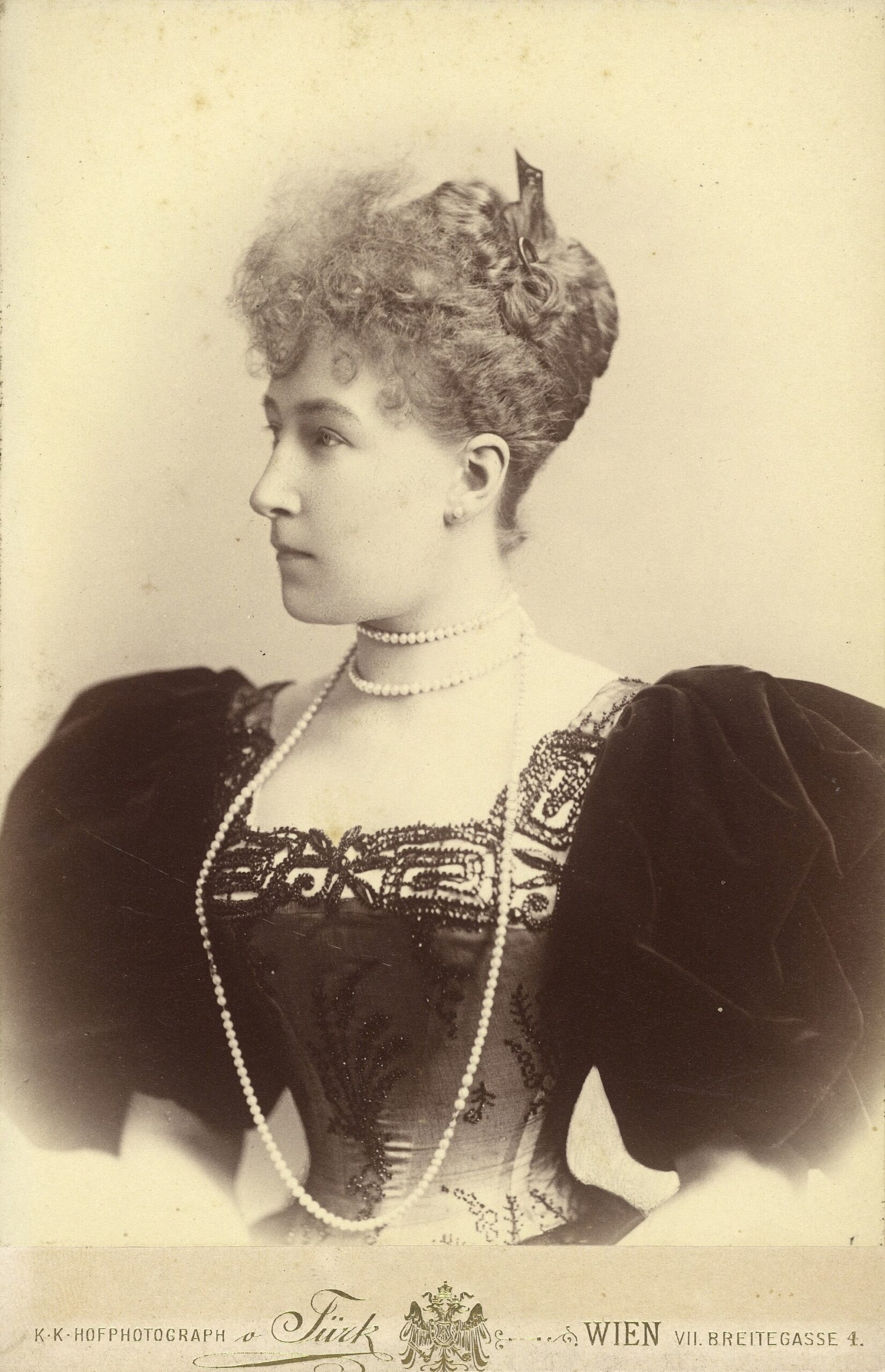
Princess Stéphanie of Belgium was born on 21 May 1864 at the Royal Palace of Laeken, the third child and second daughter of King Leopold II of Belgium and Archduchess Marie Henriette of Austria. She became Crown Princess of Austria through her marriage to Rudolf, heir to the Habsburg throne, and was widowed at 24 when Rudolf died in the Mayerling incident on 30 January 1889. A second, morganatic marriage in 1900 cost her imperial titles, her father’s inheritance, and her place in the House of Habsburg. She spent the last decades of her life in Central Europe, dying on 23 August 1945 at Pannonhalma, and left behind a memoir whose publication set off a final, bitter rupture with her only daughter.
Key facts
- Born: 21 May 1864
- Birthplace: Brussels metropolitan area
- Died: 23 August 1945
- Place of death: Pannonhalma
- Country: Belgium
- Occupation: writer; diarist
- Awards: Order of the Starry Cross
Early Life and Education
Stéphanie grew up at the Royal Palace of Laeken in the Brussels metropolitan area, the granddaughter of King Leopold I, Belgium’s first monarch. Her formal education began at the age of six under the governess Mademoiselle Legrand, who had previously taught her elder sister. The curriculum covered languages, history, mathematics, and horsemanship.
Her closest childhood figure was not a tutor but a nanny: Mademoiselle Antoinette Schariry, known as Toni, who entered the royal household shortly after Stéphanie’s birth in 1864 and remained devoted to her throughout her early years.
Engagement and Marriage to Crown Prince Rudolf
Crown Prince Rudolf of Austria visited Belgium in March 1880 at the invitation of King Leopold II and proposed to Stéphanie during that stay. The couple announced their engagement shortly after.
As Crown Princess, Stéphanie took on substantial representative duties alongside Rudolf. Their official travels included visits to Constantinople, Bulgaria, Carinthia, Carniola, Tyrol, Albania, Greece, and Montenegro. Their only child, Archduchess Elisabeth Marie of Austria, called Erzsi within the family, was born on 2 September 1883 at Schloss Laxenburg after a labour of 26 hours.
Stéphanie’s position at the Habsburg court was made more difficult by Empress Elisabeth of Austria, who openly disliked her daughter-in-law. Elisabeth reportedly described Stéphanie as ‘das hässliche Trampeltier’ (‘the ugly clumsy oaf’) and an ‘ugly elephant,’ and withheld support from her throughout the marriage.
Mayerling and Its Aftermath
Rudolf died on 30 January 1889 at the Mayerling hunting lodge in what became known as the Mayerling incident. Stéphanie was widowed at the age of 24 and retained the title of Dowager Crown Princess of Austria.
After Rudolf’s death, both her father King Leopold II and Emperor Franz Joseph I attempted to arrange a second marriage for Stéphanie, this time to Archduke Franz Ferdinand. Their motivation, at least in part, was to disrupt Franz Ferdinand’s relationship with Countess Sophie Chotek. The effort came to nothing.
Rudolf had left Stéphanie a farewell letter at Mayerling, discovered among the carnage at the hunting lodge on 30 January 1889.
Second Marriage and Exclusion from the Habsburgs
On 22 March 1900, Stéphanie married Hungarian nobleman Count Elemér Lónyay de Nagy-Lónya et Vásáros-Namény. Because the union was morganatic, she was excluded from the House of Habsburg and stripped of her imperial and royal titles.
The consequences extended beyond the court. Her father, King Leopold II, disinherited Stéphanie and refused to recognise Count Lónyay as his son-in-law. Until the end of World War II, the couple lived at Oroszvár Castle, located in what is now Rusovce, Slovakia.
Memoir, Family Estrangement, and Final Years
Stéphanie wrote a memoir that was eventually published in English. Her daughter, Archduchess Elisabeth Marie, was unable to prevent publication and instead had it banned in Austria. Stéphanie’s response was to disinherit her daughter.
When Stéphanie died on 23 August 1945 at Pannonhalma, neither her daughter nor any of her descendants attended the funeral. She was buried in the crypt of Pannonhalma Archabbey alongside Count Lónyay, her second husband.
Cultural Depictions
Stéphanie’s story has appeared in several works across different media. Kenneth MacMillan’s ballet ‘Mayerling’, produced by the Royal Ballet, premiered on 14 February 1978 at the Royal Opera House. Her image also featured in a French film production of 1936 and a Franco-British film of 1968.
She was awarded the Order of the Starry Cross, and is listed in Czech sources under the name Štěpánka Belgická.
Did you know
- Rudolf left Stéphanie a farewell letter at Mayerling that read: “You are free from my presence and plague; be happy in your way.” The letter was discovered among the carnage at the hunting lodge on 30 January 1889. (crimsonshed.com)
Data sources
- Wikidata
- unofficialroyalty.com
- global.museum-digital.org
- historyofroyalwomen.com
- baike.baidu.com
- goodreads.com
- lostinthemythsofhistory.blogspot.com
- kids.kiddle.co
Data updated: 2026-10-30