
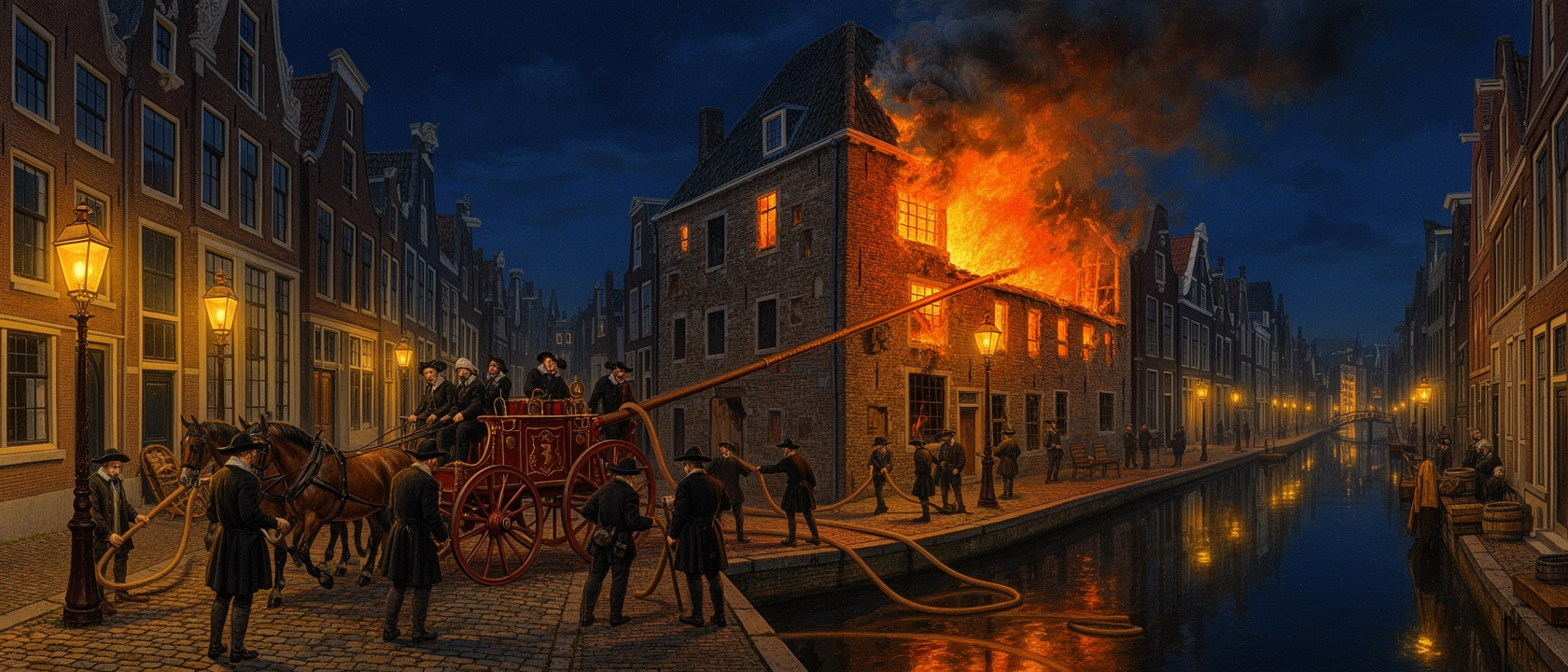
The Failure at the Printing Office
On a February night in 1672, fire broke out in one of Joan Blaeu’s printing offices on the Gravenstraat in Amsterdam. Blaeu was the city’s most celebrated cartographer, chief map-maker to the Dutch East India Company, and the man behind the Atlas Maior, a twelve-volume French edition containing 594 maps and close to 3,000 pages of text. A colored copy sold for 450 guilders, more than a skilled worker earned in a year. The building held the engraving plates, tools, and printed stock of the largest printing operation in the world.
The city’s fire engines could not reach it. The Gravenstraat sat too far from the nearest canal to draw water, and freezing temperatures rendered the pumps useless. By morning, according to Jan van der Heyden’s 1690 chronicle of Amsterdam’s fires, even the copper plates stored in the outer corners had melted. The recorded loss came to roughly 382,000 guilders: approximately 27,000 for the structure and 355,000 for the plates, tools, and goods inside. A skilled worker earned 300 to 400 guilders a year; against that figure, 382,000 guilders needs no further commentary.
A Pattern of Vulnerability
The failure was not isolated. During the 1660s, Amsterdam had purchased dozens of large water-pumping engines designed by Hans Hautsch of Nuremberg. Each was horse-drawn and equipped with a cistern; workers pumped water up through a rigid metal pipe into a fixed nozzle capable, under good conditions, of throwing a stream roughly 66 feet (20 meters) into the air. By 1670, Amsterdam held approximately 60 of these engines along with ladders, hooks, tarpaulins, and more than 28,000 leather buckets. Neither Paris nor London had anything comparable.
The rigid pipe was the system’s central weakness: it could not follow a fire into a building’s interior, and without close access to open water it was nearly inert. In December 1669, a drying oven overheated at a large sugar refinery on the Laurier Canal. The engines arrived but could not reach the roof or the interior. The refinery and the owner’s adjacent house were destroyed; Van der Heyden’s account records losses of an estimated 195,000 guilders. Fire insurance did not exist in Amsterdam at the time.
The Van der Heyden Solution
Jan van der Heyden was born in Gorinchem on March 5, 1637, and had settled in Amsterdam as a painter of urban scenes so precise in architectural detail that historian Lettie Stibbe Multhauf later described his approach to engineering problems as “one of the earliest instances of a method now called systems analysis.” Between 1668 and 1671, he and his brother Nicolaes, a hydraulic engineer, developed a replacement for the Hautsch system built around three modifications: a leather suction hose to draw water from a distance; a long, flexible leather pressure hose, called a slang (snake), that could be fed into a building and aimed directly at the fire; and an air chamber producing a continuous high-pressure flow instead of an intermittent stream, also designed to resist freezing.
In November 1672, nine months after the Blaeu fire, the city council decided to retrofit half its existing engines with the Van der Heydens’ hose system. The test came on January 12, 1673, when fire broke out at harbor buildings storing military supplies including wood shavings and sulfur. A single retrofitted engine arrived late but saved the adjacent sheds and helped extinguish approximately 100 feet (30 meters) of burning rubble; the unmodified engines could not manage comparably. That fire was the last in Amsterdam fought with unaltered Hautsch equipment, and shortly after, the city appointed Jan and Nicolaes van der Heyden as supervisors of the fire-fighting operation.
The Municipal Mandate
The brothers obtained a patent on the leather hose system in 1677 and published a folio describing the equipment that same year. In 1681, two years after a major fire prompted guild petitions for lighter, purpose-built models, the mayors ordered Jan and Nicolaes to equip each of the city’s 60 districts and draft formal management regulations.
Those regulations created a layered system of alarms, obligations, and incentives. Trumpeters were stationed in city towers; lamplighters received rewards for reporting fires quickly; watchmen who failed to notify fire fighters were fined; householders who tried to fight a fire before sounding an alarm faced fines as well. The first three companies to reach a fire received monetary awards. Each district was organized into a fire company of 36 residents under two fire masters, with compulsory one-year service, refusal cost 10 guilders. Fire fighters received no salary.
The Bill
The cost of the old system had been absorbed entirely by private citizens. The owner of the Laurier Canal refinery died a few days after the December 1669 fire. Joan Blaeu’s printing operation never recovered; Blaeu died on December 21, 1673, and the firm went bankrupt in 1674, its surviving assets sold at auction. In neither case had insurance covered anything.
Between 1682 and 1687, Amsterdam recorded 41 fires with combined losses of an estimated 18,353 guilders. Van der Heyden’s 1690 account, the Beschrijving der nieuwlijks uitgevonden en geoctrojeerde Slangbrandspuiten, concluded that the reformed system had reduced fire damage to less than one percent of what the city had absorbed between 1670 and 1681. Every figure originates with Van der Heyden, who had a direct financial interest in the system he was assessing, and some historians treat the statistics accordingly. The counterargument, put forward in the foreword to the 1996 English translation by historian Peter M. Molloy, is that Van der Heyden’s readers had lived through both periods and could measure any claim against personal experience. What the record does confirm is that the engines stayed in service and the city’s framework of compulsory companies, financial penalties, and alarm networks remained in operation long enough to be studied and replicated elsewhere. The 18,353-guilder total may be approximate. The copper plates that melted in February 1672 were not.