What Rosewood Had
In January 1923, Rosewood was a small but established Black community in Levy County, Florida, sitting about 3 miles (4.8 km) east of Sumner, a company lumber town run by Cummer & Sons. Its population stood at roughly 120 people, down from a peak of 355 in 1915. Residents owned property, ran businesses, and sent their children to school. That ownership, built up over decades, was what made Rosewood a target.
The Spark in Sumner
On January 1, 1923, Frances “Fannie” Coleman Taylor, a 22-year-old white woman married to a Cummer & Sons millwright, claimed a Black man had assaulted her at her home in Sumner. The 1993 Florida Board of Regents report and oral histories from survivors indicate that a white man had been seen leaving the Taylor house that morning; historians have broadly concluded the accusation was fabricated.
Levy County Sheriff Robert Walker deputized a posse, assuming that Jesse Hunter, a Black man who had escaped a nearby chain gang, might be sheltered in Rosewood. That afternoon, Aaron Carrier was dragged behind a car by mob members before Walker intervened and transferred him to Bronson, the county seat roughly 25 miles (40 km) to the northeast. The move may have saved his life. It did nothing to stop what followed.
The First Casualty
Later on January 1, a mob member shot Sam Carter in the face and hanged his body from a tree. His death established the pattern for the week ahead: accusation, mob action, killing, no arrests. By January 2, armed white men were gathering in Sumner, among them Klansmen who had attended a Ku Klux Klan rally in Gainesville the previous weekend. Sheriff Walker telegraphed Governor Cary Hardee that he anticipated no further violence. He was wrong.
The Erasure of Rosewood
On the evening of January 4, a mob of 20 to 30 men attacked the Carrier family home. Sylvester Carrier fired back; the gun battle ran into the early hours of January 5. Two white attackers were killed: C. Poly Wilkerson of Sumner and Henry Andrews of Otter Creek. Sarah Carrier was mortally wounded. Sylvester Carrier was also mortally wounded, though some family accounts later disputed whether he survived, most sources confirm he did not.
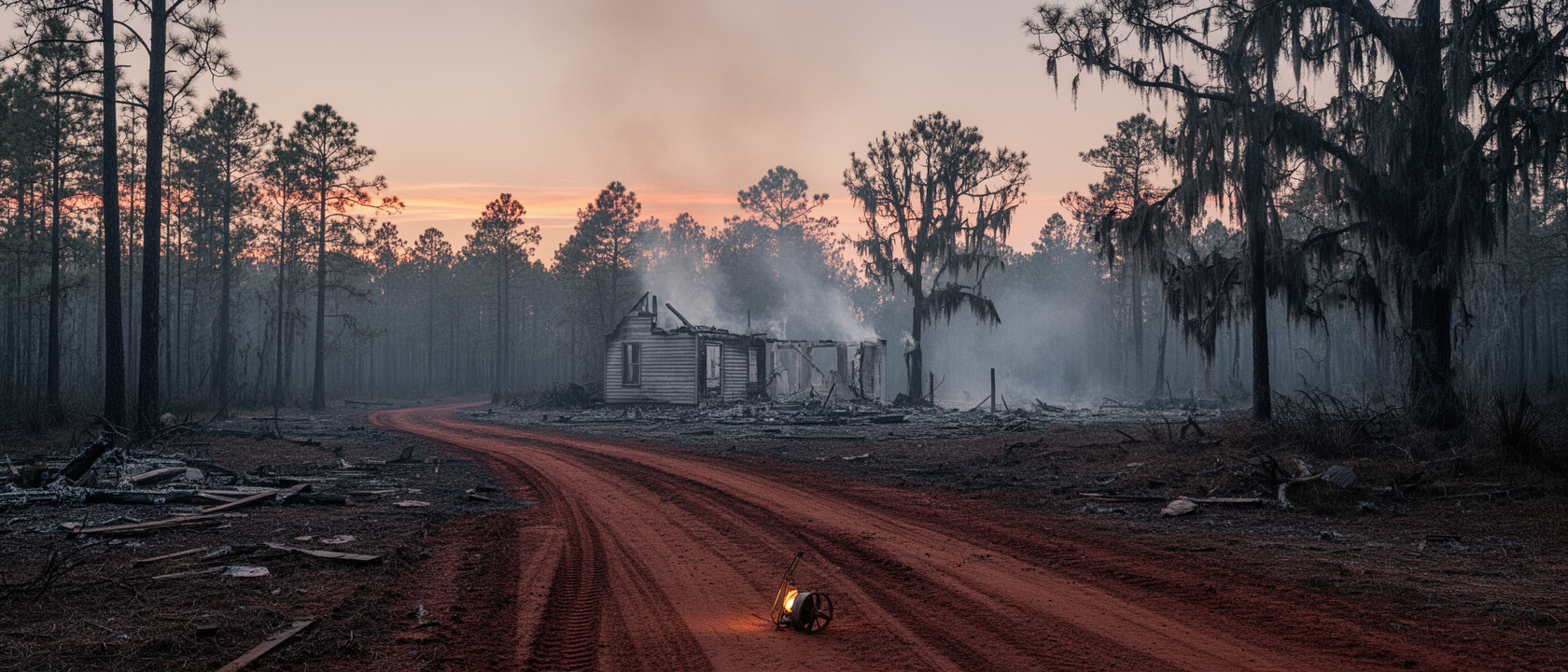
By January 5, the mob had grown to an estimated 200 to 300 men. A Black church and homes burned. Rosewood’s residents fled into the swamps of the Gulf Hammock area or took shelter with John Wright, a white general store owner who hid families during the violence. Lexie Gordon, a 50-year-old widow, was shot and killed while fleeing her burning home. Mingo Williams was shot in the head by white men driving toward Rosewood. James Carrier emerged from hiding to bury his family members; the mob found him, forced him to dig his own grave, and lynched him.
At around 4:00 a.m. on January 6, train conductors John Bryce and William Bryce loaded Black women and children onto a train and carried them to stations at Otter Creek, Archer, Gainesville, and Fernandina Beach. Men were excluded; the Bryces feared the mob would attack a train carrying Black men. On January 7, a mob of 100 to 150 returned and burned every remaining Black-owned structure. None of Rosewood’s Black residents ever came back to live there.
The official 1993 Florida state report counted eight dead: six Black residents and two white attackers. Survivor accounts put the toll between 27 and 150. The exact number has never been established.
The Economic Theft
In February 1923, Governor Hardee convened an all-white special grand jury, which found insufficient evidence to prosecute anyone. No person was ever charged for the killings, the arson, or the destruction of the community. John McCoy and his wife Mary, who had purchased nearly 150 acres in 1903, sold their land in May 1923 under displacement pressure at roughly $3 per acre; the buyers resold it at roughly $10 per acre. The McCoys lost both their home and two decades of accumulated value, as did every generation that might have inherited it.
The Legislative Redress
The massacre was largely absent from public record for six decades. Gary Moore’s July 27, 1982, article in the St. Petersburg Times was among the earliest accounts to reach a broad readership. In 1993, the Florida Board of Regents published a formal investigation led by Associate Professor Maxine D. Jones of Florida State University. Survivors and descendants, among them Arnett Doctor, Minnie Lee Langley, and Lee Ruth Davis, pushed the state for compensation. The Holland & Knight law firm took the case pro bono, with Martha Barnett as lead attorney. Claimants sought more than $7 million.
On May 4, 1994, Governor Lawton Chiles signed Florida House Bill 591 into law, authorizing $2.1 million in compensation, considered the first instance of a U.S. state paying compensation specifically for racial violence. Nine living survivors received $150,000 each; 143 descendants received additional payments. In 2020, the scholarship fund created by the bill was expanded to support up to 50 minority students at Florida state universities, with priority for Rosewood descendants.
The Missing Record
The official plat map of Rosewood is missing from Levy County archives, the only plat map absent from the county’s holdings. Records from the 1923 special grand jury are also gone. Archaeological work using ground-penetrating radar is ongoing, aimed at locating the burial sites of victims. The last known survivor, Mary Hall Daniels, died in May 2018. A Florida Heritage Landmark designation came in 2004, and Governor Jeb Bush dedicated a historical marker at the site in May of that year. What had been a community of roughly 120 people, with land, churches, and a school, is now marked by a roadside sign on State Road 24, about 9 miles (14.5 km) east of Cedar Key. The land was sold for $3 an acre. Nobody paid for it.