
The Omaha Spill
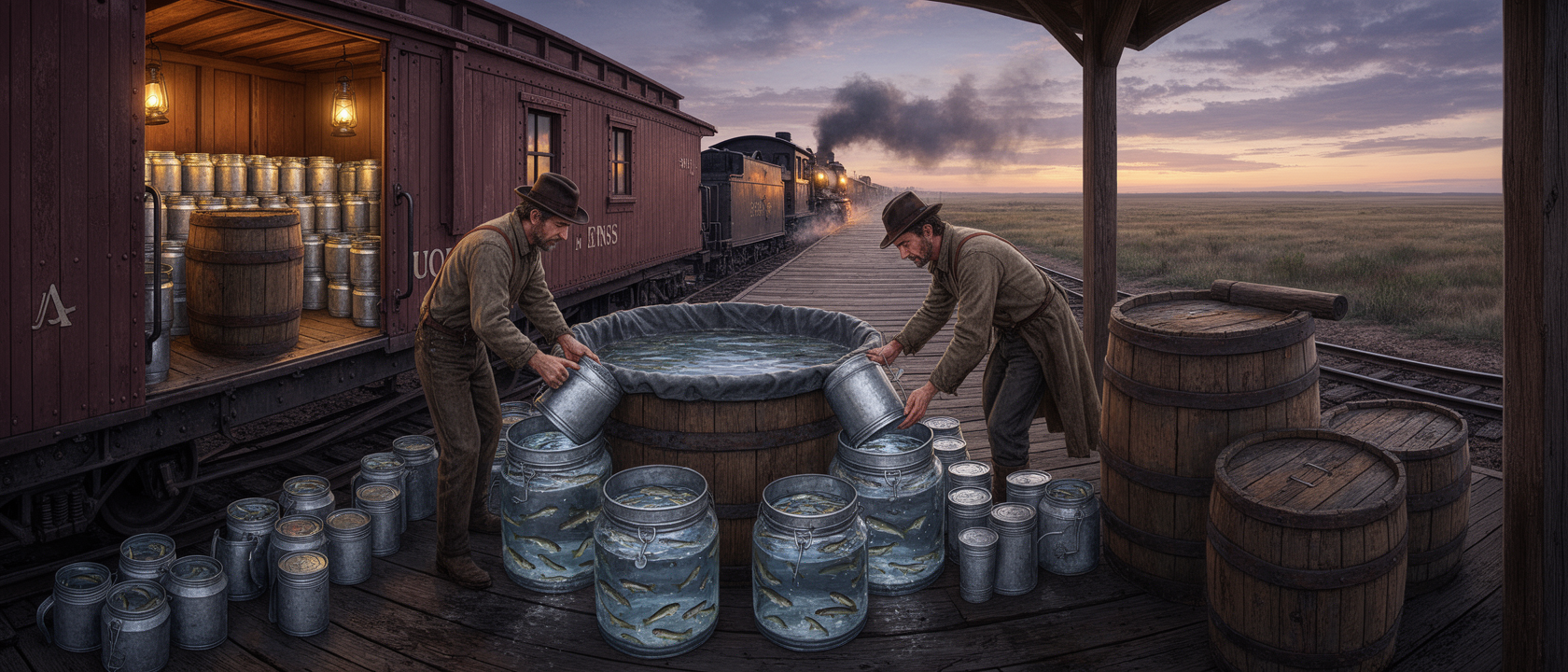
A bridge over Nebraska’s Elkhorn River gave way in the summer of 1873 while a westbound train was crossing it. The rear car had been stripped of its original use and rebuilt as a rolling aquarium: Livingston Stone and his U.S. Fish Commission assistants had converted a Central Pacific fruit car, fitting it with a zinc-lined tank, twenty additional containers, stacked tin cans, two casks of ocean water, an ice chest, six large cases of lobsters, and half a barrel of live moss. The cargo was perch, catfish, and trout. When the structure collapsed, at least one crew member was killed. Stone and the others survived, according to the one primary account, by climbing onto the submerged car.
The fish were gone. Within 17 days, Stone was on another westbound train carrying 40,000 juvenile American shad in eight 10-gallon (37.9-liter) milk cans, bound for the Sacramento River. These particulars rest on a single source, but the broader pattern is well documented: the early work of moving live fish across a continent was improvised, fragile, and occasionally fatal.
The Logistics of Depletion
Congress created the U.S. Fish Commission in 1871 and extended its authority to fish culture in 1872. Dams were blocking spawning runs and commercial fishing had reduced stocks that had once seemed inexhaustible; breeding fish at federal hatcheries and shipping them to replenish exhausted waters was the chosen remedy.
Keeping fish alive through days of rail travel was harder than breeding them. Stone had established the first federal freshwater hatchery on the West Coast at Baird Station on the McCloud River in Shasta County, California, in 1872, with the nearest rail connection at Redding, 22 miles (35.4 km) away. The gap between hatchery and railhead meant fish had to survive a road journey before the rail journey even began, and the men managing them had to solve problems of temperature and aeration with whatever was at hand.
The Era of the Specialized Car
By 1881, the Commission had its first custom-designed fish car, built on a baggage car frame rather than a converted fruit car. The fleet expanded over the following decades. Fish Car No. 10, completed in 1929, was the tenth and last of the federal cars: at 81 feet (24.7 m) long, it carried its own generator and could hold 500,000 one-inch (2.5 cm) fish, or 34,000 three-inch (7.6 cm) fish in 325 cans.
That same year, Pullman Car Works on Chicago’s South Side built the Nautilus for the John G. Shedd Aquarium at a cost of $30,000. One end held berths, a galley, and living space for six men; the other was a traveling display aquarium. The Shedd opened on May 30, 1930, and filling its saltwater exhibits required 20 railroad tank cars to make eight round trips between Key West, Florida, and Chicago, hauling approximately one million US gallons (3,785,000 liters) of seawater. The Nautilus ran until around 1959 before being replaced by the stainless-steel Nautilus II, which operated until 1972.
Across the fleet’s peak period in roughly the first two decades of the 1900s, the federal fish cars transported more than 72 billion fish, the record gives 72,281,380,861, over more than 2 million miles (3.2 million km). Fish Car No. 10 was taken out of service in 1947.
From Rails to Pneumatics
Trucks absorbed much of the work that rail had handled. Hatcheries also began loading fish into fixed-wing aircraft and dropping them into backcountry lakes unreachable by road or rail. Moving fish past dams required something else entirely. In 2007, Vincent Bryan III founded Whooshh Innovations in Bellevue, Washington, originally to move tree fruit through pneumatic tubes. Reapplied to fish, gentle pressure differentials carried a salmon through a flexible tube in seconds. The device acquired the informal name “Salmon Cannon”; Whooshh’s formal product names are the Whooshh Transport Tube and the Whooshh Passage Portal.
The Human and Territorial Bill
The 1873 Elkhorn River accident produced at least one death. The larger territorial cost fell on the Winnemem Wintu, whose name translates to “Middle Water People.” Their homeland centered on the McCloud River, and they had helped Stone’s team gather salmon eggs at Baird Station from 1872 onward. Construction of Shasta Dam began in 1937; when completed in 1945, its 602-foot (183.5 m) structure flooded approximately 90% of the tribe’s traditional lands and blocked chinook salmon from the McCloud River entirely. The hatchery program was built partly on Winnemem Wintu territory and depended on Winnemem Wintu labor; the dam that came later, tied to the same river system, flooded approximately 90% of that territory.
Global Loops and Genetic Returns
Baird Station had been exporting McCloud River chinook eggs internationally since at least the 1890s and 1900s, including shipments to the Auckland Acclimatisation Society in New Zealand. The McCloud chinook established themselves in the Rakaia River on New Zealand’s South Island, where Māori communities including the Ngāi Tahu and Waitaha came to care for them. In 2004 or 2005, sources disagree on the exact year, the Winnemem Wintu learned that descendants of salmon their ancestors had helped collect were living in New Zealand. In March 2010, roughly 30 Winnemem Wintu traveled there for a two-week visit that included a four-day salmon ceremony on the banks of the Rakaia River, near Christchurch.
In July 2022, the U.S. Fish and Wildlife Service transported approximately 20,000 winter-run chinook salmon eggs from the Livingston Stone National Fish Hatchery, at the base of Shasta Dam, to waters above the Shasta Reservoir on the McCloud River, described not as a reintroduction but as a relocation driven by rising downstream water temperatures.
The Fiscal Void
What the record does not preserve is the money. No figure survives for what the federal government spent building the ten fish cars between 1881 and 1929. The $30,000 cost of the Nautilus is documented because it was a private commission; the government fleet has no equivalent accounting. The 72 billion fish and the 2 million miles are on the record. The invoice is not.