
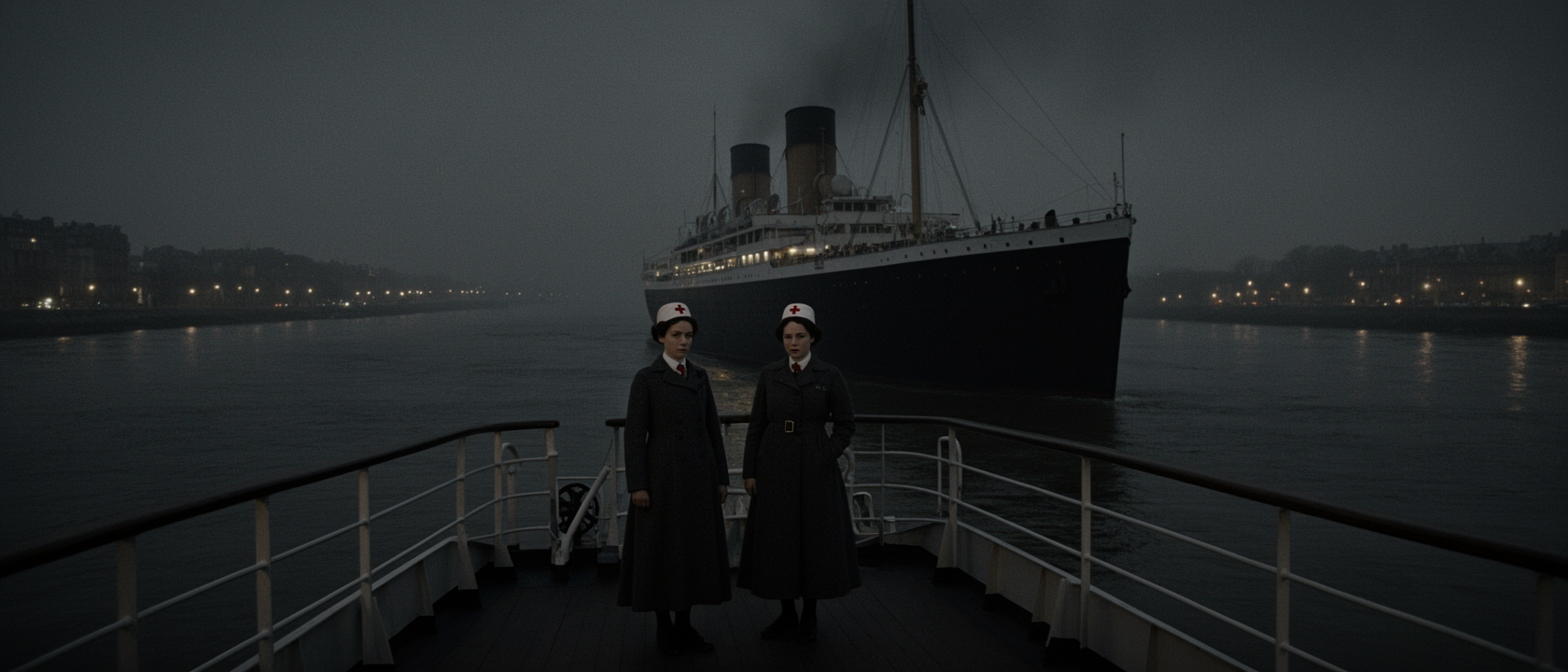
The Ornamental Life
The twins were born in Brooklyn in November 1885 (some records, including JSTOR Daily, give 1886; the American Battle Monuments Commission, Wikipedia, and Green-Wood Cemetery all favor 1885). Their father, Frederic Cromwell, served as treasurer of the Mutual Life Insurance Company of New York and held interests in several railroad and transportation companies. The family occupied a four-story Beaux-Arts mansion in Brooklyn Heights. Their mother, Esther Whitmore Husted Cromwell, raised Dorothea and Gladys as the fourth and fifth children in a household organized around propriety. Neither sister had ridden a subway or boarded a streetcar before the war began. The limits of their daily life were the mansion and whatever functions their mother judged acceptable.
The Intellectual Awakening
In 1899, a governess named Mary Helena Bothwell Horgan arrived at the Cromwell household. She was around 25, trained at the Art Students League, and had worked as a newspaper illustrator, artist’s model, art teacher, and curator. The following year she took the twins on a tour of France and England.
In 1907, she married the sculptor John Frederick Mowbray-Clarke, with the Cromwell twins among the few guests. Their mother died two years later, in 1909, at 62. The sisters moved to an apartment at 535 Park Avenue.
Mowbray-Clarke helped organize the International Exhibition of Modern Art, held at the 69th Regiment Armory on Lexington Avenue from February 17 to March 15, 1913. Mary gave the sisters a private tour of that exhibition, according to a single secondary account.
Gladys published her first collection, The Gates of Utterance and Other Poems, in 1915 through Sherman French and Company in Boston, having earlier placed verse in Poetry: A Magazine of Verse under the pseudonym Helen Jaffreys to keep the family name out of public literary discussion. Dorothea wrote poetry and short stories, and according to one account produced an unpublished roman à clef about their upbringing, though none of her work appeared in print during her lifetime.
In 1916, Mary Mowbray-Clarke and a partner opened the Sunwise Turn bookshop on East 31st Street in Manhattan, one of the first women-owned bookshops in the United States, carrying feminist, socialist, and birth-control literature alongside literary titles.
The Western Front
In January 1918, Dorothea and Gladys joined the American Red Cross Canteen Service and crossed the Atlantic aboard the USS Æolus. They were posted to Châlons-sur-Marne (now Châlons-en-Champagne), a garrison town and major rail hub near Verdun, and later to Verdun itself. For roughly eight months, they worked under German bombardment in shifts that stretched past 24 hours, sleeping in cellar tunnels or under trees. Anne Dunn, a former Brearley teacher who served alongside them, recorded these conditions. The people of Châlons called the sisters “The Saints”; French infantry soldiers called them “Twin Angels.” Both accounts come from a single secondary source. The armistice took effect on November 11, 1918, but the hospitals remained at capacity and the orphanages were overflowing. Dorothea and Gladys stayed on.
The Gironde River
By January 1919, the sisters were aboard La Lorraine, a French ocean liner carrying approximately 1,300 soldiers, civilians, and Red Cross personnel from Bordeaux toward New York. Dorothea and Gladys occupied second-class cabin 703. On the evening of January 19, 1919, moving through the Gironde estuary on a moonless night, both sisters went to the deck and jumped overboard, one after the other. A 24-year-old US Army private witnessed it. No rescue was possible.
On January 26, the police commissioner of Bordeaux formally confirmed the deaths were by suicide. Coverage in The New York Times began January 25. France awarded both sisters the Croix de Guerre posthumously on March 22, 1919, and subsequently awarded them the Médaille de la Reconnaissance française as well. They were buried side by side with full military honors at Suresnes American Cemetery, just outside Paris; their brother Seymour chose to leave them there. The Cromwell family lot at Green-Wood Cemetery in Brooklyn holds a cenotaph in their names.
Gladys’s posthumous collection, Poems, appeared in December 1919 from Macmillan in New York, with an introduction by the Irish poet Padraic Colum, and received the Poetry Society of America prize in 1920. Each sister left an estate valued at $661,748, reported in the Brooklyn Daily Eagle in October 1919.
The Medical Gaps
Aboard La Lorraine, two physicians saw the sisters before January 19. Dr. Caroline Purnell, Commissioner of the American Women’s Hospitals in France, examined them and prescribed a soothing powder for headaches and insomnia. Dr. Clelia D. Mosher of the American Red Cross was also asked to look in on them. No formal psychological evaluation was conducted, and no definitive account of their mental state in those final weeks survives. Historians and medical commentators since have described their symptoms as consistent with what clinicians now call post-traumatic stress disorder, though no diagnosis was made at the time and the contemporary term was shell shock.
Two women who had never ridden a subway spent eight months working past the point of physical endurance, within range of German guns, in tunnels underground. They were honored by the soldiers they served and examined by two doctors on a ship heading home. Neither the powder’s contents nor the full weight of what the sisters had absorbed is recoverable from the documents that remain.