
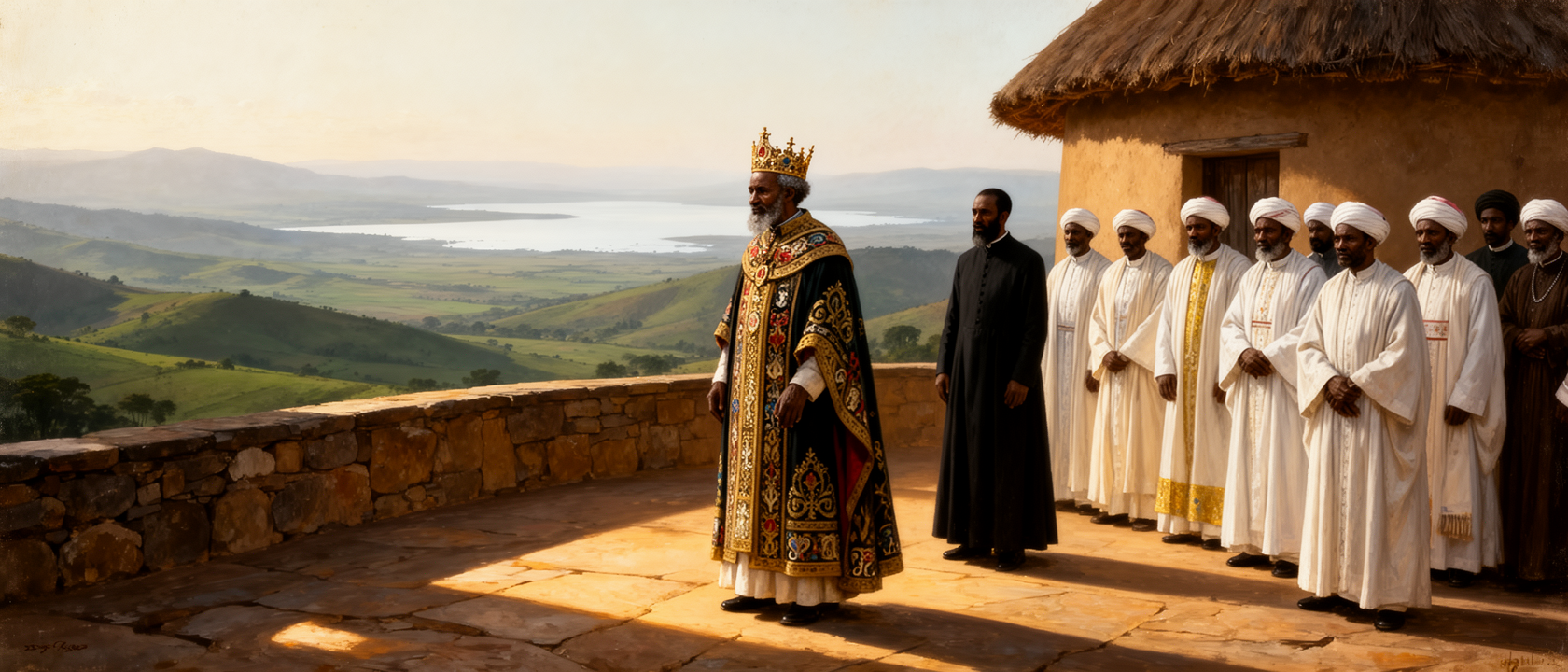
The Address of Afonso Mendes
In February 1626, Afonso Mendes stood before the court of Emperor Susenyos I and delivered an address that, according to the primary account, ran to 30,000 words. Mendes was Portuguese, a Jesuit, and had been appointed Latin Patriarch of Ethiopia by Pope Urban VIII in December 1622. He had landed at the Red Sea port of Massawa on January 24, 1624, and reached the imperial court in 1625. His audience with Susenyos gave him his moment, and he used all of it.
The speech covered the obligations the Emperor and his subjects now owed to Rome. What the court made of it, the sources do not record precisely. What followed over the next six years made the stakes of that reception clear enough.
The Cultural Fault Lines
Ethiopia had been Christian since the fourth century AD, when King Ezana of Aksum made it the official religion of his kingdom. The church that took root there answered to the Alexandrian, or Coptic, tradition, not to Rome, and had developed its own liturgical language, ecclesiastical literature, and practices that diverged from Roman Catholicism on several specific points.
The Jesuits wanted those practices changed. The dispute was concrete: Ethiopian Christians observed the Saturday Sabbath alongside Sunday; they practiced circumcision; their fasting rules differed from Rome’s; and their laws on divorce did not conform to Catholic canon. Each of these was a negotiating point from the Jesuit perspective and a matter of lived identity from the Ethiopian one.
The stakes went higher than religious custom. The Solomonic dynasty grounded its claim to rule in a lineage tracing back to the biblical Queen of Sheba and her son by King Solomon. This genealogy was, in a functioning political sense, the basis of its legitimacy. A church aligned with Rome, whose patriarch had sailed in from Portugal and spoke Latin, sat uneasily inside that claim.
The formal rupture with the Ethiopian church had come at the Council of Ephesus in 431 AD, after which Rome regarded the Ethiopian church as apostate. The Jesuits arriving in the early seventeenth century were not proposing a modest liturgical correction; they were asking an ancient institution, and the empire built around it, to accept that it had been in error for nearly twelve centuries. Popular feeling found its voice in the names ordinary Ethiopians attached to the missionaries: “sons of Leo,” “relatives of Pilate,” and “Franks.” Susenyos himself acquired the epithet “black Portuguese.”
The Path to Conversion
Jesuit missionaries first arrived in Ethiopia in 1557. Susenyos began his reign in 1607. The Spanish Jesuit Pedro Páez had been at the Ethiopian court since 1603, and by 1622 he had formally received Susenyos into the Catholic Church. Some historians argue, citing Susenyos’s own later accounts, that he may have converted privately as early as 1607; whether the state religion was formally proclaimed Catholic in 1621 or 1622 is disputed, with most sources settling on 1622.
Páez died in May 1622 at Gorgora, on the northern shore of Lake Tana, and Mendes was appointed Patriarch the same year. Civil rebellions had already broken out by the late 1610s; a documented armed response followed Susenyos’s pro-Catholic initiatives as early as 1617. The resistance Mendes encountered when he delivered his address had been building for at least a decade before Mendes arrived. By 1629, Mendes himself wrote that he considered their position close to hopeless.
The Cost of Victory
On July 26, 1631, at Lasta (in present-day Amhara Region, Ethiopia), Susenyos’s forces met a rebel army estimated at 25,000 and defeated it. One secondary source puts the dead at around 8,000; the primary account records thousands killed on the field. Whatever the precise count, Susenyos held the battlefield, and then chose not to press the policy forward.
The sources indicate that the scale of death among his own subjects shaped what came next. The toll was real, and Susenyos chose not to press further.
Abdication and Death
On June 14, 1632, Susenyos abdicated in favor of his son Fasilides, born November 20, 1603. With the abdication came an edict of toleration: the population was free to return to the original liturgy, and the altars reformed under Jesuit direction were restored. Fasilides reversed his father’s religious policy without delay, restored the Ethiopian Orthodox Church, banned Catholicism, and expelled the Jesuit missionaries; final deportations were completed between 1633 and 1635.
Susenyos died at Dangaz on either September 16 or 17, 1632 (the exact date is disputed), roughly three months after the abdication. He was buried at the Church of Ganata Iyasus in Azazo, near Gondar, a church that Páez, the same man whose persuasion had brought the Emperor to Catholicism, had built.
Unverified Accounts
Two claims circulated at the time without entering verified records: that Jesuit missionaries used animal excrement in producing the sacramental host, and that the missionaries’ presence was linked by the local population to locust infestations. Neither has been verified in higher sources. Both are best understood as evidence of the depth of popular hostility rather than established fact, hostility that required no fabrication to explain itself. What the Jesuits demanded reached into marriage law, food practices, Sabbath observance, and the physical body. When Susenyos concluded, after July 26, 1631, that the cost was too high, the body count was the argument. The missionaries left Ethiopia no later than 1635. The church they had tried to replace was still there.