
The German Monopoly
In 1913, the United States spent $13 million importing potash, and nearly all of it came from one place. The salt deposits around Staßfurt in Saxony-Anhalt, in what was then the German Empire, controlled roughly 95 percent of world production. A state-sanctioned cartel called the Kalisyndikat set the prices, and American buyers had no serious alternative. Potash turned up in glass, soap, matches, dyes, and explosives, but its biggest market was the farm. Corn, cotton, tobacco, potatoes, and beets all depended on it as fertilizer. American agriculture ran on German minerals.
The Strategic Vacuum
Germany went to war in August 1914. Potash exports stopped almost immediately, and a formal absolute embargo on all potash salts followed on January 29, 1915. For American farmers, that was an agricultural problem. For American planners, the shortage was harder to absorb: black powder and smokeless gunpowder both depend on potassium compounds. A country that could not reliably grow its food or produce enough munitions from domestic sources was exposed on two fronts at once.
The USDA had not been entirely unprepared. Before the war, the department had commissioned surveys of the Pacific coast’s kelp beds. George Rigg, an ecologist at the University of Washington, had mapped the coastlines of California, Oregon, Washington, and Alaska in 1911 and 1912, using a 40-horsepower motorized yacht. What those surveys produced was a detailed inventory of giant kelp, Macrocystis pyrifera, the brown seaweed common along the U.S. west coast. In 1914, with potash suddenly scarce, that inventory became a procurement option.
The Scottish Method on the Pacific Coast
The technique the industry turned to was not new. From roughly 1750 to 1820, coastal communities in Scotland, particularly on Orkney and the Outer Hebrides, had burned seaweed in stone kilns to produce a fused ash called “kelp,” supplying glassmakers, soapmakers, linen bleachers, and explosives manufacturers. The word “kelp” came from that Scottish industry; when American botanists named the Pacific seaweed, they borrowed the term from the product, not the plant. The chemistry is straightforward, if labor-intensive: wet seaweed is harvested, dried, and burned. Producing one tonne of usable ash required burning approximately 24 tonnes of wet seaweed. The Scottish industry collapsed after around 1820 once cheaper mineral sources became available, and the commercial mining of Staßfurt deposits, historians place the discovery at 1856 and the first commercial plant at 1861, made the seaweed approach uneconomical. By 1914, those kilns had been cold for the better part of a century.
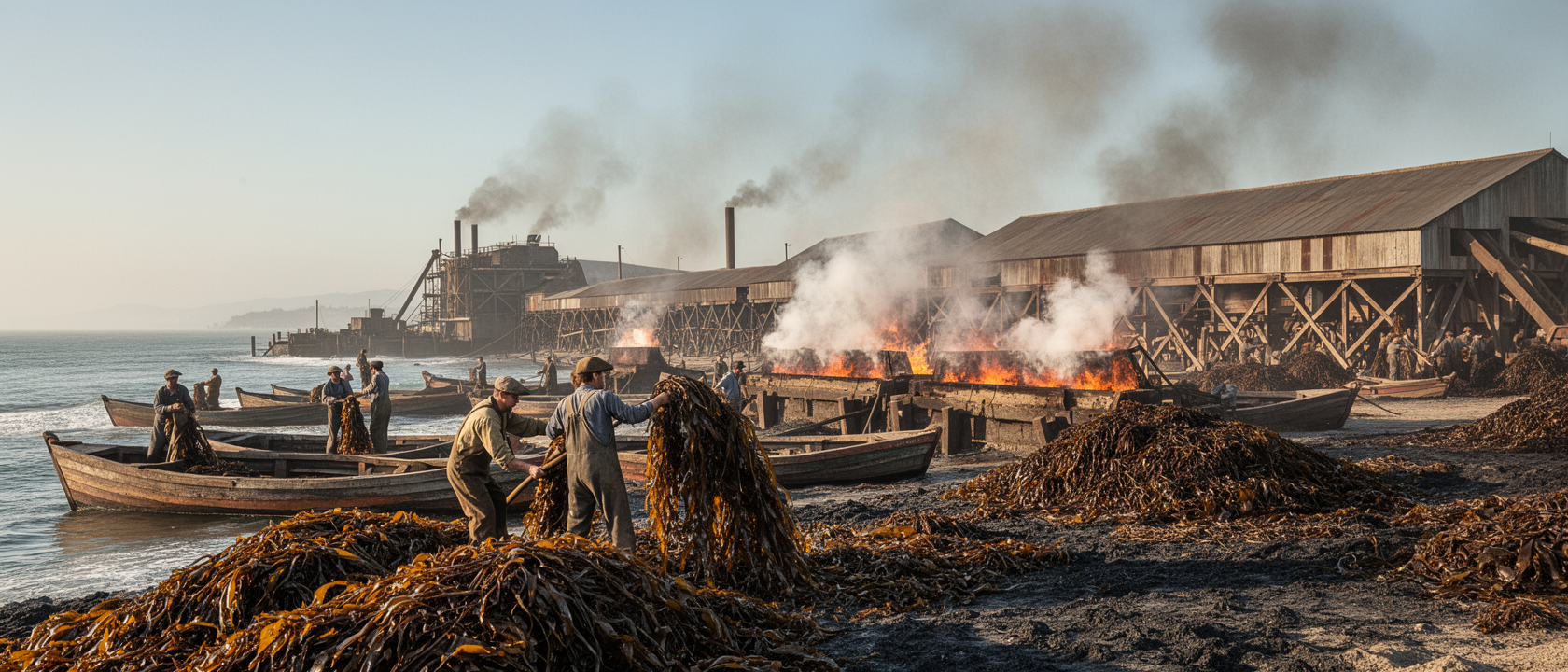
California revived the method. A USDA experimental station was established at Summerland, California, under J.W. Turrentine to work out the processing details. Harvesting boats moved through the kelp beds off the California coast, cutting the seaweed and bringing it ashore for drying and burning.
Industrial Scaling and Innovation
By 1916, eleven companies were processing Pacific kelp into potash. Ten used the traditional approach: harvest, dry, burn. U.S. potash imports that year fell to under $500,000, down from $13 million three years earlier. The price of what little still crossed the Atlantic had roughly doubled compared to pre-war levels, according to Peter Neushul’s 1989 study in Technology and Culture; a later source puts the wartime peak at fifteen times the pre-war price, the discrepancy likely reflecting different points in the war and different market segments.
The eleventh company operated on a different scale entirely. Hercules Powder Company, formed in 1912 when a federal antitrust judgment broke up DuPont, built its kelp processing plant at Chula Vista, California, on a site known informally as Gunpowder Point. The plant covered approximately 30 acres and ran day and night with a workforce of 1,500 people. Rather than burning seaweed to ash, Hercules developed a process that extracted potash, acetone, and other chemicals simultaneously. Between 1915 and 1917, Hercules delivered approximately 23,000 tonnes of cordite to Britain, though a separate official tally from the City of Chula Vista puts the figure closer to 20,838 tonnes, and the discrepancy remains unresolved. Acetone output exceeded 11 million pounds over the same period. The plant also extracted potassium chloride for black military powder and rifle powder, and produced lacquer ingredients used to coat artillery shells and airplane wings. By 1918, kelp was the second-largest source of potash in the United States, trailing only natural brines and salt lakes.
The Market Crash
The war ended in November 1918. German and French potash exports resumed under a new Franco-German cartel, re-entering world markets at prices the California kelp operations could not match. The economics that had driven the industry into existence reversed within months, and firms that had invested in harvesting boats, drying facilities, and processing plants found the one thing sustaining them had vanished. The industry collapsed entirely.
The Ecological and Economic Aftermath
Neushul noted in his 1989 study that no consideration was given, during the harvesting years, to what removing seaweed in industrial quantities might do to the coastal ecosystem. The specific scale of damage to California’s kelp forests is not documented in the available sources. What can be said is that giant kelp, Macrocystis pyrifera, forms the structural base of a coastal ecosystem supporting fish, invertebrates, and marine mammals, a dependency the harvesting boom was conducted without assessing.
The financial loss attached to the industry’s collapse sharpens when set against what the companies did not do. Alginic acid, extractable from giant kelp, had been identified by British chemist E.C.C. Stanford in 1881. None of the California kelp companies extracted it. Commercial alginate production began elsewhere in 1927 and grew into a worldwide industry now producing approximately 40,000 metric tonnes per year, used in food, pharmaceuticals, textiles, and dental materials. The firms that spent the war years burning Macrocystis pyrifera to ash left that value in the water, and then left the business entirely when the potash market closed.