
The Dover Appointment
The first surviving record of Thomas Tallis as a working musician places him at a small Benedictine priory in Dover, Kent, around 1530. The Oxford Dictionary of National Biography puts the earliest firm documentary evidence in 1531, when his name appears in the house accounts alongside an annual fee of £2. Tallis was probably in his mid-twenties, born around 1505, his birthplace disputed between Leicestershire and the southeast of England. His role combined playing the organ with directing the choir for an institution shaped entirely by the liturgical calendar of the Roman church.
The Vulnerability of the Cloister
The institution was already vulnerable. Henry VIII’s rupture with Rome deepened through the early 1530s, and by the middle of the decade English religious houses were no longer answerable to any structure beyond the Crown. For musicians attached to monastic institutions, employment depended on whether the house they worked in would survive royal scrutiny, a question no individual employee could answer. Smaller houses were visited first, and priories like Dover’s had no leverage when commissioners arrived.
Displacement and Dissolution
Dover Priory was suppressed on November 16, 1535. By around 1537 to 1538 Tallis was working as a singing-man at St Mary-at-Hill, a parish church in London, before moving to the Augustinian Abbey of the Holy Cross at Waltham, in Essex, probably in the autumn of 1538.
Waltham Abbey was the last English monastic house to surrender, which it did in March 1540. When Tallis walked out he carried two things: a severance payment of 40 shillings and a single volume of music theory from the abbey’s library. He then served as a lay clerk at Canterbury Cathedral from around 1540 to 1542.
The Chapel Royal
Somewhere between 1542 and 1545, with 1542 or 1543 most commonly cited, Tallis joined the Chapel Royal as a Gentleman. The Chapel Royal was not a fixed building but a body of clergy and musicians who traveled with the court. After three institutions dissolved beneath him, it offered something none of his previous positions had: continuity. He remained there until his death on November 23, 1585, serving four Tudor monarchs: Henry VIII, Edward VI, Mary I, and Elizabeth I.
The sequence spanned the full arc of official English religious policy, Roman Catholicism under Henry, Protestant reform under Edward, a return to Rome under Mary, and a Protestant settlement under Elizabeth. The sources describe Tallis as a lifelong, unreformed Roman Catholic, meaning he spent a substantial portion of his career setting Protestant texts as a condition of employment.
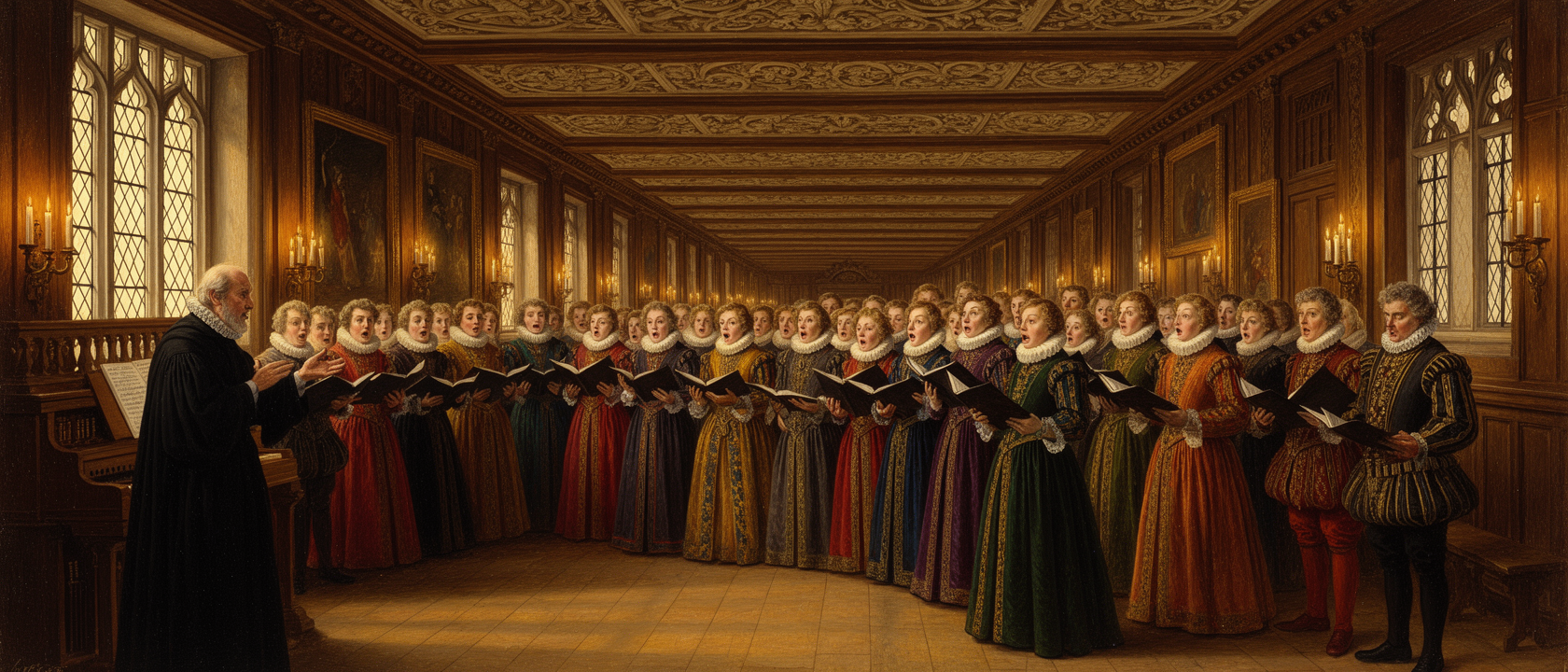
Around 1570 he composed Spem in alium, a motet for 40 separate vocal parts arranged in eight choirs of five voices each, its text drawn from the Sarum Rite, a form of Latin Catholic liturgy that had been in official use before the Reformation. The commission is traditionally attributed to Thomas Howard, the 4th Duke of Norfolk, with the first performance said to have taken place in the Long Gallery at Arundel House, the London home of the Earl of Arundel. No document confirms a specific commission from Howard; historians treat the attribution as probable, not established.
In 1575, Elizabeth I granted Tallis and William Byrd a 21-year monopoly on printing music and music paper in England. That same year the two men published Cantiones quae ab argumento sacrae vocantur, containing 17 motets each and dedicated to the queen, the first collection of Latin sacred motets printed in England.
The Price of Survival
Thomas Howard did not survive the period intact. He was tried for high treason on January 16, 1572, over his involvement in intrigues on behalf of Mary, Queen of Scots, and executed on June 2, 1572, at Tower Hill in London.
Tallis died at his own house in Greenwich on November 23, 1585, and was buried in the chancel of St Alfege Church. A brass memorial plate listed the four sovereigns he served and closed with lines recorded by John Strype in his 1720 edition of John Stow’s Survey of London: “As he did Lyve, so also did he dy, / In myld and quyet Sort (O! happy Man).” When the plate disappeared is disputed, one account points to the Second World War, another to the collapse of the church roof in 1710 and the rebuilding completed in 1718.
The Unresolved Record
No letter, journal entry, or documented statement survives to indicate Tallis’s personal response to composing Protestant worship music as a Catholic, or to leaving Waltham in March 1540 with 40 shillings and a borrowed book. The Howard commission sits in a similar category: the anecdote is old and widely repeated, and a performance at Arundel House is consistent with what is known about Howard household patronage, but no commissioning document has come to light.
What the record does settle is the sequence: three dissolved institutions, one surviving one, four monarchs, and a 40-voice motet written in a Catholic rite for a Protestant court. William Byrd wrote an elegy on Tallis’s death. The Cantiones remain in print. The brass plate in Greenwich is gone.