
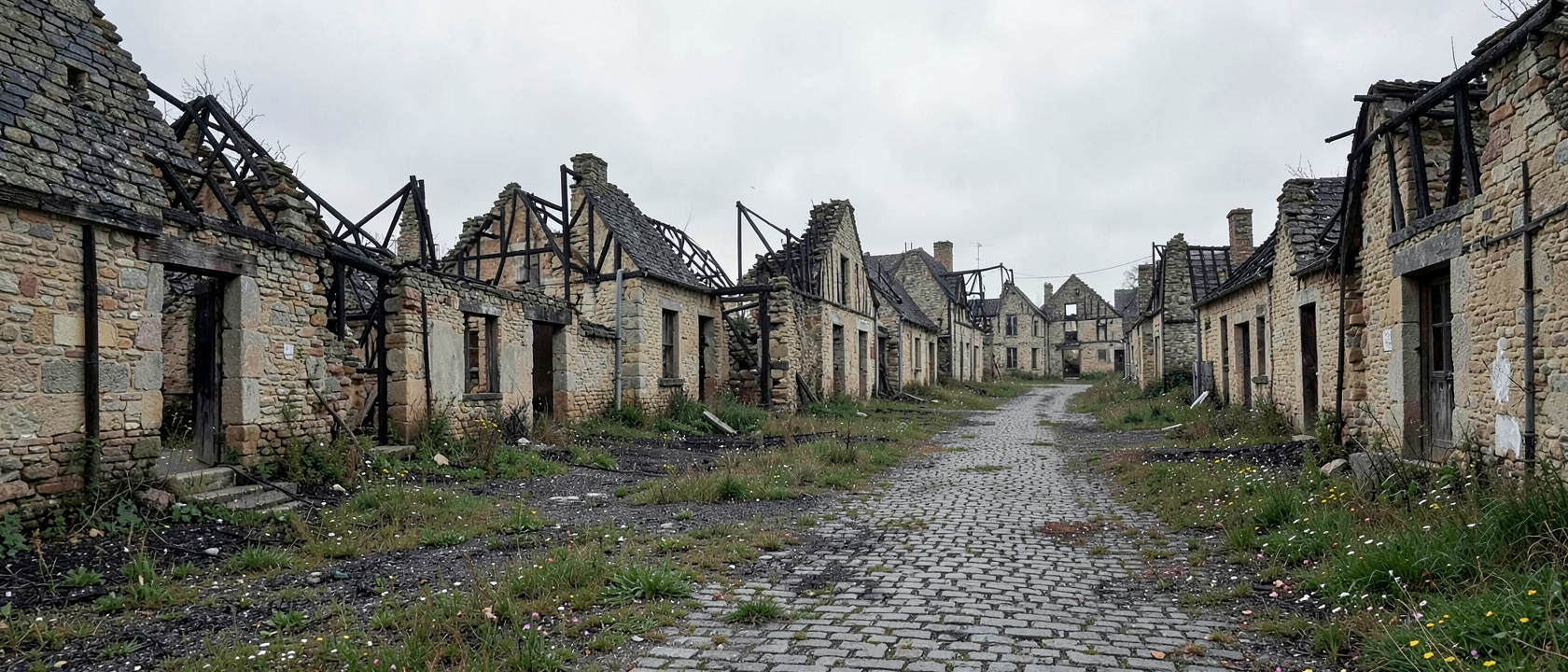
A Place Built for Ordinary Life
Before June 1944, Oradour-sur-Glane was a village people went to on weekends. It sat beside the river Glane, roughly 9 to 12 miles (15 to 20 km) west-northwest of Limoges, in the Haute-Vienne department of the Limousin region of France. By June 10, 1944, the population present numbered approximately 650 people, including farmers, tradespeople, and refugees who had arrived during the occupation years. The village had no garrison, no strategic installation, and no recorded Resistance presence. Historians at the United States Holocaust Memorial Museum and Sciences Po’s Mass Violence and Resistance Network have described it as a quiet community with no documented involvement in armed activity against the German occupation.
Four Days Between Normandy and the Limousin
On June 6, 1944, Allied forces landed on the beaches of Normandy. Four days separated that event from what happened at Oradour-sur-Glane. The 2nd SS Panzer Division “Das Reich,” regrouping near Montauban after two years on the Eastern Front, received orders on June 7 to move north. The specific unit that entered Oradour-sur-Glane was the 3rd Company, 1st Battalion, 4th SS-Panzergrenadier Regiment “Der Führer,” under SS-Sturmbannführer Adolf Diekmann; the division was commanded by SS-Brigadeführer Heinz Lammerding.
Why Oradour-sur-Glane was selected remains unresolved. The most widely cited explanation is that Diekmann and Lammerding acted on intelligence linking the village to the kidnapping of SS-Sturmbannführer Helmut Kämpfe, captured by the French Resistance on June 9. A separate theory, supported by a German military war diary entry dated June 14, 1944, holds that Oradour-sur-Glane was confused with the nearby village of Oradour-sur-Vayres, approximately 15 miles (24 km) to the southeast and known for Resistance activity. Neither the International Military Tribunal nor the Bordeaux trial of 1953 produced a definitive answer.
Saturday, June 10, 1944: Four Hours
SS troops surrounded the village at around midday on June 10. By early afternoon the population had been assembled in the market square. Approximately 190 men were separated from the women and children and taken to barns and garages on the outskirts, where they were machine-gunned. Approximately 247 women and 205 children were locked inside the church, where grenades and incendiary devices were used before the building was set ablaze. Those who tried to escape were shot.
One woman, Marguerite Rouffanche, escaped by jumping from a church window. She was shot five times before hiding in a garden, where she was found and rescued the following afternoon. Six men survived the barn shootings by sheltering beneath the dead. The total death toll is recorded as either 642 or 643, depending on the source, the USHMM and Sciences Po cite 642; the World History Encyclopedia and the Centre de la Mémoire d’Oradour cite 643. By the end of that afternoon the village had been looted and destroyed. Later that same evening, Diekmann ordered his officers and NCOs not to speak of the killings.
The General’s Order and What It Fixed in Place
Diekmann was killed in combat in Normandy roughly three weeks after June 10. Lammerding survived the war, was sentenced to death in absentia by a French court, but was never extradited; he died in 1971. General Charles de Gaulle visited Oradour-sur-Glane in March 1945 and decreed the ruins be preserved intact. The Centre de la Mémoire d’Oradour records the formal governmental decision as March 4, 1945; the French National Assembly followed with a legislative mandate in 1946, and construction of a new village began in 1947.
The framing de Gaulle applied was national and collective from the outset: Oradour-sur-Glane as the representative cost of occupation, the 643 dead cast as martyrs of the nation before any sustained effort was made to recover them as individuals.
What the Memorial Replaced
Among the victims were at least 7 Jewish refugees and at least 18 Spanish refugees. None of that demographic complexity fits smoothly inside a narrative organized around a single, undivided French village. The argument that official commemoration performed its own kind of erasure is an interpretive claim, not a settled historical verdict, but the underlying biographical fact is not contested: each of the dead had an occupation, a family, an age, a place of origin. The ruins, spread across approximately 40 acres, are maintained by the French Ministry of Culture and receive an estimated 300,000 visitors each year. What most visitors encounter is the physical evidence of destruction and the count of the dead. The names, mostly. The lives, much less.
What Remains Unresolved
Three gaps remain distinct. The motive for selecting the village has not been established. The full history of postwar legal accountability, including the political fallout over the Alsatian conscripts known as the Malgré-nous, men forcibly drafted into the SS after Germany annexed Alsace, is a separate and contested subject this piece has not fully addressed. And the argument that the victims’ individual histories deserve systematic recovery rather than continued absorption into collective memory remains active in the scholarly literature.
The Centre de la Mémoire d’Oradour, inaugurated in July 1999 by President Jacques Chirac and Culture Minister Catherine Trautmann, represents a more recent effort to document and contextualize June 10, 1944. Whether it has meaningfully shifted how the dead are remembered is a question historians are still working through. The ruins remain. The names are listed. The individual lives those names represent remain largely unrecovered.