
What the Builders Laid Down First
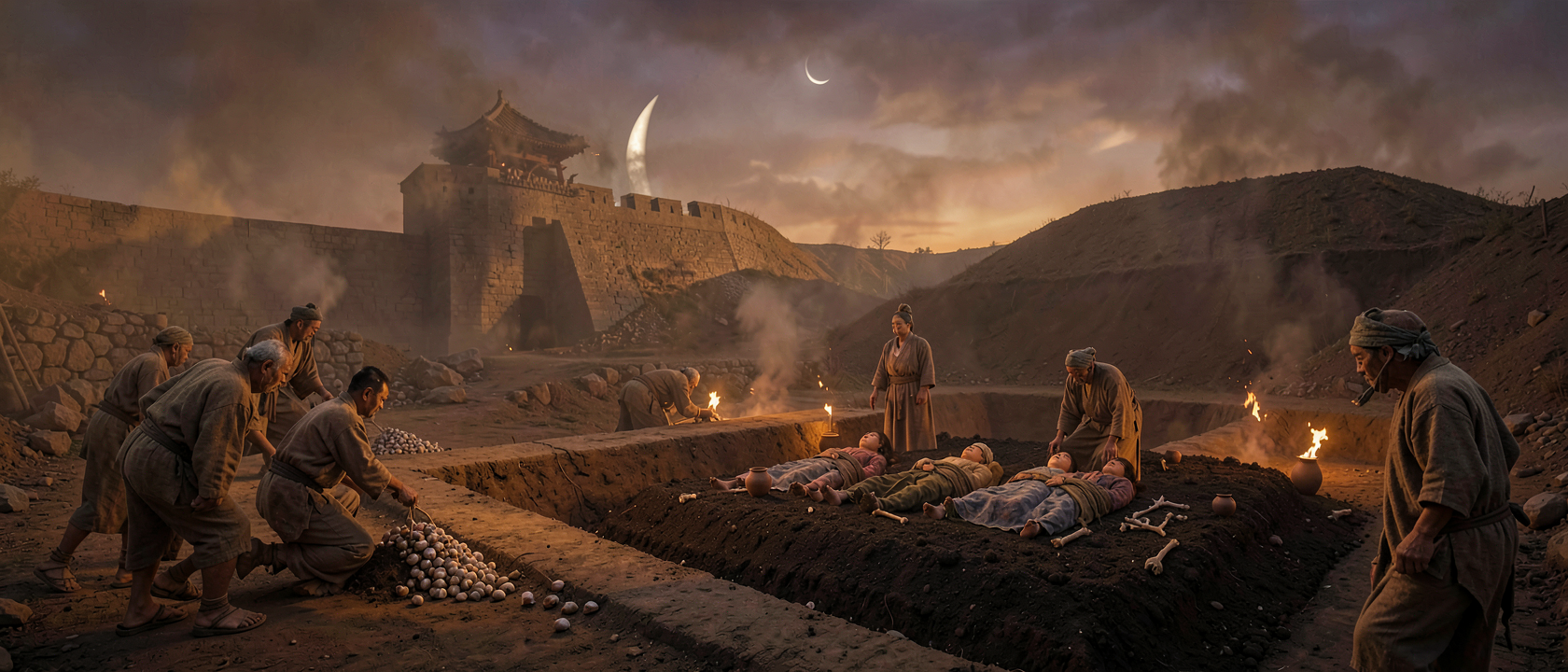
The foundation of the western rampart at Wolseong was built from packed shells and earth. Radiocarbon dating places the work in the mid-fourth century CE, at what is now Gyeongju, in southeastern Korea. When the foundation layer was finished and the stonework had not yet begun, someone placed three people inside it.
Two of them, a man and a woman both estimated to have been in their 50s, were laid side by side with a few broken pottery pieces. Approximately 20 inches (50 cm) above, a young woman estimated to have been in her 20s was positioned near an intact ceramic jug with a smaller pot inside it, wearing a bracelet and a glass earring later described by researchers as non-luxurious.
All three were interred at the same construction phase: after the foundation was complete, before the rampart began growing upward. The excavated section ran approximately 40 yards (37 meters) long and stood roughly 30 feet (9 meters) high. Once vertical construction resumed, all three were sealed inside permanently.
Why Wolseong Needed to Be Built at All
Wolseong (월성, literally “moon fortress,” named for the crescent shape formed by building over a natural hill) was the royal seat of the Silla kingdom. The Samguk sagi (History of the Three Kingdoms), completed in 1145 CE, gives Silla’s founding as 57 BCE and attributes Wolseong’s construction to 101 CE under King Pasa. Both dates are disputed. Archaeological evidence, as scholars including Mark Byington of the Cambridge Institute for the Study of Korea have noted, supports no kingdom-level Silla state before the fourth century CE at the earliest. Radiocarbon dating places the western rampart’s construction in the mid-fourth century, with approximately fifty to seventy years of work to complete it.
By the mid-sixth century, three polities divided the Korean peninsula: Silla in the southeast, Baekje in the southwest, and Goguryeo in the north and northeast. A permanent royal enclosure was not only a residence but a declaration of institutional permanence. Wolseong served as the kingdom’s administrative and ceremonial center through Silla’s defeat of Baekje in 660 CE and Goguryeo in 668 CE, its expulsion of Tang Chinese forces by 676 CE, and the Unified Silla dynasty’s rule of the peninsula until 935 CE. This was the wall behind which Silla’s kings lived and from which they governed.
What the Bones Say
Bone and tooth analysis of all three individuals revealed signs of nutritional deficiency: stunted growth and serious dental problems. Researchers interpret this as evidence that all three were drawn from the lower social strata of Silla society, consistent with the absence of high-status grave goods. The couple’s broken pottery and the young woman’s ceramic jug, bracelet, and glass earring were ordinary objects.
The cause of death has not been determined. Whether the three were killed before placement or buried alive remains an open question. The skeletal record establishes deliberate positioning at a specific point in the construction sequence; it does not establish how they died. Their names are not recorded anywhere in the historical sources, and whether they knew one another before placement has not been established.
A Practice With a Paper Trail
The Wolseong sacrifices belong to a broader category of ritual known in Korean as sunjang (순장): the burial of retainers alongside the dead, based on the belief that the deceased required attendants in the afterlife. What sets Wolseong apart is that the three individuals were placed not in a tomb but in the foundation of a palace rampart, a construction sacrifice rather than a mortuary one. No prior confirmed case of construction-related human sacrifice had appeared anywhere in the Korean archaeological record before the 2017 find.
The Samguk sagi records that King Jijeung, the 22nd ruler of Silla (r. 500–514 CE), formally outlawed sunjang in 502 CE, approximately 150 years after the Wolseong burials. A formal royal prohibition typically signals that a practice was current and widespread enough to require official suppression. The physical record at Wolseong and the textual record in the Samguk sagi point in the same direction without resolving into a single unified argument.
The Excavation and the Questions It Left Standing
Archaeologists from the Gyeongju National Research Institute of Cultural Heritage had been working the Wolseong site since 2014. The 2017 discovery of the couple produced the first confirmed physical evidence of construction-related human sacrifice in the Korean archaeological record. Human and animal remains unearthed during earlier excavations in 1985 and 1990, approximately 33 feet (10 meters) from the later finds, showed no clear intentional positioning and were not recognized at the time as evidence of ritual sacrifice.
The young woman’s remains came to light in April 2021, with a public announcement in September of that year. Choi Byung-heon, professor emeritus of archaeology at Soongsil University, stated after that discovery that the additional find left no basis for doubting that Silla practiced human sacrifice at Wolseong.
Researchers are attempting to extract DNA and analyze soil chemistry from the bones, but neither analysis has produced published results. The rampart has not been fully excavated, and how many additional individuals may remain inside is not known. Wolseong was included in the Gyeongju Historic Areas when UNESCO designated the site a World Heritage property in November 2000. The rampart still stands, and whatever else it contains, it has not yet given it up.