
A Week of Photographs
On April 11, 1945, soldiers of the US Army’s 6th Armored Division entered Buchenwald. The SS guards had already gone; prisoners who had armed themselves held the watchtowers. Four days later, British forces arrived at Bergen-Belsen.
Established on July 16, 1937 on Ettersberg hill, roughly 4.5 miles (approximately 7.2 km) northwest of Weimar, Buchenwald held an estimated 240,000 to 280,000 people during its eight years of operation. SS records logged 33,462 deaths, a known undercount; historians put the actual toll at approximately 56,000. Buchenwald was not a death camp with gas chambers but a concentration and forced-labor site. The distinction mattered in the legal arguments that followed. It did not change what the photographs showed.
British newspapers ran those photographs within days of both liberations, Bergen-Belsen especially. The Mass-Observation project, which collected diaries and interviews from ordinary British people, documented something striking: diarists wrote of becoming “hardened” to the pictures, some describing looking away. Within roughly a week of saturation coverage, the emotional weight the photographs had initially carried was dissipating rather than accumulating. That dissipation is documented and datable. It is the problem the parliamentary delegation was meant to solve.
Churchill’s Instruction
On April 19, 1945, Winston Churchill announced to Parliament that a delegation of ten members would travel to Germany to see the camps. The invitation had come from General Dwight D. Eisenhower, channeled through Churchill. The mandate, as an Early Day Motion recorded it, was to “find out the truth.” Churchill framed it more broadly: the delegation was to tell the world what had been done.
Churchill was weeks from a general election that would end his tenure as Prime Minister in a landslide defeat in July 1945. Sending parliamentarians rather than journalists carried institutional weight a press delegation would not have carried. These were elected and appointed members of the legislature, cross-party, their names in the public record. Their testimony would be official in a way newspaper copy was not. Whether that official weight could reach a public already learning to look away was the open question.
The Visit
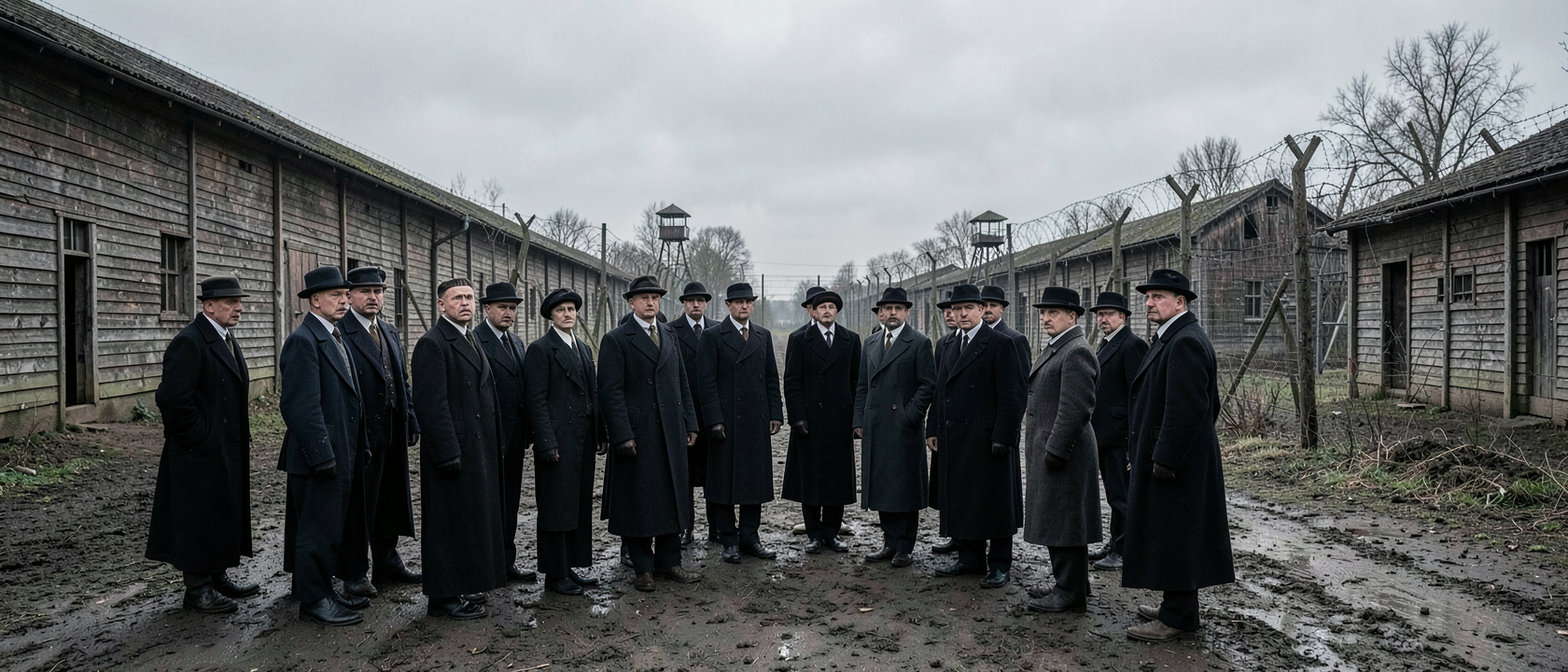
The delegation visited Buchenwald on April 21, 1945. It comprised eight MPs and two Lords: Earl Stanhope (7th Earl, chairman); Lord Addison, a Labour peer and physician; Mavis Tate, Conservative MP for Frome and the only woman in the group; Sir Henry Morris-Jones, Liberal-National MP for Denbigh and also a doctor; Sir Graham White; Sir Archibald Southby, Conservative MP for Epsom; Lt. Col. Tom Wickham, Conservative MP for Taunton; Ness Edwards, Labour MP for Caerphilly; Sidney Silverman, Labour MP; and Tom Driberg, Independent MP for Maldon, assigned to draft the group’s report. Despite initial intentions, the delegation did not proceed to Bergen-Belsen, which was still considered behind active enemy lines.
Earl Stanhope submitted the report to Churchill on April 25. Churchill presented it to Parliament on April 27; the House of Lords debated it on May 1. The report, formally titled Buchenwald Camp: The Report of a Parliamentary Delegation and issued as Command Paper Cmd. 6626, closed with one sentence: “The memory of what we saw and heard at Buchenwald will haunt us ineffaceably for many years.” Mavis Tate narrated a British Pathé newsreel combining footage from both camps, released in cinemas after April 30.
Whether the report moved public opinion in any measurable way, the sources do not establish. The public had already had the photographs for weeks.
Who Paid
The numbing the delegation was meant to address had set in before the delegates boarded their flight, and no surviving evidence suggests the report reversed it. What the record does show is what the visit cost the ten people who made it.
The most documented case is Ness Edwards. In a 1989 Parliamentary debate, Edwards’s daughter, by then Baroness Golding, stated that her father had not slept for weeks after returning and that nightmares persisted for years. Edwards left no public account elaborating on this; the testimony comes from his daughter’s recollection, decades later, in Parliament.
Mavis Tate lost her seat in the July 1945 general election. She died on June 5, 1947, in London, at the age of 53. Some secondary accounts connect her death partly to trauma from the Buchenwald visit; that connection appears in popular history writing and in material from the South West Heritage Trust but has not been confirmed in primary sources and should be read as a claim rather than a settled fact. Sir Archibald Southby was the only Conservative MP in the delegation who retained his seat in July 1945, doing so, the sources note, during convalescence from influenza.
The report’s closing sentence, that the memory of Buchenwald would haunt the delegates “ineffaceably for many years”, reads in retrospect less like a rhetorical flourish and more like an accurate description of what actually followed.
What the Record Leaves Open
Four gaps constrain what this episode can actually tell us. First, the personal effects on most of the ten are undocumented: Edwards’s trauma is on record through his daughter; Tate’s case is circumstantially noted but unverified; for the other eight, the record is largely silent. Second, the Mass-Observation evidence of public numbing, though specific and datable, comes from a self-selecting group and cannot be treated as a representative sample. Third, no comparison is drawn between British press coverage and equivalent processes in the United States, France, or other Allied nations. Fourth, the gap between the delegation’s stated purpose and its documented outcome remains unexplained. Churchill’s framing was public truth-telling for a global audience; the report’s public impact is not established as significant. The episode’s most concrete legacy is the one that was never part of the brief: what it did to the people who went.