
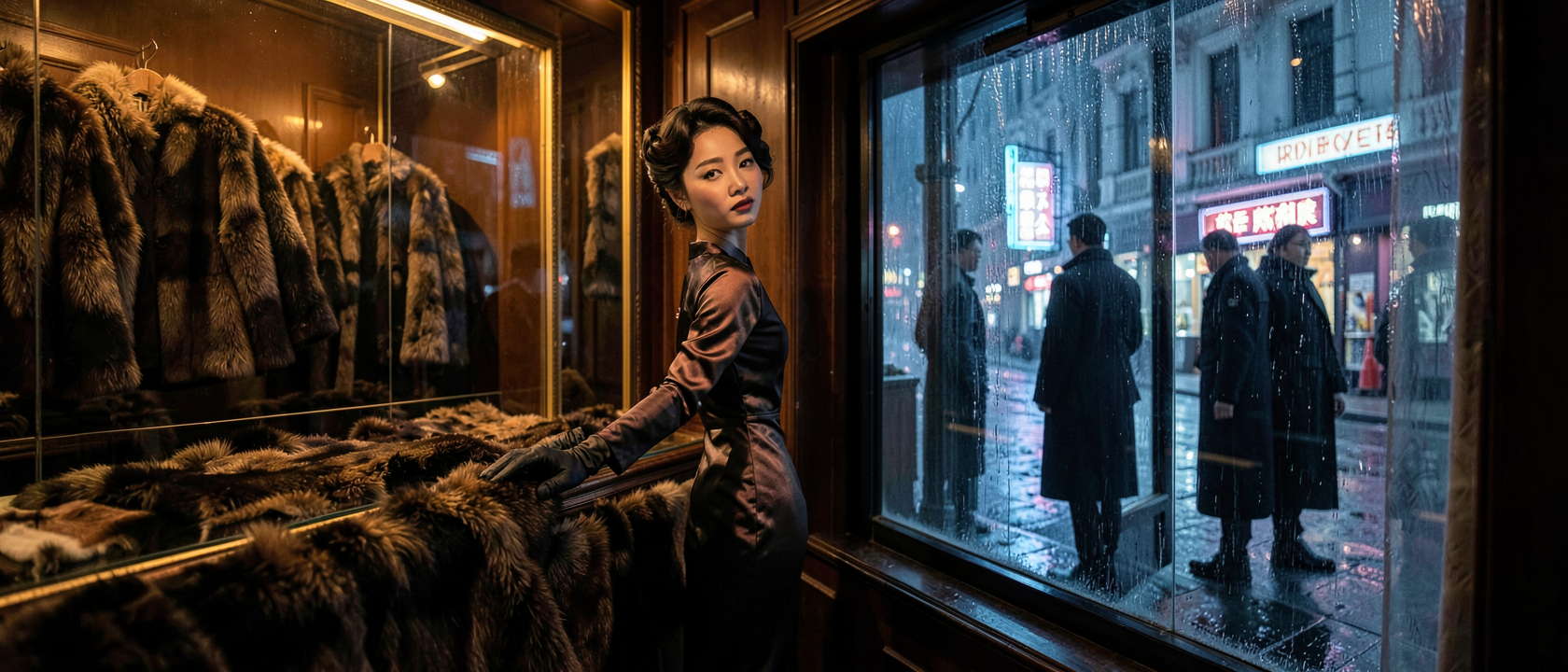
The Last Summer
The cover photograph appeared in July 1937. Zheng Pingru, approximately nineteen years old, wore a qipao and a finger-wave bob on the front of Liángyǒu, The Young Companion, one of Shanghai’s most widely read pictorials. Her father, Zheng Yueyuan, was a Nationalist official who had taught at Fudan University; her mother, Hanako Kimura, was Japanese. That combination gave the family unusual social reach in a city already under strain. About a month after the cover was published, Japanese forces entered Shanghai, and the semi-autonomous urban world that had put Zheng on its cover collapsed before the year was out.
The Asset
Shortly after the invasion, an official from the Chinese Central Investigation and Statistics Bureau (CISB) recruited Zheng. The logic was straightforward: her Nationalist father gave her cover as a patriot; her Japanese-speaking mother and prewar social connections gave her access to circles on both sides of the occupation divide.
The target was Ding Mocun, born in 1901 in Changde, Hunan Province, a former school principal turned collaborationist security chief. Zheng spent more than a year working her way into his circle. She presented herself to Ding full of charm and reminded him that she had once been his student at Mingguang Middle School, exploiting his documented predilection for young women. By March 1939 she was close enough to be useful. The following month, in April 1939, Ding formally established the Special Service Department at 76 Jessfield Road, No. 76, a facility that held and executed suspected Nationalist and Communist resisters, and the center of gravity for the operation against him shifted there.
Eleven Days in December
By December 1939, the CISB judged the moment had come. A first attempt brought Ding to Zheng’s home, where a team waited; he declined to enter. Eleven days later, on December 21, 1939, a second attempt was staged at the Siberian Fur Store on one of Shanghai’s principal shopping streets. Something alarmed Ding and he fled; gunfire followed him out. Zheng was left standing on the shop floor. Her cover was finished, and so was the operation.
The Return
After the December 21 failure, Ding contacted Zheng directly. She went to No. 76 and was arrested by Ding’s deputy, Li Shiqun. Why she went rather than fled is not definitively recorded. Under interrogation she held to one story: the fur store incident had been a personal matter, a crime of passion. She never admitted to being a Nationalist agent. Wang Jingwei’s regime offered to spare her if her father would accept the position of Minister of Justice; he refused. After more than a month’s imprisonment, she was shot near Zhongshan Road in western Shanghai in February 1940. Her exact age at death turns on a disputed birth year, either approximately twenty-one or twenty-two, if she was born in 1918, or approximately twenty-six, if she was born in 1914, with neither figure settled.
What Ding Did Next
No. 76 continued operating for nearly six more years. Ding was not arrested until September 1945, after Japan’s surrender ended the Wang Jingwei regime. His trial produced the first public accounting of what Zheng had done: her mother appeared in proceedings and demanded Ding be held responsible, describing her daughter as a patriot who had never broken. Ding was convicted of treason in February 1947 and executed on July 5, 1947, at a prison in Suzhou. The accounts that emerged conflicted in detail, and the political landscape of 1947, the civil war between Nationalists and Communists already under way, was ill-placed to produce a settled verdict on what Zheng had been or deserved.
A Story That Kept Being Rewritten
Eileen Chang published her novella Lust, Caution in 1979, after working on it for roughly two decades. Its plot is recognizably shaped by Zheng’s case: a young woman operative, a collaborationist target, a mission that fails. Chang learned of Zheng through her former husband Hu Lancheng, a propaganda official in the Wang Jingwei government. In the novella the operative’s mission collapses because she falls in love with her target, a fictional choice, not a documented one. Because the association between Chang’s character and Zheng was widely understood, the novella’s moral ambiguities were routinely read back onto the historical record. Ang Lee’s film adaptation premiered at the Venice Film Festival on August 30, 2007, won the Golden Lion, and extended the debate to a global audience.
The Statue in Qingpu
On June 6, 2009, a life-size bronze statue of Zheng Pingru was unveiled at Shanghai Fushou Garden in Qingpu district, where she had been killed. Chinese authorities formally designated her a patriotic martyr at the ceremony. The statue does not show the cover girl or the operative; it depicts Zheng bound, at the moment before her execution, with the fur store scene reproduced in the background. The gap between her death in February 1940 and that formal state recognition runs to nearly seven decades, a measure of how long the question of what she had done, and what it was worth, took to settle.